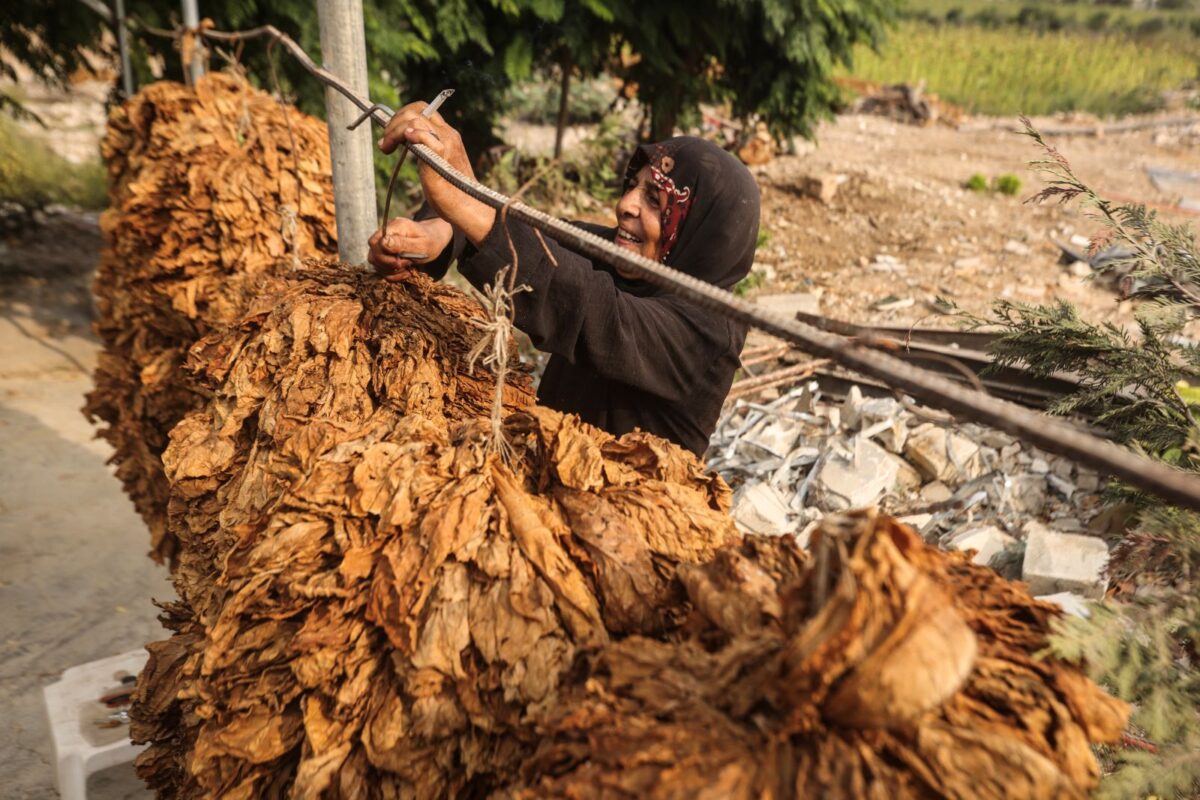
Photo by MAHMOUD ZAYYAT / AFP. A member of the Issa family handles bundles of tobacco leaves at a farm in the southern Lebanese village of Deir Qanoun Ras al-Ayn on August 21, 2026.
For Mohammad Bazzi, agriculture was supposed to be part of his retirement.
From his home in Khiam, a southern Lebanese town long known for its agricultural land and production, farming has provided an additional source of income for Bazzi and his wife. Over the years, he cultivated avocados, beans and seasonal vegetables on land near his home, while also planting tobacco each year on another plot.
But the war has destroyed much of what he had built. Land near his home has been destroyed alongside his house, while another plot used for tobacco cultivation has also been lost. His son’s olive grove in the area has become another unknown: with the family unable to access it, they do not know whether anything remains.
Khiam has been one of the main focal points of Israeli military operations in southern Lebanon. The strategic border town has experienced ground incursions, combat and extensive destruction, including demolitions and fires affecting homes and agricultural land.
For farmers, that military reality has turned access to agricultural land into a central obstacle to rebuilding their livelihoods.
For Bazzi, the losses have extended beyond the land itself.
He had expected to retire and continue earning from his agricultural properties, relying on the income they generated for him and his wife. Instead, the instability and losses he endured during the war have led him to consider leaving Lebanon.
“This war has cost us so much. It has cost every individual in southern Lebanon, not just farmers. But farmers have suffered even more because we are not only mourning our homes, we are mourning the land too, the land we have spent years working, investing in and caring for, hoping it would give something back to us.”
Bazzi said he had received no meaningful assistance from any institution following the destruction. For now, he said, simply being able to return to Khiam, rebuild their lives and work their land again would feel like a miracle.
The experience illustrates a wider problem facing farmers across southern Lebanon: the agricultural crisis is not limited to land that has been physically destroyed. Even where orchards and fields remain standing, farmers may be unable to reach them, maintain them or harvest them, potentially turning a single season of disruption into losses that continue for years.
The experience illustrates a wider problem facing farmers across southern Lebanon: the agricultural crisis is not limited to land that has been physically destroyed. Even where orchards and fields remain standing, farmers may be unable to reach them, maintain them or harvest them, potentially turning a single season of disruption into losses that continue for years.
When farmland cannot be reached
In parts of southern Lebanon, the agricultural crisis is also a crisis of access.
Villages including Khiam, Kfar Kila, Meiss al-Jabal, Blida, Houla, Rmeish, Marwahin, Ramyah and Aita al-Shaab have extensive agricultural land close to the Blue Line, where access has been particularly sensitive.
Previous olive harvest operations in other areas close to the Blue Line have required coordination between the Lebanese Army and UNIFIL to allow farmers to reach their land.
Houssein El Sakka, an agricultural protection specialist at the Lebanese Ministry of Agriculture with a regional role covering Nabatieh, said the inability to access agricultural land is among the most serious problems currently facing farmers.
“Agricultural land is tied to schedules that cannot be postponed indefinitely,” El Sakka told NOW. “Every crop has an agricultural cycle, with specific timing for planting, irrigation, pruning, pest control and harvesting.”
If that timing is missed, a farmer can lose the season even if the land and crop have not suffered direct physical damage.
There is also the question of safety.
Farmers cannot simply be encouraged to return to their land if access is not safe, El Sakka said. Restoring agricultural production in affected areas is therefore first dependent on safe access, including addressing the risks posed by unexploded ordnance and remnants of war.
“The farmer needs to be able to reach his land, bring his workers and equipment, carry out the necessary agricultural operations and eventually transport and sell his production,” El Sakka said.
The longer access is disrupted, the more problems accumulate.
“For this reason, access to land is not only a logistical issue,” El Sakka told NOW. “It is itself an issue of production, food security and livelihoods.”
The cost in numbers
The scale of the disruption is reflected in the Ministry of Agriculture’s own assessment.
A scientific assessment by the Lebanese Ministry of Agriculture and the National Council for Scientific Research, with UN support, estimated direct agricultural damage at $41.2 million, while production losses reached around $530.5 million across 56,320 hectares. The losses were driven not only by physical destruction but also by restricted access to farmland, disrupted farming activities and lost harvests.
Recently, Agriculture Minister Nizar Hani said updated ministry estimates put overall agricultural losses and damage at more than $1 billion, with more than 56,000 hectares affected, around 52,000 of them in South Lebanon and Nabatieh.
Hani has also described access to land as a central part of the recovery effort. Following a meeting with President Joseph Aoun on September 10, he said the ministry was working to provide farmers with the programmes and equipment needed to reach their land and harvest their crops, adding that the ministry had already worked with the Lebanese Army to facilitate access.
The figures also illustrate how the agricultural crisis has evolved from an immediate destruction problem into a recovery problem.
For El Sakka, rebuilding therefore cannot stop at repairing visibly damaged infrastructure.
“The recovery of agriculture is not only about repairing a damaged field,” he said. “It is about restoring the entire production cycle.”
“The recovery of agriculture is not only about repairing a damaged field,” he said. “It is about restoring the entire production cycle.”
That cycle includes access to land, labour, irrigation, agricultural inputs, machinery, pest control, harvesting and the ability to get produce to markets.
For farmers who have already lost several seasons, restarting that cycle also comes with a financial burden. A farmer who has had little or no income from a plot may still have to pay for seeds, fertiliser, pesticides, labour, irrigation and equipment before seeing any return.
This is particularly difficult for small farmers, whose ability to absorb another season of losses is limited.
A sector facing a long recovery
The Ministry of Agriculture has acknowledged that restoring production will require funding beyond the immediate provision of agricultural inputs.
Hani said on September 10 that the ministry was working to secure financing from several sources, including a joint project with the World Bank worth around $40 million dedicated to addressing agricultural damage in southern Lebanon.
But for farmers like Bazzi, government plans and financial programmes remain distant from the immediate reality of a damaged home, inaccessible land and an uncertain future.
His agricultural properties were supposed to provide an income for the years after retirement. Instead, the war has left him considering a life outside the country.
“We are tired of war. Our parents grew up facing war, we grew up facing war, and our children and grandchildren are growing up facing war. We just want to live without fear of losing everything again” Bazzi said.