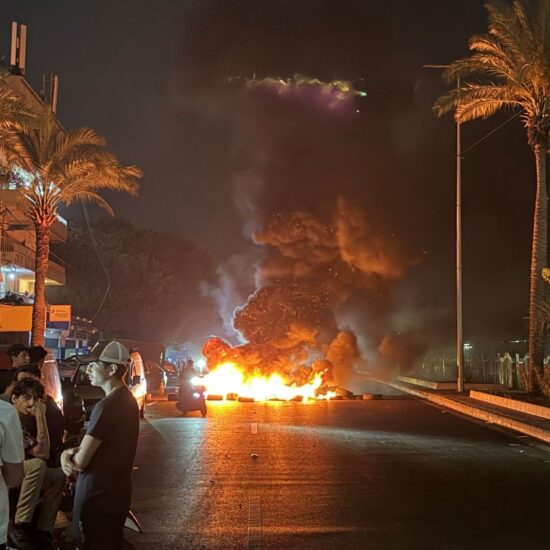
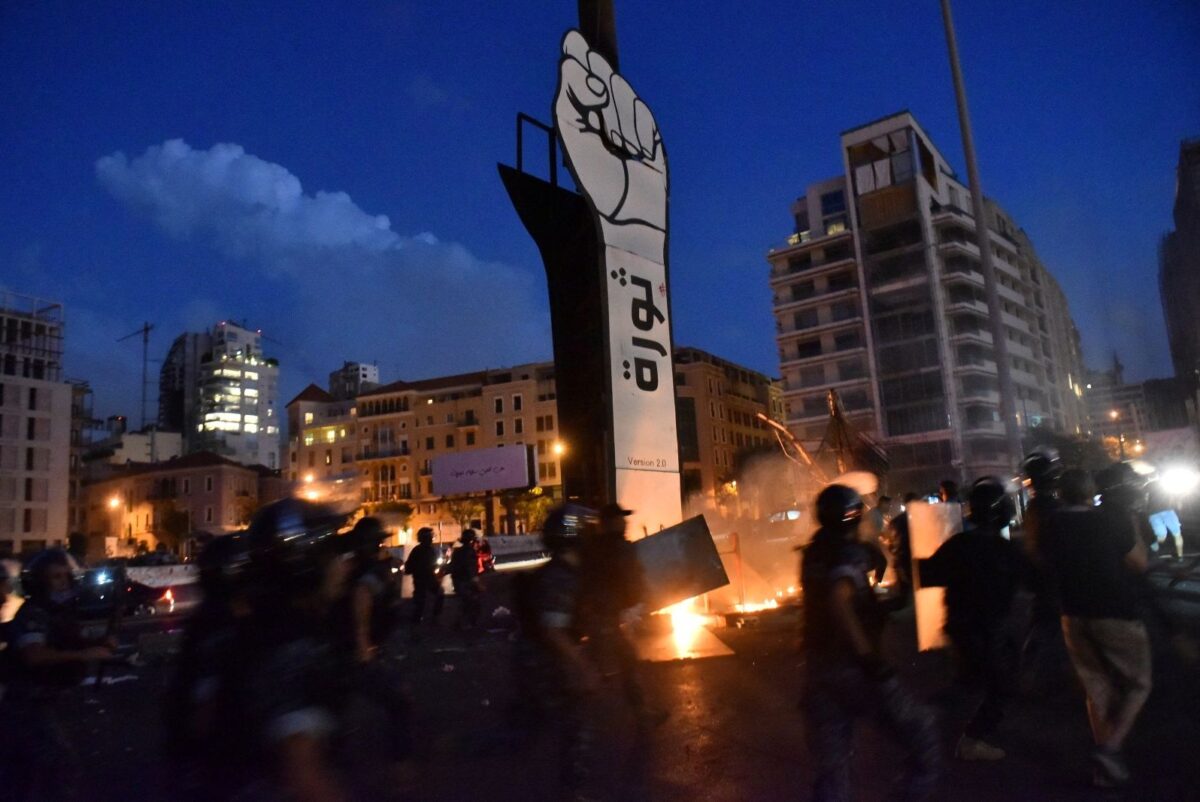
Members of the Lebanese security forces intervene after the ‘Revolution fist’, symbol of Lebanon’s October 2019 uprising, was set on fire during clashes between anti-government protesters and supporters of former prime minister Saad Hariri, in the capital Beirut's central Martyr's square, on October 21, 2020. (Photo by AFP)
Seven years on, I do not measure 17 October 2019 by the size of the demonstrations, the governments that fell or the parliamentary seats that followed. I measure it by the freedom I recovered.
The freedom to think without seeking permission. To speak without calculating which leader I might offend. To question what I had been taught to accept. To stop defending a political order that demanded our loyalty while consuming our country.
For me, 17 October was emancipation. Something within me changed, and no disappointment since has persuaded me to surrender it. That is why I regard it as perhaps the most consequential date in modern Lebanese history.
What made it different
We have no shortage of defining dates: independence in 1943, the civil war in 1975, the Israeli invasion of 1982, Taif in 1989, the Israeli withdrawal of 2000, and the Cedar Revolution of 2005, which helped end the Syrian military presence. Each transformed Lebanon’s circumstances. 17 October challenged something deeper: the relationship between the Lebanese citizen and power itself.
It asked whether we would remain subjects of leaders, sects and patrons, or finally become citizens of a country belonging equally to us all. In 2005 we demanded to free Lebanon from foreign tutelage. In 2019 we demanded to free ourselves from the domestic system that reproduced our dependency.
The day the fear broke
For decades, the establishment gnawed at the very bones of the country. It turned public rights into personal favors, institutions into possessions and citizens into petitioners. Its power rested on a lie, given emotional force by the civil war and passed down to us as fear: that we could not live together without its protection.
On 17 October, that certainty broke.
That night I was sitting on the steps of the Mohammad Al-Amin Mosque, facing Martyrs’ Square. Beside me sat a friend, a professor at AUB and a businesswoman. She turned to me and said: “For years we let them sit in the front row and walk ahead of us, as if we were their subjects. It is over. They stole from us. Their place now is at the back, or in prison.”
I had heard anger before. What I heard that night was the end of permission. In that moment I felt the dignity of being Lebanese without needing a patron to establish my worth. I felt closer to the free and responsible human being I believe the Creator intended us to be.
That is the sacred part of 17 October for me: the recovery of conscience, dignity and belonging. No one elected in its name owns that experience. No parliamentary failure can cancel it.
Those who failed it
Yet those failures must be confronted honestly. Some MPs who emerged under the banner of change disappointed those who trusted them. Some reproduced the habits they had promised to challenge. Others mistook opposition for a programme, visibility for leadership, or personal positioning for collective responsibility. Too often, they entered the machinery without changing its methods.
They were not all equally disappointing, and the revolution was always larger than those who claimed to represent it. They must answer for what they did with our trust, but their shortcomings cannot become an acquittal of the system they were elected to confront.
That distinction matters because 17 October has been relentlessly demonized: blamed for the collapse it exposed, accused of serving foreign agendas, judged as though a popular uprising should have arrived with a governing apparatus. The movement made mistakes. But Lebanon’s ruin was built over years. The revolution made it impossible to ignore.
What followed was devastating: the pandemic, the financial collapse, the port explosion, war and displacement. I will never romanticize that suffering. No political promise makes another person’s loss acceptable.
What remains
Yet suffering has not erased what changed. The establishment has lost its claim to inevitability. The taboo against questioning the system has been broken. And once we have experienced belonging to one another beyond the barriers of the civil war, that possibility becomes hard to dismiss.
For years I have argued that Lebanon needs sovereignty, stability and prosperity. 17 October taught me that none of them can be handed to a people who are not free.
Sovereignty, for me, means ending Iran’s tutelage through Hezbollah’s parallel military power, a tutelage I see weakening though not yet ended. It also means ending Israeli occupation and attacks, so that the national decision finally belongs to the Lebanese. Stability means institutions stronger than personalities and justice stronger than immunity. Prosperity means a country where talent, not connections, opens doors, and where our children can imagine a future beyond survival or departure. Together, they are what I call a Future-Ready Lebanon.
I see the presidency of Joseph Aoun and the government of Nawaf Salam as an imperfect bridge toward that country, whose value depends on what it delivers. Supporting it does not require surrendering scrutiny. We have paid too much for unconditional loyalty.
Why I still believe
Seven years later, I have no interest in defending every slogan, activist or MP associated with the revolution. I remain committed to the dignity it awakened, the fear it challenged and the freedom it returned to me. I will hold its representatives accountable precisely because its purpose deserves better.
The road remains harsh and unfinished. But I no longer believe that the country we inherited is the only country we can have.
17 October was a blessing. Some who claimed its name failed its promise. Those who feared its meaning worked to discredit it. Neither has taken away what it gave me: my freedom, and the conviction that a free Lebanon can become a Future-Ready Lebanon, sovereign, stable and prosperous, a homeland finally worthy of its people.
Farid Fakherddin is a Lebanese businessman and Board Member of the Lebanese Private Sector Network (LPSN).
The views in this story reflect those of the author alone and do not necessarily reflect the beliefs of NOW.