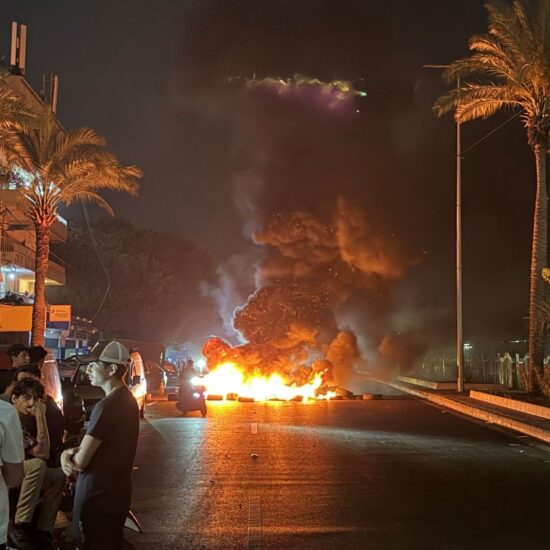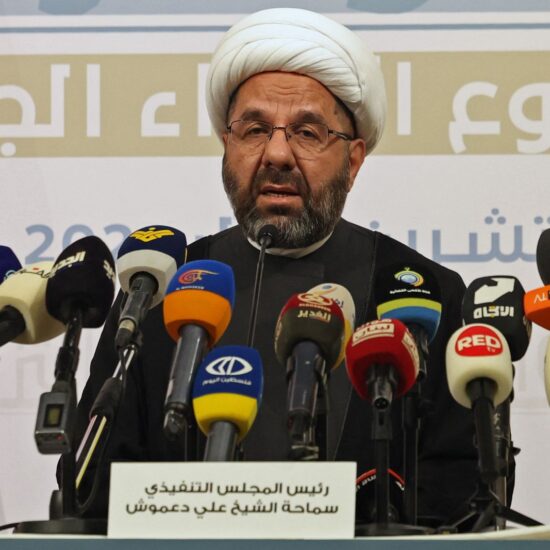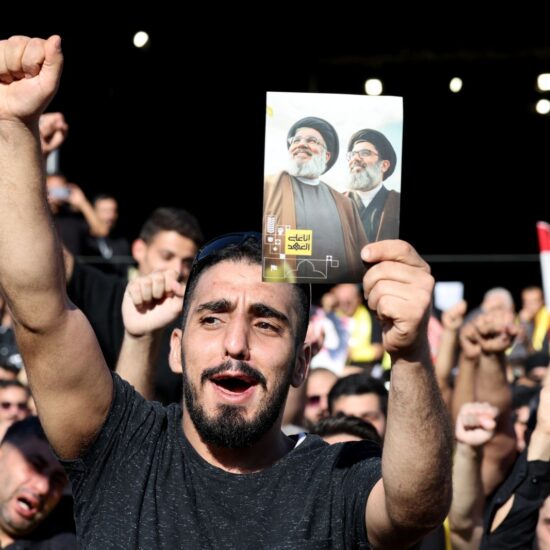
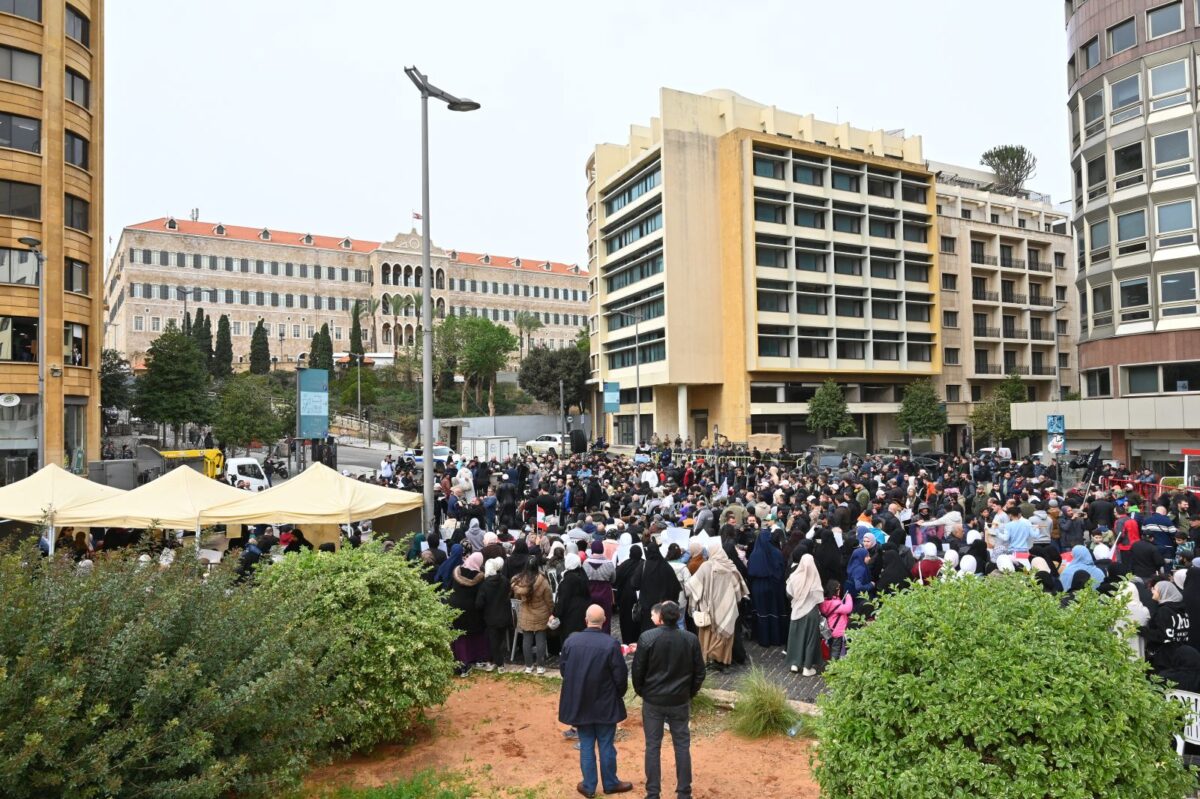
Relatives and families of Islamist prisoners at Roumieh prison carry pictures of their loved ones during a protest outside the Government Palace in downtown Beirut, Lebanon, on January 30, 2026. (Photo by Fadel Itani / NurPhoto / NurPhoto via AFP)
Lebanon’s general amnesty law has cleared a major hurdle after the Constitutional Council rejected a challenge to the legislation on October 12, allowing the law to proceed towards implementation. But the decision has left questions over how some of its provisions will be interpreted and which detainees will ultimately benefit.
The law, passed by Parliament on August 12 and signed by President Joseph Aoun, grants amnesty for specified offences committed before March 1, 2026. It also provides for sentence reductions in certain cases and measures for detainees who have spent prolonged periods in custody without receiving final verdicts.
The legislation was presented as a means of addressing long-standing problems within Lebanon’s judicial system, including lengthy pretrial detention and severe overcrowding in prisons. However, its passage and subsequent challenge have exposed disagreements over which offences should be covered and whether the legislation treats different categories of detainees fairly.
The Free Patriotic Movement parliamentary bloc, headed by MP Gebran Bassil, challenged the law before the Constitutional Council after Aoun signed it. The challenge temporarily suspended its implementation, prompting protests among detainees awaiting a decision.
Around 600 inmates participated in a hunger and medication strike that lasted 30 days and spread beyond Roumieh Central Prison to facilities in Jeb Jenin, Baalbek and Rashaya. The detainees ended the strike following the council’s October 12 decision, although some expressed disappointment with its interpretations of the law’s provisions.
The ruling did not order the release of particular detainees or establish that all prisoners belonging to a particular group would qualify for amnesty. Instead, eligibility depends on the offences involved, the applicable sentences and the conditions and exclusions set out in the legislation.
For Mohammed Sablouh, a Lebanese lawyer and director of the Prisoners’ Rights Center at the Tripoli Bar Association, the controversy reflects deeper problems in the law’s drafting and the administration of justice.
Sablouh, who has spent nearly 15 years documenting torture and other ill-treatment in Lebanese detention facilities, told NOW that the law’s provisions and the Constitutional Council’s subsequent decision raised serious legal concerns.
Drug offences and the scope of the law
One of the central disputes concerns the legislation’s treatment of drug-related offences.
Sablouh argued that the parliamentary debate placed significant emphasis on the cases of Islamist detainees, while insufficient attention was paid to the potential beneficiaries among people accused or convicted of drug offences.
He said the legislation risked benefiting people involved in drug trafficking, including individuals who had not spent time in prison, while many Islamist detainees who had been held for years would remain incarcerated or face further delays before their cases were resolved.
However, the law does not grant amnesty to everyone accused of a drug-related offence. Its provisions distinguish between different circumstances, including repeat offences, and exclude certain drug offences committed by military and security personnel.
The Constitutional Council’s interpretations have also prompted questions about how the law’s provisions on repeated drug offences should be understood.
Sablouh questioned whether the wording could allow people facing multiple drug-related charges to qualify for amnesty without having served prison sentences. He argued that the council should have clarified the relevant provisions more explicitly.
The wider concern, he said, is that the legislation could produce different outcomes for detainees depending on how individual cases are interpreted and processed.
The controversy also reflects a broader disagreement over the purpose of the law. Supporters have argued that it is needed to address prolonged detention and judicial delays, while critics have questioned whether its provisions could allow people accused of serious offences to benefit.
The distinction between an accusation and a conviction is particularly important in this context. A person facing charges has not necessarily been found guilty, while eligibility for amnesty or a sentence reduction depends on the specific legal circumstances of each case.
Dispute over the Constitutional Council’s role
Sablouh also criticised the Constitutional Council’s handling of the challenge, arguing that its interpretations went beyond reviewing the law’s constitutionality and effectively altered provisions that should have been determined by Parliament.
The council rejected the challenge to the law as a whole while clarifying or narrowing the application of certain provisions, including those concerning corruption and serious crimes.
Among the issues highlighted in coverage of the ruling were the treatment of corruption-related offences and the exclusions applying to crimes such as torture, enforced disappearance and certain serious offences against individuals.
Sablouh argued that the council’s approach had created further uncertainty for lawyers seeking to determine how the legislation should be applied in individual cases.
He also questioned the provisions governing sentence reductions. Under the law, death sentences are commuted to 28 years in prison, while life sentences with hard labour are reduced to 17 years. Sablouh argued that the council’s interpretation of these provisions raised questions about the relationship between different categories of sentences.
The dispute is significant because the practical consequences of the ruling will depend on how courts interpret and apply the law. Even where the legislation provides for a reduction, a detainee’s release is not necessarily immediate, as the remaining sentence and other applicable legal conditions must still be considered.
The ruling has therefore left lawyers and detainees waiting for greater clarity on how some provisions will operate in practice.
Islamist detainees and allegations of political interference
For Sablouh and Tarek Chindeb, a Lebanese lawyer and researcher specialising in international law, international criminal law and human rights, the amnesty debate cannot be separated from concerns about the treatment of people detained in connection with security incidents and the conflict in Syria.
Chindeb told NOW Lebanon that he believed political interference had affected investigations and prosecutions involving people accused of supporting the Syrian opposition.
He alleged that some individuals were treated as security threats because of their political positions or support for the Syrian uprising, and questioned whether investigations and prosecutions in these cases had consistently met legal standards.
Chindeb also criticised the role of military institutions and the military judiciary in cases involving Islamist detainees. He alleged that, in some instances, the Lebanese Army had been drawn into confrontations shaped by political interests and that some detainees had not received fair trials.
The amnesty law was described by Chindeb as an opportunity to address what he sees as shortcomings in previous judicial proceedings. He argued that the legislation was intended, in part, to correct injustices arising from investigations and trials that he considers flawed.
However, he questioned whether the final legislation had achieved that purpose, arguing that the political negotiations surrounding its passage had complicated the process.
Both lawyers also raised concerns about the law’s potential effects on detainees accused of offences connected to armed clashes involving the Lebanese Army. Their arguments highlight the need to assess each case individually rather than treating all Islamist detainees as a single category.
The law does not provide a blanket amnesty based on religious or political identity. Whether an individual qualifies depends on the specific offence, the procedural status of the case and the applicable exclusions.
What happens next?
The immediate question is how the law will be implemented and how quickly authorities will review the cases of eligible detainees.
Lebanon’s prison system has long faced overcrowding and delays in judicial proceedings. Arab News reported that the prisons directorate counted approximately 6,268 inmates at the end of March 2026, while the National Human Rights Commission estimated that overcrowding had reached around 300% the previous year.
The amnesty law could ease pressure on prisons and the judiciary, but its effects will depend on how many detainees qualify and how efficiently their cases are processed.
For Sablouh, the ruling has raised questions about the boundaries between constitutional review and legislative authority. Chindeb, meanwhile, sees the wider dispute as part of a longer-running debate over political influence and accountability within Lebanon’s judicial system.
Ultimately, the legislation’s impact will be measured by whether eligible detainees receive the benefits provided by law, whether prolonged detention is addressed and whether the exclusions are applied consistently.