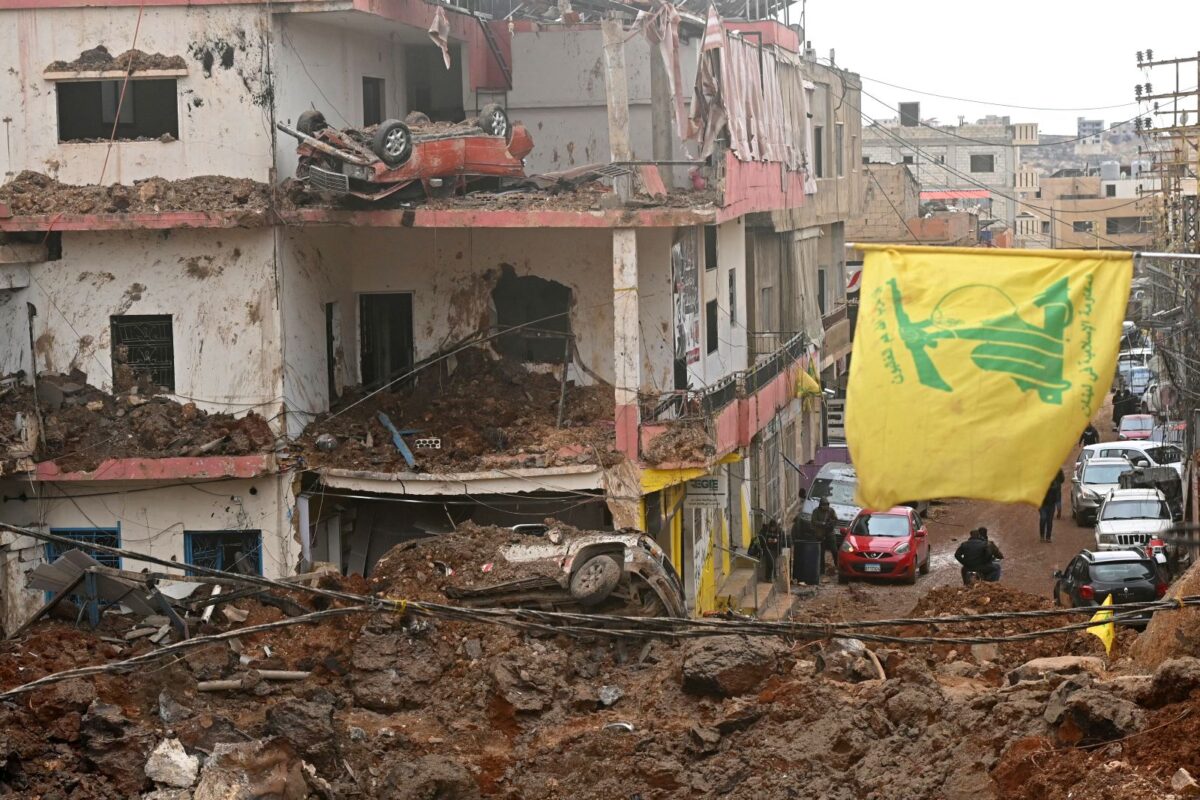
Photo by FADEL ITANI / AFP. This photograph taken during a media tour organized by the Hezbollah shows a flag of Hezbollah installed on the balcony of a damaged building at Nabi Sheet town after an Israeli military operation in the Bekaa Valley of Lebanon, on March 7, 2026.
Lebanon’s estrangement from the Arab world was years in the making. Hezbollah placed the country at the service of Iran’s regional wars, while much of the Lebanese political class treated accommodating the militia as an acceptable substitute for governing. The Lebanese have paid for that bargain with their economy, their reputation and their children’s future.
This is the Lebanese story running through Saudi political writer Abdulrahman al-Rashed’s conversation with Omar al-Jeraisy on the Socrates podcast. Ostensibly a discussion of the wars confronting Saudi Arabia, the interview offered a sober account of how Iran has spent four decades turning Arab states into battlefields, their populations into hostages and their institutions into instruments of the Islamic Revolutionary Guard Corps.
Al-Rashed’s most valuable contribution was his political realism. He understands that seeking an accommodation with Iran does not, in itself, amount to surrender
Al-Rashed’s most valuable contribution was his political realism. He understands that seeking an accommodation with Iran does not, in itself, amount to surrender. Trying diplomacy was never the fundamental mistake. The mistake was to assume that concessions could indefinitely contain organizations whose purpose is to serve Tehran’s ambitions.
His discussion of the Houthis exposes Hezbollah’s place in that enterprise. Training fighters, building tunnels and developing military and security structures are part of a transferable system. Hezbollah has served as a strategic adviser to Iran’s machinery of terror, exporting expertise accumulated at the expense of the Lebanese state.
The organization that invokes Palestine to justify its weapons has helped build military structures serving Iran across Syria, Iraq and Yemen. Having seized control of Lebanon’s decisions on war and peace, it went on to help other militias do the same in their own countries. These interventions served a regional network designed to encircle and intimidate Arab states, particularly Saudi Arabia and its Gulf neighbors.
Hezbollah also exported a method of capturing states from within. Its model allows militias to use legitimate institutions as cover for illegitimate weapons and to turn local communities into shields for a project that has little to do with their national interests. The outward forms of government survive, while the armed organization determines what the state is allowed to do.
This is the reality Lebanese politicians must confront before asking their Arab counterparts to open their doors again.
Relations with the Gulf did not unravel because of an ill-considered ministerial statement or an unfortunate diplomatic misunderstanding. The damage accumulated as Lebanon’s territory, institutions and political cover were used to support Iran’s wars against Arab countries.
Relations with the Gulf did not unravel because of an ill-considered ministerial statement or an unfortunate diplomatic misunderstanding. The damage accumulated as Lebanon’s territory, institutions and political cover were used to support Iran’s wars against Arab countries. The angry statements and diplomatic crises were symptoms of that deeper failure.
No one required the Lebanese to endorse every Saudi or Gulf policy. They were required to prevent their country from becoming a training ground for those launching missiles and drones at Arab cities and infrastructure. They were required to ensure that the Lebanese passport did not become cover for the Revolutionary Guards and their emissaries.
Instead, Lebanese citizens bore the economic and reputational costs while Hezbollah continued to present itself as their protector against dangers it had helped create.
Al-Rashed’s argument is also valuable because it avoids reducing these conflicts to sectarian identities. He distinguishes the Houthis’ place in Yemeni society from the Iranian military project they have embraced. He also recognizes the difference between negotiating with a state and negotiating with a militia whose decisions ultimately belong to someone else.
Lebanon needs the same clarity. The problem is an armed organization that chose to serve the Revolutionary Guards and subordinate the Lebanese state to that relationship.
Lebanon needs the same clarity. The problem is an armed organization that chose to serve the Revolutionary Guards and subordinate the Lebanese state to that relationship. Lebanon’s Shiites are citizens with the same rights as everyone else. Their place in the country cannot be made conditional on Hezbollah retaining an arsenal, nor can opposition to that arsenal be treated as hostility toward an entire community.
That distinction does not absolve the rest of Lebanon’s political class. Parties that struck bargains with Hezbollah and governments that sheltered behind talk of “dissociation” from regional conflicts and a “defense strategy” all helped sustain this arrangement. Their leaders turned buying time into a national policy. Hezbollah used that time to consolidate its position.
Any promise to restore relations with the Gulf while leaving this armed structure intact is another attempt to sell the Lebanese an illusion.
Saudi Arabia hardly needs more declarations of Lebanese affection. Nor does it need another delegation traveling between Beirut and Riyadh to recite the history of their bilateral ties. Decades of Gulf support, investment and opportunities for Lebanese citizens have already established that history. What Riyadh needs, and what the Lebanese need even more, is a state capable of ensuring that its territory will no longer serve as an operations room against its Arab neighbors.
One of al-Rashed’s most consequential observations concerns Hezbollah’s diminished military role. After the blows it has suffered, the organization can no longer perform its previous role against Israel, yet it retains the ability to wreck Lebanon from within. That warning deserves far more attention than it receives.
Hezbollah’s reduced capacity to threaten Israel offers little reassurance to Lebanese citizens who remain exposed to its coercion. Its weapons can still be used to intimidate opponents, prevent the state from exercising its authority and force the population to bear the consequences of decisions it never made. Military weakness abroad does not automatically translate into political restraint at home.
The assumption that weakening Hezbollah will eventually persuade it to integrate into the state ignores the purpose for which it was built.
The assumption that weakening Hezbollah will eventually persuade it to integrate into the state ignores the purpose for which it was built. The organization was designed to stand above the state and to preserve an independent military command serving Tehran. So long as that structure survives, Lebanon’s institutions remain vulnerable to the threat of force.
Recovering Lebanon’s place in the Arab world therefore requires more than electing a president, forming a government or issuing another set of reform promises. It requires a clear political decision to end Hezbollah’s autonomous military and security role, dismantle its armed structures and restore the state’s legitimate monopoly on armed force and its authority over war and peace.
This means guaranteeing every Lebanese citizen a place in the state while ending the exceptional power of an organization that has placed the country in the service of a regional project hostile to its interests. Shiite participation in public life is a right. Hezbollah’s military supremacy is not.
The experience al-Rashed describes exposes the limits of appeasement. Accommodating Iran and its proxies while leaving their military project intact gives them time to rebuild and prepare for another confrontation. Lebanon cannot keep asking Arab governments to trust it while refusing to confront the organization that has helped threaten their security.
Nor can its leaders continue presenting submission to Hezbollah as the price of stability. That submission has already exposed the country to wars chosen by others. Restoring the state is the necessary condition for escaping them.
Lebanon will not recover its place in the Arab world as long as Hezbollah can drag it out again on orders from Tehran.
This article originally appeared in Elaph.
Makram Rabah is the managing editor at Now Lebanon and an Assistant Professor at the American University of Beirut, Department of History. His book Conflict on Mount Lebanon: The Druze, the Maronites and Collective Memory (Edinburgh University Press) covers collective identities and the Lebanese Civil War. He tweets at @makramrabah