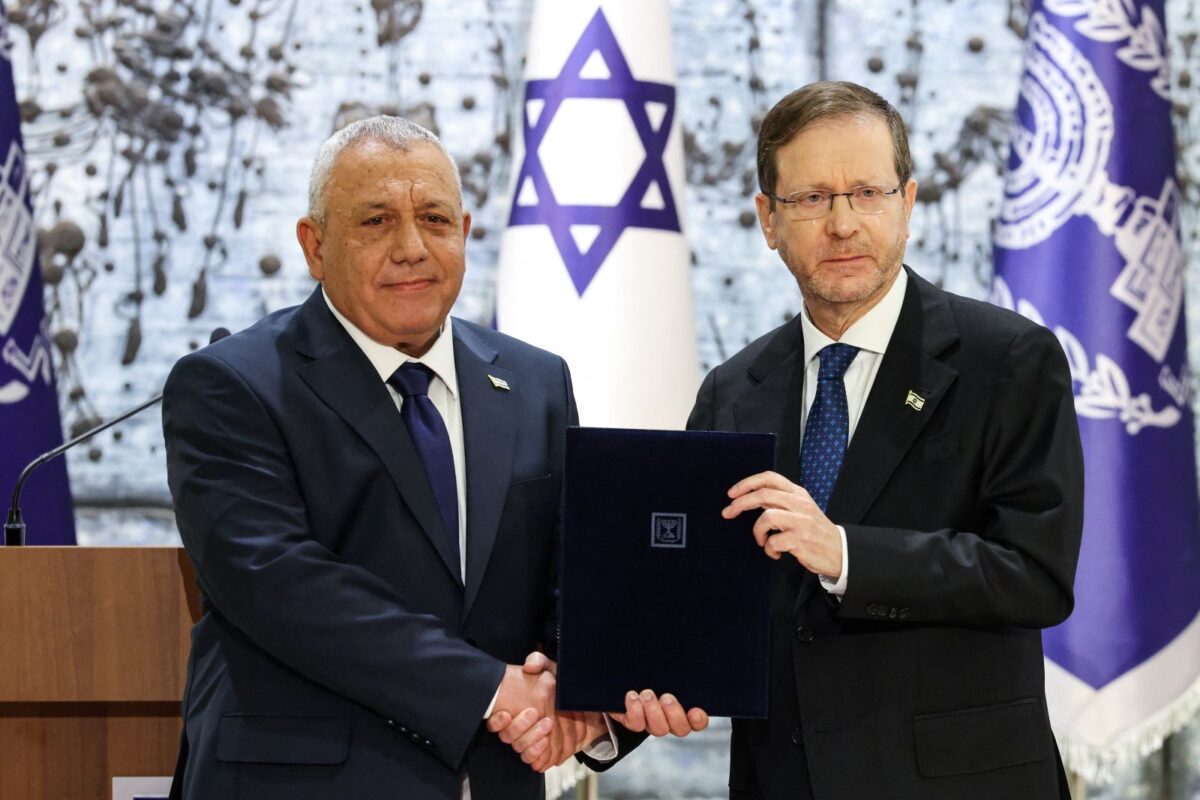
Photo by ILIA YEFIMOVICH / AFP. Israel's President Isaac Herzog (R) and Israeli opposition bloc leader Gadi Eisenkot pose with the signed mandate to form a new government during a press conference at the President's office in Jerusalem on November 8, 2026.
Gadi Eisenkot’s opportunity to form a government changes Lebanon’s diplomatic prospects before it changes anything on the ground. Benjamin Netanyahu remains prime minister until a successor takes office. But Beirut should already be asking whether a government led by the former army chief would negotiate differently, demand different concessions, or face domestic pressures that Netanyahu could ignore.
On the central security demands, Eisenkot has offered little reason to expect relief. Like Netanyahu, he wants Hezbollah disarmed and Israeli troops retained until satisfactory security arrangements exist
On the central security demands, Eisenkot has offered little reason to expect relief. Like Netanyahu, he wants Hezbollah disarmed and Israeli troops retained until satisfactory security arrangements exist. In June, he criticized restrictions confining operations to southern Lebanon and demanded freedom to strike Hezbollah elsewhere. His disagreement with Netanyahu has sometimes been that military pressure was insufficient or poorly directed.
His more consequential criticism is that Netanyahu has failed to convert military gains into durable political arrangements. Eisenkot has argued for international forces capable of supporting the Lebanese army, including French and Italian participation. That suggests an Israeli leadership more interested in building an enforceable settlement, although it gives Lebanon no assurance that the settlement’s terms would be generous.
Netanyahu’s government has itself accepted a framework providing for phased withdrawal. The distinction lies partly in the political obstacles each leader faces in implementing it. An Eisenkot cabinet excluding Ben Gvir and Smotrich could have fewer ideological constraints on compromise. But the composition of that cabinet remains undecided, and replacing Netanyahu would not remove the security concerns around which much of Israeli politics now revolves.
He would not begin with a blank page. In a pre-election interview, Eisenkot said agreements Netanyahu had reached with Washington would remain binding on him. The existing American-mediated framework is therefore the likely starting point. Negotiations would concern how to implement and verify commitments already made, alongside bargaining over withdrawal’s timing, territorial scope and the forces supervising it.
September reporting by The Jerusalem Post identified two possible differences: restoring France to a significant role alongside the Americans, and accepting a security zone eight kilometers deep under certain conditions, where Netanyahu favored holding a larger area. These were reported preferences, not a government programme. Still, they point to potential flexibility over territory and supervision without a retreat from Israel’s underlying security demands.
For Lebanon, this could mean more negotiable geography but more exacting tests of army performance. Eisenkot’s military background offers no reason to assume greater trust in the Lebanese army; the same reporting describes deep skepticism.
For Lebanon, this could mean more negotiable geography but more exacting tests of army performance. Eisenkot’s military background offers no reason to assume greater trust in the Lebanese army; the same reporting describes deep skepticism. My assessment is that he could exchange limited territorial concessions for stronger verification and firmer action against Hezbollah. A government rebuilding relations with Paris could also secure broader international support for those demands.
His military authority could also matter politically. A former army chief may be better placed to defend a limited withdrawal as a professional security judgement. But that advantage would depend on backing from the military and coalition partners. It could disappear quickly after an attack. Lebanon would therefore be negotiating with someone whose credibility might permit a compromise, while making demonstrable security results essential to defending it.
Arab-party support introduces a separate question. The nineteen Arab-led seats helped secure Eisenkot’s nomination, but recommending him to form a government does not establish a coalition or a foreign-policy bargain. Ra’am and the Joint List also have different approaches. Reporting on November 8 suggested Ra’am might support his installation without a completed coalition agreement, while the Joint List would withhold an affirmative vote without an agreement.
Their priorities include crime, housing and resources for Arab citizens. The Joint List has also demanded a diplomatic path towards Palestinian statehood. Those are real political claims, but they do not establish an Eisenkot commitment to withdraw from Lebanon. Their influence over Lebanon would arise from how much his government needed their continuing support, and which issues they chose to make conditions of that support.
If their votes become essential to budgets and parliamentary survival, a wider war could become politically more costly. That would be bargaining power, not automatic control of military decisions. Eisenkot would simultaneously face hawkish partners such as Bennett and Liberman. A coalition built with Likud or ultra-Orthodox parties instead would further reduce Arab-party influence.
Even dependence on Arab votes could complicate concessions. The November 8 report alleging withdrawal talks explicitly linked them to Arab-party backing; Eisenkot’s party denied it. That episode shows how quickly a Lebanese agreement could be portrayed inside Israel as a political payment. He might seek protection against that accusation through visibly tougher security conditions.
Lebanon should therefore prepare for negotiations that could become more structured, more internationalized and potentially less forgiving.
Lebanon should therefore prepare for negotiations that could become more structured, more internationalized and potentially less forgiving. The immediate indicators are the coalition agreement, the choice of defense minister, and the proposed role of American and French monitors. Eisenkot may offer a clearer route to partial withdrawal. He may also be better placed than Netanyahu to persuade Lebanon’s allies to insist on the price.
Ramzi Abou Ismail is a Political Psychologist, Researcher and Analyst.
The views in this story reflect those of the author alone and do not necessarily reflect the beliefs of NOW.