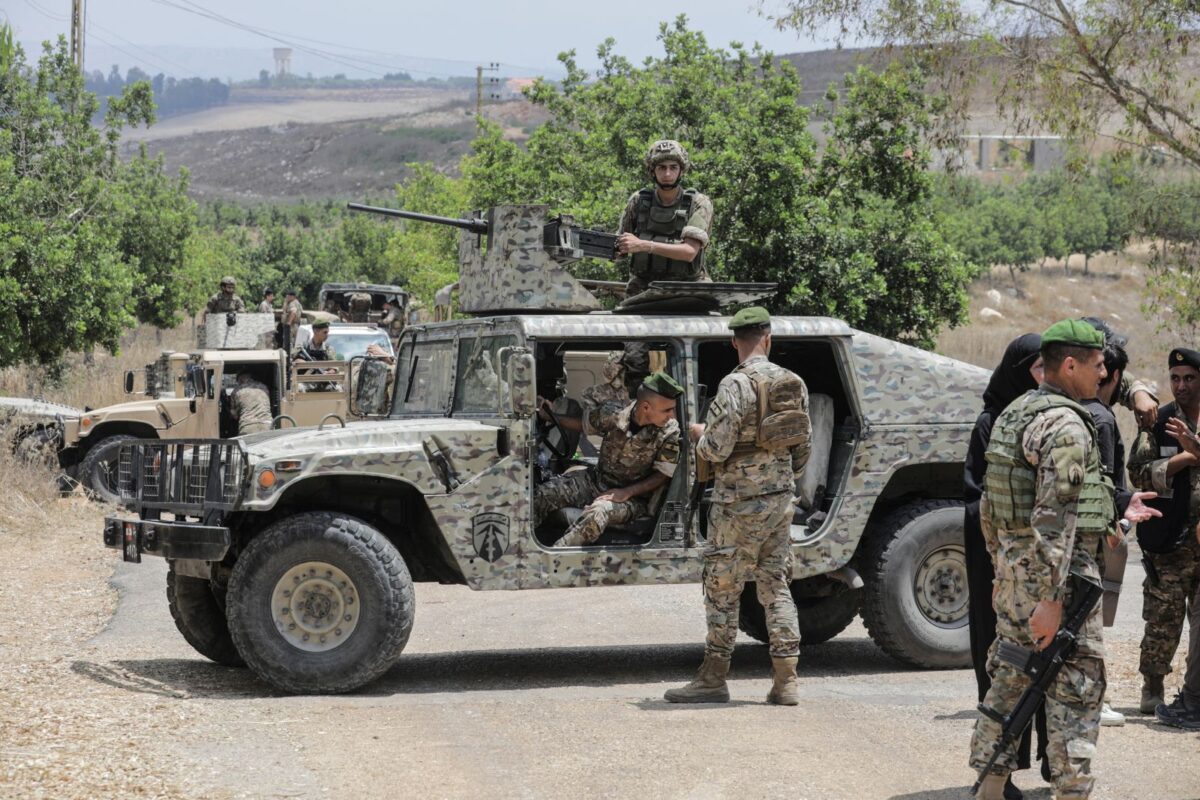
Photo by IBRAHIM AMRO / AFP. Lebanese soldiers gather on a road at the entrance to the southern village of Zawtar al-Gharbiya on July 22, 2026, after the army deployed to the village.
What happens when it appears that the army doesn’t abide by the directives of the executive branch? This is the situation that Lebanon finds itself in today: at a time when the Lebanese government has apparently made a commitment to disarm Hezbollah in exchange for Israel’s withdrawal from Lebanese territory, there has been little to show for it. The public posture of the army appears at odds with that of the government, which is almost always a recipe for an open-ended constitutional crisis. As a result, while we hear statements about disarmament, no tangible progress has been made so far.
Our region has a very colorful history of military coups and authoritarianism. Syria and Egypt, in particular, illustrate the speed with which militaries seize power from well-established regimes.
These military regimes relied on a police apparatus that stifled dissent and crushed political opposition. Civil liberties were relegated to the far margins of public life, a move which not only had consequences at the time, but distorted the way future generations would conceive of civil liberties.
These military regimes relied on a police apparatus that stifled dissent and crushed political opposition. Civil liberties were relegated to the far margins of public life, a move which not only had consequences at the time, but distorted the way future generations would conceive of civil liberties.
Cronyism and corruption would handicap economies for generations, forcing countries into debt and pushing millions into poverty. Progress and change become less likely with time.
Among its neighbors and wider region, Lebanon was historically associated with political liberalism. Beirut would become the cultural and financial center of the Middle East, a place where business and culture flourished. An extraordinary measure of free speech would attract a host of exiled writers and political activists, who found a safe haven in Lebanon. Political unrest and the civil war would gradually destroy the space for such freedoms, advancing a culture of political violence and nonchalance about human life. Decades of Syrian occupation and political interference entrenched several authoritarian politicians who strove to take and preserve power by force.
The nature of our political system is extremely conducive to authoritarian takeover. The president is elected by members of parliament instead of the public, the speaker of parliament controls the legislative agenda, and the separation of powers is frequently ignored. The sectarian division of political power, in turn, forces the public to prioritize narrow communal interests in exchange for patronage and government largesse. Why would a politician who can practically guarantee reelection without accountability do their job? There is no real obstacle which prevents politicians from engaging in blatant corruption, and votes are basically bought in exchange for economic patronage.
Since the end of the civil war, there has never been a discussion about how to best change the political system. Since 1998, every Lebanese president has been a former army chief of staff, and this naturally made that position a de facto right to the presidency
Since the end of the civil war, there has never been a discussion about how to best change the political system. Since 1998, every Lebanese president has been a former army chief of staff, and this naturally made that position a de facto right to the presidency. As a result, every chief of staff finds they ought to maintain healthy ties with the political establishment as a way to win their support for a presidential bid, even at the risk of disobeying the government. Why should we tolerate a system which only elevates selfish opportunists who won’t do their jobs?
Why do people assume we are safe from an authoritarian takeover? Political systems much stronger than ours have been rattled by militant politics, not to mention that there is opposition capable of stopping such an event.
Why do people assume we are safe from an authoritarian takeover? Political systems much stronger than ours have been rattled by militant politics, not to mention that there is opposition capable of stopping such an event. As usual, there appears to be no sense of urgency to have the hard conversations and take the hard steps necessary to preserve the country. With the passage of time, the reality of occupation and displacement will embed itself deeply in the daily economic and social cycle. We are already seeing a rise in crime, and this is likely to extend to different sectors of society.
Mohammad el-Sahily is a student and activist. He tweets @moesahily.
The views in this story reflect those of the author alone and do not necessarily reflect the beliefs of NOW.