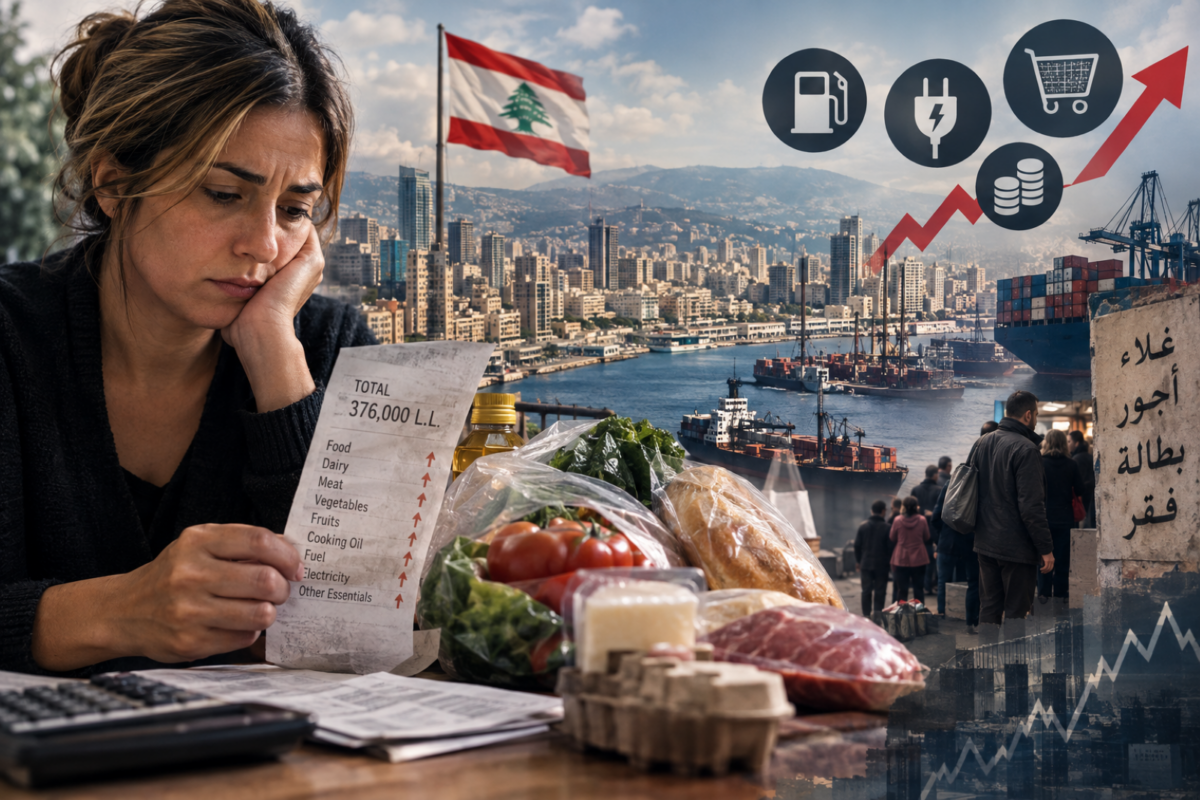
Lebanon’s households are facing another squeeze on their purchasing power as rising fuel, electricity and essential goods costs add to an economic crisis that has already pushed millions into poverty.
The World Bank said Lebanon had entered 2026 on firmer footing, recording estimated real GDP growth of 4.2 percent in 2025, but the March 2026 escalation sharply disrupted that momentum by damaging infrastructure, displacing communities, disrupting supply chains and weighing on tourism and domestic demand.
For households, however, the deterioration cannot be measured through inflation and GDP figures alone.
A July 2026 analysis by the Lebanese Center for Policy Studies (LCPS) found that 57.3 percent of respondents in a January survey of 2,400 people identified economic insecurity as their primary concern, while 46.7 percent reported rising living costs. The study also found that 38.2 percent had reduced spending on essentials such as food and clothing.
According to LCPS, the total price of the essential food basket increased by 5 percent, 9 percent and 13 percent annually between 2023 and 2026.
Lebanon’s heavy reliance on imports leaves consumers particularly exposed to exchange-rate movements, international shipping costs and fuel prices. LCPS estimates that around 85 percent of national consumption is imported, while market concentration among major importers and distributors and weaknesses in supply chains add further pressure to prices.
But economists argue that these external pressures are exposing deeper weaknesses within Lebanon’s economic model rather than creating the cost-of-living crisis on their own.
Dr Walid Marrouch, Professor of economics and associate dean of Graduate Studies and Research at the Lebanese American University, told NOW that Lebanon’s cost-of-living problem needs to be understood within the country’s broader political, economic and infrastructural structure.
He argued that regional conflicts and global fuel prices are exposing weaknesses that have existed for years, rather than being the sole drivers of higher prices.
According to Marrouch, Lebanon operates as what he described as an artificially expensive “hotel island economy,” characterised by severe geographical and infrastructural bottlenecks.
The country has one commercial airport, two major ports and a single land border with Syria, which he said has historically been unreliable or closed.
“These choke points” give entrenched cartels and special interests significant influence over import supply chains, Marrouch said.
He argued that when external shocks occur, such as increases in global oil prices, transport costs or wartime shipping risks, these actors do not necessarily simply pass higher costs on to consumers.
Instead, he said, some can use crises to increase their margins.
Marrouch described the state as acting as a “complicit player” in protecting monopolistic structures rather than functioning as an impartial regulator protecting consumers.
Marrouch described the state as acting as a “complicit player” in protecting monopolistic structures rather than functioning as an impartial regulator protecting consumers.
In his assessment, this means Lebanon’s rising cost of living is not simply a temporary wartime fluctuation.
“This is a permanent, structural tax extracted by a system of entitlement and cartelization that continuously hollows out the purchasing power of ordinary citizens,” Marrouch said.
He added that prices could eventually decline once the current regional conflict and associated disruptions subside, but Lebanon would remain an expensive place to live and work compared with other countries in the region unless its underlying economic structure changes.
Food prices fall less quickly than inflation
The distinction between falling inflation and persistently high prices is particularly important for Lebanese households.
LCPS found that although headline inflation declined from 221.3 percent in 2023 to 12.2 percent in early 2026, this did not translate into a meaningful reduction in the cost of essential goods. Its analysis of Ministry of Economy and Trade data showed continued increases in several food categories.
The problem is compounded by declining incomes and precarious employment, meaning that even slower price growth can continue to feel like an increase in the cost of living when household earnings do not keep pace.
The World Bank also found that households were cutting food and non-food consumption and reducing health expenditure to cope with the crisis.
Fuel and electricity prices add another layer to the pressure because they affect transportation, production and distribution across the economy.
Lebanon’s electricity crisis has also made households and businesses dependent on private generators to compensate for limited state electricity supply. This leaves consumers exposed not only to the cost of fuel itself but also to the cost of generating electricity.
A crisis deeper than temporary inflation
Adib Nehme, a consultant and expert on development, socio-economic policies and poverty, also told NOW that Lebanon’s deterioration in living standards is fundamentally structural and cumulative rather than simply the result of recent price increases.
He said the current increases linked to the war since October 2023 and higher fuel prices should instead be viewed as new elements within longer-term processes that are contributing to expanding impoverishment and inequality.
Nehme said the current situation is the product of “a combination of structural and emergency factors, economic and political, internal and external,” whose relative importance changes across successive and overlapping periods.
Nehme said the current situation is the product of “a combination of structural and emergency factors, economic and political, internal and external,” whose relative importance changes across successive and overlapping periods.
He argued that Lebanon’s present crisis is the result of multiple layers of political and economic transformation dating back to the post-independence period, with further disruptions specially starting in 1975, the Syrian hegemonyafter the Taif Agreement, and subsequent political settlements and regional conflicts.
“What we are witnessing today of deep economic, political and societal crises is the product of these chronic structural transformations and the dynamics they generated,” Nehme said.
He also pointed to what he described as the dominance of political and geopolitical factors over economic considerations, including Lebanon’s involvement in the current war, inadequate official policies and weaknesses in economic and social governance.
For Nehme, the problem is compounded by divisions within Lebanon’s institutions themselves. He described Parliament as being in contradiction with the government and argued that the executive authority is not unified, with competing centres of decision-making involving the government, the prime minister and the president.
He said these divisions have weakened the state’s ability to implement economic and social reforms and to address the domestic and regional dimensions of the crisis.
The cost of political and economic fragmentation
The cost-of-living crisis also raises a broader question about the relationship between Lebanon’s political structure and its economic performance.
Asked about the economic cost of Hezbollah maintaining an independent armed capability outside state control, Nehme described Lebanon’s system as a “three-headed dragon.”
He identified the first head as “the authority of arms, the predominance of violence and the regional dimension as a whole,” with Hezbollah as its most prominent representative.
The second, he said, is “the authority of money and the economy,” represented prominently by the Association of Banks, major importers and businessmen and their allies within institutions.
The third is what he described as the “deep state,” comprising a hybrid of traditional political leaders who have retained their influence alongside figures who have reached positions of power since 1975 through political inheritance, militia influence, political money, corruption or alliances with centres of influence.
Nehme said the 2019 crisis and its aftermath demonstrated the “organic interconnection” between these three authorities, with one sometimes becoming dominant over the others depending on circumstances.
He said Hezbollah’s responsibility for prolonging and worsening the economic and social crisis was significant because, in his assessment, it represents the clearest contradiction to the concept of the state and has insisted on keeping a centre of power outside state institutions and outside Lebanon.
At the same time, Nehme explicitly stressed that Hezbollah does not bear sole responsibility for prolonging the crisis.
“When it comes to the economy, particularly the main issue represented by reforming the banking system in order to save it — and today no economy can recover without a healthy banking system that complies with the law — a much broader alliance emerges,” he said.
Nehme argued that this alliance protects bankers rather than the banking system itself, while also pointing to what he described as “cartels/mafias” operating in sectors including oil and energy, hospitals, schools, generators and essential goods imports.
“This highly backward rentier and financial form of the economy is currently the dominant feature of the Lebanese economy,” he said.
Hezbollah and the “sovereign risk premium”
Marrouch similarly linked Lebanon’s economic difficulties to the country’s political and security environment.
He described the cost of what he called “an unaccountable militia operating a parallel state” as ultimately threatening Lebanon’s ability to function as a sovereign economy.
“Economies cannot function under a permanent ‘sovereign risk premium’ where decisions of war and peace are hijacked by a non-state actor,” Marrouch told NOW.
He argued that Hezbollah’s political and military role has contributed to Lebanon’s isolation from traditional investment partners and weakened its macroeconomic foundations.
“Economic stability requires a state that possesses an absolute monopoly on both violence and institutional governance,” he said.
Marrouch said the issue extends beyond the direct economic consequences of conflict.
He pointed to Lebanon’s dependence on imports and the concentration of control over key supply chains, arguing that the country’s geographical and infrastructural limitations make it particularly vulnerable to disruptions.
When global oil prices, shipping costs or wartime risks increase, these vulnerabilities become more visible, he said, allowing entrenched market interests to take advantage of the disruption.
The result, according to Marrouch, is that Lebanese consumers can end up bearing costs that go beyond the actual increase in the price of importing a product.
This means that even if external pressures eventually ease, the structural factors keeping prices high would remain unless Lebanon addresses its monopolistic market structures, supply-chain bottlenecks and weak regulatory institutions.
Rebuilding purchasing power requires more than price controls
For Nehme, addressing the cost of living cannot be separated from rebuilding the authority and capacity of the Lebanese state.
“In the state of spoils, and in the economy of spoils, it is not possible to carry out a limited and partial technical reform,” he said.
He argued that the first step should be the restoration of state sovereignty, both domestically and externally, including exclusive control over decisions of war and peace and the monopoly over weapons.
He also stressed that state sovereignty should extend beyond security to economic, financial, educational and cultural spheres.
“If it is necessary to choose a priority entry point in this economic and social reform, there is no doubt that reforming the banking sector and restoring the rights of citizens and the state — as the expression of the citizens’ state — from the alliance of bankers and politicians who plundered citizens and became wealthy at their expense” should be prioritised, Nehme said.
He described banking reform as a battle comparable in difficulty to restoring the state’s authority over war, peace and weapons.
The World Bank has likewise identified banking-sector restructuring and fiscal management as critical to restoring confidence and mobilising financing for reconstruction and recovery. It warned in August that Lebanon’s public debt remained unsustainable and that the banking sector remained deeply weakened despite progress on parts of the restructuring agenda.
For ordinary Lebanese, however, the question is ultimately more immediate: whether wages and household income can keep pace with the cost of food, transport, electricity and other necessities.
The economic crisis has already forced households to reduce consumption and rely on coping mechanisms, while the latest conflict has added another layer of pressure.
Lebanon’s challenge, therefore, is not simply to bring down the latest increase in fuel or food prices. It is to address the structural weaknesses that determine how prices are formed, how resources are distributed and how effectively the state can protect purchasing power.
Without progress on those fronts, a decline in headline inflation may do little to change the reality faced by households whose incomes remain under pressure and whose essential expenses continue to consume an increasing share of what they earn.