Sometimes the story of one family tells us more about a great migration than any statistic. Such is the case of the Abi Qasta, a family from Ottoman Mount Lebanon whose sons left for the United States during the first wave of mass Lebanese emigration, between 1880 and 1914. Their journey, from the silk-producing town of Bayt Chabab to the small towns of Missouri and the studios of Hollywood, mirrors that of thousands of men and women who left the mountain in search of a better life. Retracing it is an exercise in microhistory, an approach that examines a small subject, such as an ordinary person, a single family, or a brief event, to address larger historical questions. The Abi Qasta brothers lead us to the simplest and most important question of all: why did they leave?
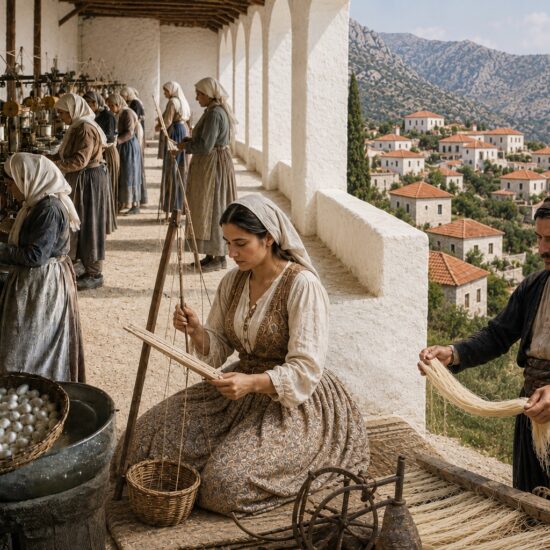
The answer calls for caution, as a great deal of mythology surrounds the Lebanese Diaspora. Popular and official narratives speak of extraordinary success, of hardships overcome, of inflated numbers, and of Christians fleeing persecution. The work of historians such as Professor Akram Khater offers a more precise and more human picture. Mount Lebanon had indeed known civil strife in 1841, 1845, and 1860, yet the decades between 1861 and 1914 are remembered as the “Long Peace”, and the persecution narrative was partly developed by newcomers seeking the sympathy of American immigration officials. Those who left, from what we call Lebanon today, were above all seeking a better life. An economic crisis set them on the road: the collapse of the silk economy on which Mount Lebanon depended, a series of bad harvests, and the arrival of cheaper Chinese silk on European markets. A population that nearly doubled in two generations added to the pressure, while new steamship lines brought the dream of “Amerka”, as the locals called the United States, within reach.
Sometimes the story of one family tells us more about a great migration than any statistic. Such is the case of the Abi Qasta, a family from Ottoman Mount Lebanon whose sons left for the United States during the first wave of mass Lebanese emigration, between 1880 and 1914.
The Abi Qasta brothers belong to this wider movement. They were one of the clans affiliated to the al-Hayek family of Bayt Chabab, in the Matn district of Ottoman Mount Lebanon, one of the most dynamic centres of craftsmanship in the mountain, known for its silk, pottery, metalwork, and textiles. The family worked in silk production, as well as in olive oil production in Mazraat Yashou’, a satellite village of Bayt Chabab where they had settled on their property after Ibrahim Pasha’s Egyptian army attacked Bayt Chabab in 1840. The silk crisis of the 1880s hit the family hard, and the decision was taken to leave for “Amerka”. Between 1888 and 1896, five brothers, Abdallah, Fares, Girgi, Ibrahim, and Amin, left the Ottoman Mutasarrifiyya of Mount Lebanon. Little is known about their journey from the mountain to Beirut, from Beirut to New York, and from New York to Missouri.
Life in America soon transformed them in many ways, beginning with their names: Abdallah became Joe, Girgi became Geo, Fares became Frank, Ibrahim became Abraham, and Amin became Herman, while the family name, Abi Qasta, became Bookasta. Immigration and naturalisation records also reveal how complex it was to fit these newcomers into American categories. Abraham’s “Declaration of Intention” of 1917, the first step towards U.S. citizenship, offers a telling example. Abraham had first moved to Argentina before returning to the United States to join his brothers, and to become a citizen, he had to renounce his allegiance to the Ottoman Sultan Mehmet V and declare that he was neither an anarchist nor a polygamist.
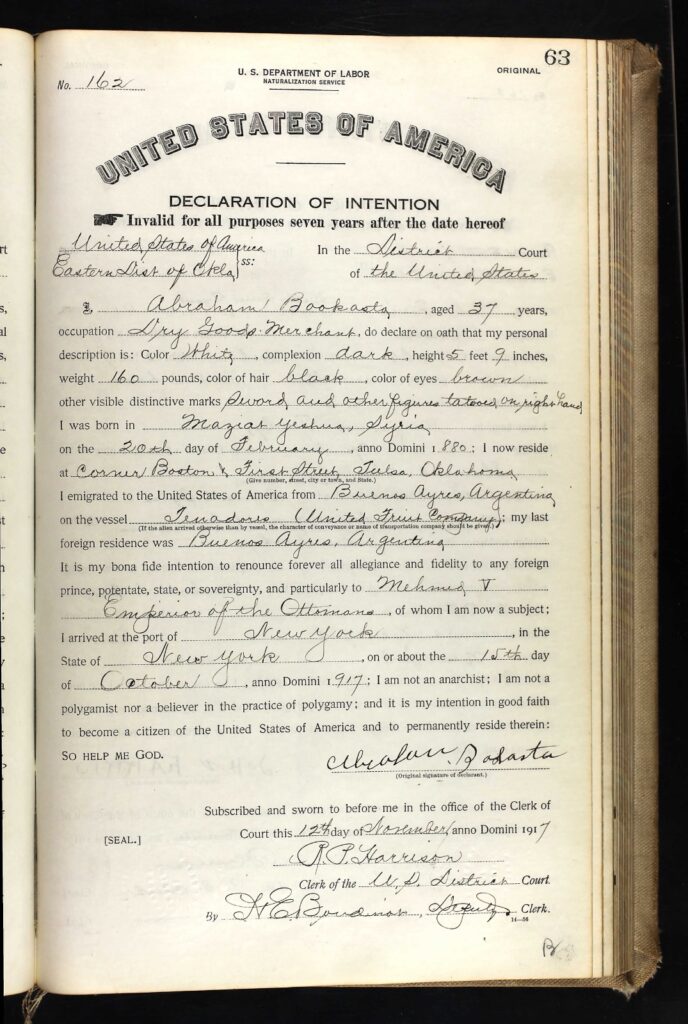
Declaration of Intention of Abraham Bookasta, 1917. National Archives At Fort Worth; Fort Worth, Texas.; ARC Title: Declarations of Intention, Compiled 1909 – 1988; NAI Number: 4477673; Record Group Title: Records of District Courts of the United States; Record Group Number: 21
Two brothers from the same family were assigned two different countries of birth: “Turkey”, meaning the Ottoman Empire, and “Arabia”, meaning its Arabic-speaking provinces. Joe’s passport application from 1900 sums up this confusion in a single line: “Born at Beirut-Mazra’et Yashouh, Syria, in Turkey”. In the 1910 census, Joe and his wife Tefeha appear as both Turks and Syrians; he is listed as fluent in English, while she speaks “Syrian”. Such records reveal how complex the question of identity was for these early emigrants.
Written sources confirm the family’s oral history. The Syrian Business Directory, first edition 1908–1909, compiled by Salloum Mokarzel and H. F. Otash and held at the Moise A. Khayrallah Center for Lebanese Diaspora Studies, records the dry goods stores the brothers established in Missouri: Joe in Higginsville, Geo in Napoleon, and Frank in Wellington. Between 1900 and the end of the 1910s, the brothers acquired American citizenship. Their choice of trade was typical of their time. In the late nineteenth and early twentieth centuries, dry goods offered immigrants an accessible path to economic integration and social mobility. The growth of American consumer markets, the modest capital required, and the durability of textiles and clothing made the sector particularly attractive. Like many Levantine immigrants, the Bookasta brothers invested in this sector.
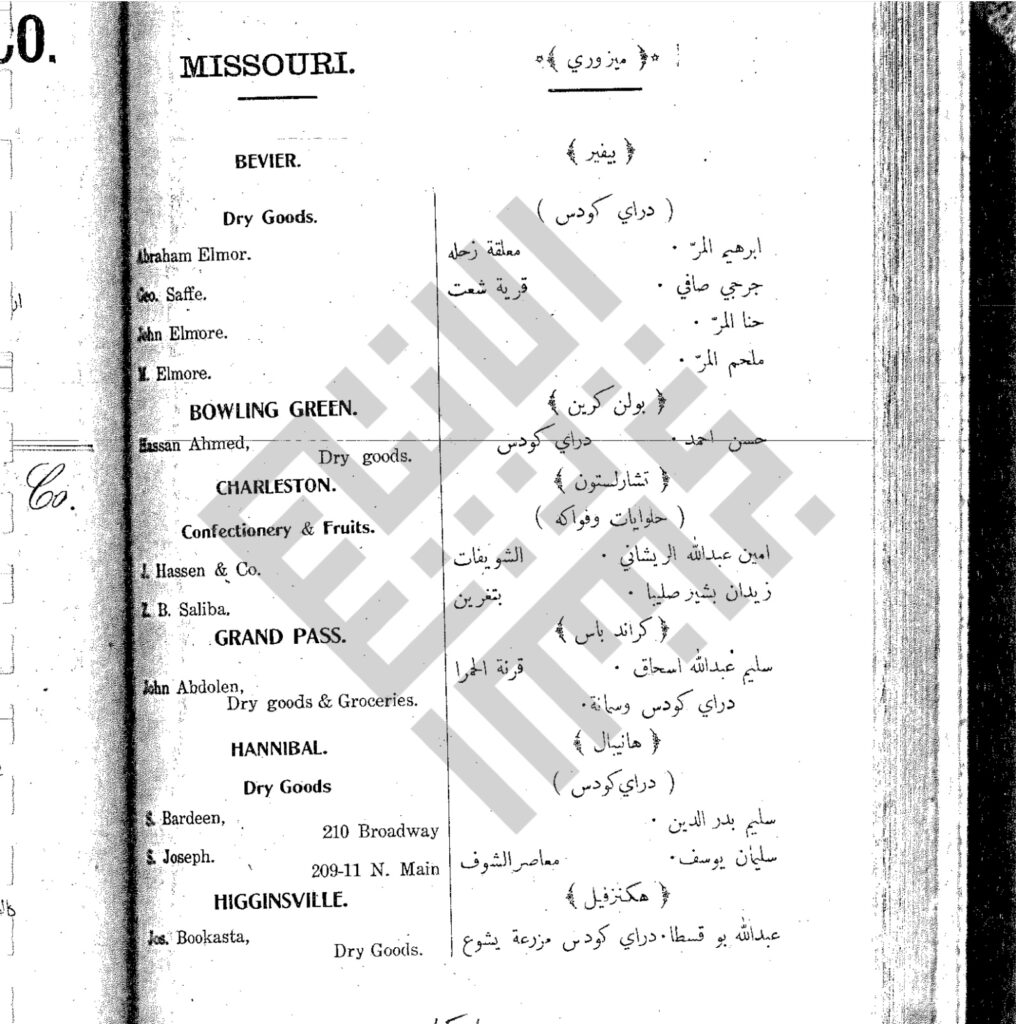
Abdallah Bookasta’s dry goods store, as listed in The Syrian Business Directory (first edition, 1908–1909), where his name appears in English as Joe. Source: Moise A. Khayrallah Center for Lebanese Diaspora Studies, North Carolina State University (https://lebanesestudies.omeka.chass.ncsu.edu/items/show/11374)
After almost twenty years in the United States, Abdallah, now Joe Bookasta, decided to return to Mount Lebanon. He had already visited the Vilayet of Beirut and the Mutasarrifiyya in 1900 to buy land for the family, and in 1912 he came back with his wife to marry his only son, Qabalan, in Lebanon. Qabalan’s marriage reflected the reach of the diaspora: his wife, Maria al-Mallah, came from the Matn district, yet she was born in Buenos Aires. Abdallah settled in Dbayeh, an emerging coastal town in the Mutasarrifiyya, where he invested in citrus orchards. He planned to travel back to the United States to check on the family business, and the outbreak of the First World War prevented the journey. He ended up staying for good. When the French Mandate authorities registered the citizens of the newly established State of Greater Lebanon in the early 1920s, the family dropped the name Bookasta and reverted to al-Hayek as their surname. By then, the family had divided into two branches: an American branch known as Bookasta, and a Lebanese branch officially registered as al-Hayek, though still known in Dbayeh as the Bookasta.
It is time to move from macrohistory to microhistory, so that Lebanon can understand its diaspora through the lives of those who made it and give them their rightful place in public memory.
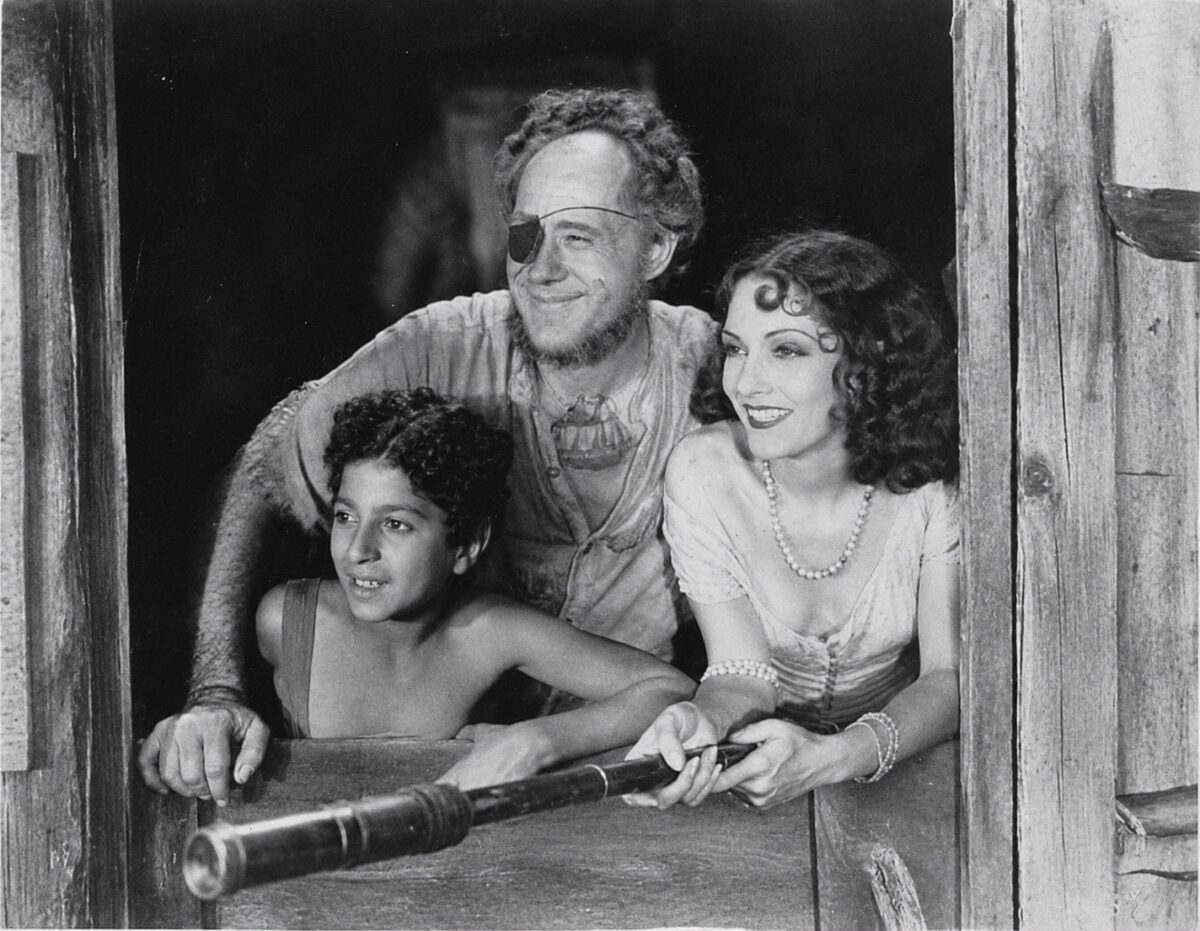
The American branch followed a very different path. George, born in the United States in 1917 to Amin, known as Herman Bookasta, was three years old when he stood on a vaudeville stage in Los Angeles in 1920, dressed as Chaplin’s Little Tramp. Charlie Chaplin himself spotted him, brought him to United Artists, and signed him to a contract, and the family moved to Hollywood. At six, George appeared opposite Mary Pickford in Rosita (1923). A year later, the family entered the screen together: Herman rode an elephant into Baghdad as a stand-in for Douglas Fairbanks in the legendary The Thief of Bagdad (1924), while his sons Basil and George appeared as page boys. By 1930, George was playing “Spotty” in Hell Harbor, one of the first films with synchronised sound. A Lebanese-American child had become part of Hollywood’s history.
George grew up with the film industry. In the 1930s, he formed his own orchestra, which soon headlined Hollywood’s Café de Paris on national radio, and he continued to appear in films such as The Great O’Malley (1937) with Humphrey Bogart and That Night in Rio (1941) with Don Ameche and Alice Faye. By the early 1940s, he had joined Paramount Studios, working both in front of and behind the camera, learning every aspect of filmmaking, and directing film, theatre, documentaries, and commercials. During the filming of Sergeant York (1941), his wife, Laura Williams of the Williams Sisters (A singing group), gave birth to their first son, whom they named Gary in honour of the film’s star, Gary Cooper. George’s marriage illustrates the process of integration: while the first generation of emigrants mostly married within the Lebanese community of the diaspora, the second generation increasingly married Americans.
In 1943, George joined the United States Army and was sent to the European front. As a sergeant and radio operator, he saw active service in Germany and France, where he was wounded in battle. He formed an orchestra in the army, led men on the battlefield, and escaped death many times. After the war, he helped build American television itself, directing the variety series The Colgate Comedy Hour in New York and working behind the camera on programmes such as Bachelor Father and Have Gun – Will Travel, alongside a steady stream of commercials. He retired in 1990, returned briefly in 2002 for a musical, and lectured on the Golden Age of Hollywood in which he had grown up. He died in 2014 at the age of 96, after a life that spanned the full course of Lebanese-American integration into the economic, cultural, and civic life of the United States.
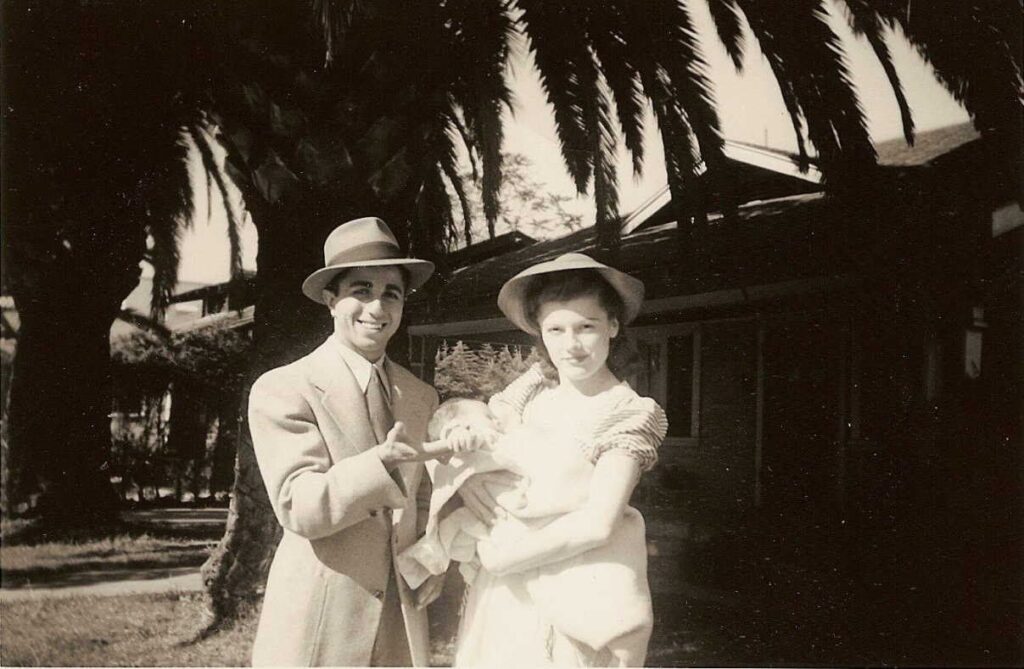
George Bookasta with his wife, Laura, and their firstborn son, Gary, in Saratoga Springs, New York, in the 1940s. Source: author’s archives.
Traditional narratives of the diaspora in Lebanon tend to promote the image of successful emigrants who went to new lands, made money, and lived the good life. Part of this picture is true, yet these grand narratives overlook what microhistory reveals: the small stories of Lebanese emigrants, and with them, failure and separation. Qabalan, son of Abdallah, and George, son of Herman, were cousins who never met. George lived the Golden Age of Hollywood, while Qabalan lived the founding years of Lebanon. For a century, the two branches of the family lived apart, connected by letters that, with time, stopped coming. In April 2021, the silence was finally broken. Petur Georgesson, son of George Bookasta, set out to find his roots in Mount Lebanon, and through Heritage and Roots, the cousins of the two branches finally met.
Imagine, then, what Lebanon, its diaspora, and the global history of mobility, integration, and immigration would gain if such stories were assembled, reconstructed, and analysed. The Bookasta story reveals emigration as a family strategy unfolding across generations and continents, in which departure, settlement, and return formed parts of a single process. It shows how identities were negotiated in administrative records, and how integration into American society and attachment to the homeland could coexist, and eventually diverge, within one family. Many more such stories wait to be found in oral history, family archives, and institutional archives. The Moise A. Khayrallah Center for Lebanese Diaspora Studies at North Carolina State University is leading this work as a research and public history centre dedicated to documenting and sharing the history of Lebanese immigrants and their descendants worldwide. These stories also illuminate a wider relationship. In Lebanon, the shared history with the United States is often reduced to recent years. In fact, it goes back to the 1820s and 1830s, with the arrival of American missionaries, who would later establish schools and universities, and of the first American consular representatives in Beirut. It continues with Lebanese emigration to the United States, which began with individual travellers in the 1850s, before the mass departures of the 1880s. These two centuries of shared history can be understood through microhistory. Lebanese textbooks and official narratives, meanwhile, still look to the big picture and leave out the men and women who made it possible. It is time to move from macrohistory to microhistory, so that Lebanon can understand its diaspora through the lives of those who made it and give them their rightful place in public memory.
Charles al-Hayek is a public historian and the founder of Heritage and Roots.
The views in this story reflect those of the author alone and do not necessarily reflect the beliefs of NOW.