“The Lebanon he inspired could at best be a confederation of theocratic mini-states. It is high time that Lebanon’s historiographers pay as close attention to the Sa’adallahs as they do to the Iliases.”
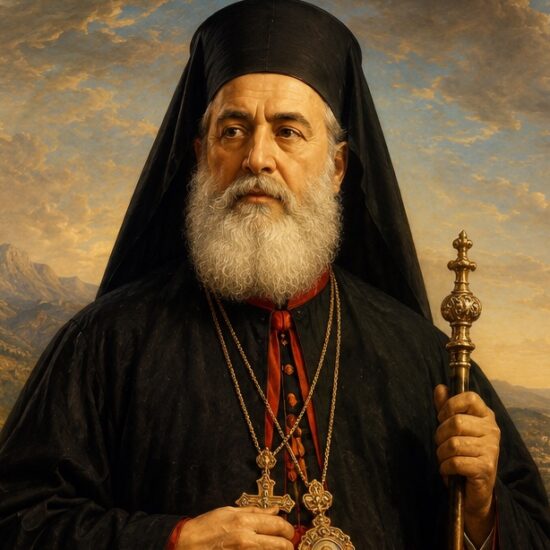
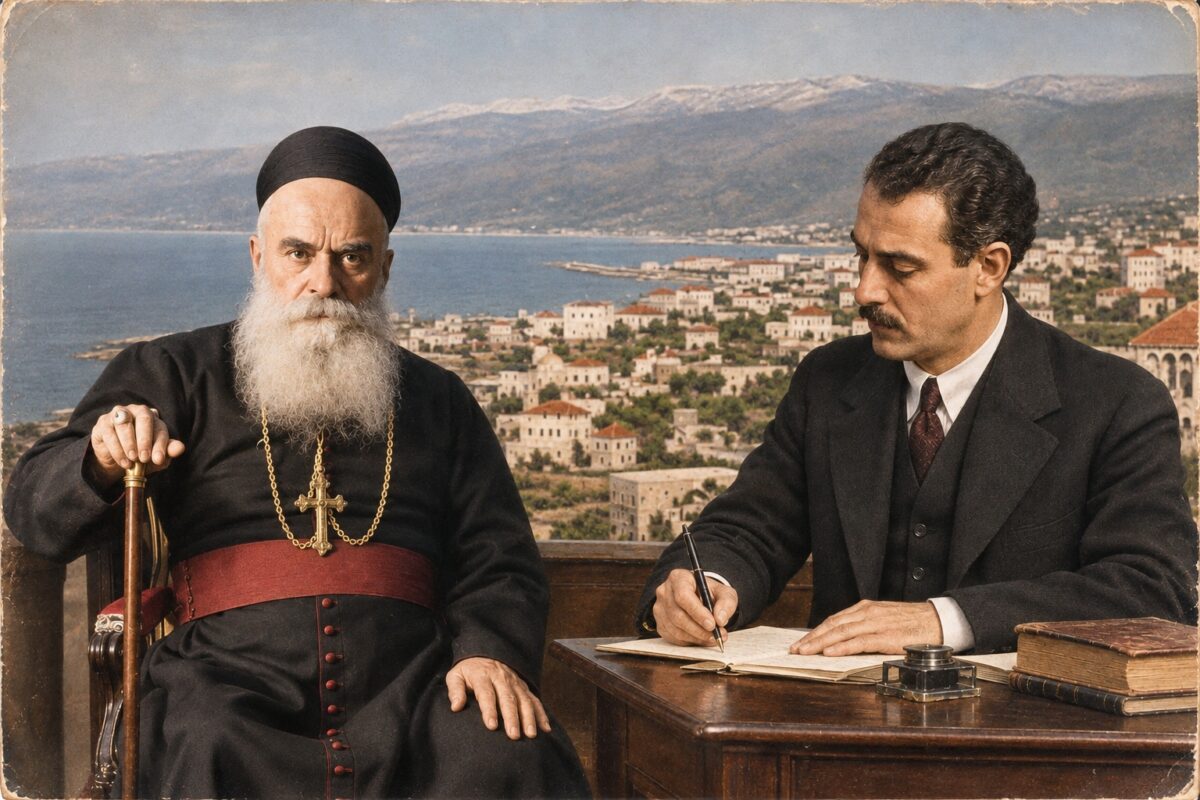
These words come from the concluding remarks of The Long Peace: Ottoman Lebanon, 1861–1920 (University of California Press, 1993) by the historian Engin Deniz Akarlı. The book remains the reference work on the period. It explains the complex system that sustained peace in Mount Lebanon for half a century and shows how the Lebanese learned to govern themselves together after two decades of civil unrest. In these remarks, Akarlı contrasts two brothers. The first, the Maronite Patriarch Elias Hoayek, is celebrated in the national narrative as the father of Greater Lebanon. The second, Saadallah Hoayek, was a prominent secular politician who sat on the Administrative Council of the Mutasarrifiyya of Mount Lebanon and served as its deputy chairman. The Patriarch is commemorated, while his brother is now almost forgotten by the wider public. Akarlı died on 8 November 2026. In tribute to him, this article asks two questions: how did the two brothers differ, and why has their story been forgotten?
In September 1918 the Ottomans withdrew from the Arab provinces. The Administrative Council of the Mount Lebanon Mutasarrifiyya then resumed its work and governed the Mountain for twenty months, from 1918 to 1920. Numerous and conflicting projects and promises were put forward for administering the region either by the Allied powers or locals who lobbied at the Paris Peace Conference. Within this regional and international context, the Council sought to defend the Mountain’s autonomy and the project for its expansion.
The Patriarch is commemorated, while his brother is now almost forgotten by the wider public. Akarlı died on 8 November 2026. In tribute to him, this article asks two questions: how did the two brothers differ, and why has their story been forgotten?
In effect, the Council was exercising a role it had been preparing for over half a century. When the Mutasarrifiyya regime was proclaimed in 1861, Mount Lebanon gained legal autonomy. It acquired a Constitutional Charter (Règlement Organique) under which it was governed with an international guarantee, along with an administrative apparatus and a local judiciary and security force. This period saw the beginnings of competitive political life, through the election of mukhtars and members of the Administrative Council, and the spread of popular political awareness. Local officials drawn from the popular base ran these institutions. They worked within a political system founded on sectarian alliances and centred on the Administrative Council, which represented the communities of the Mountain.
This interaction, which Akarlı calls the “Long Peace”, gave rise to a secular movement in Mount Lebanon. It also brought a gradual shift from the Maronite Church’s conception of Lebanon toward a broad, proto-national conception that emphasized peaceful coexistence and collective progress. A liberal elite, drawn largely from the educated middle class, championed it. By the late nineteenth century this elite formed the majority of the Administrative Council. It called for expanding the Mutasarrifiyya’s borders, broadening self-administration, and reducing the influence of religious institutions.
Akarli, Engin Deniz. The Long Peace: Ottoman Lebanon, 1861–1920. Berkeley: University of California Press, 1993.
The career of Saadallah Hoayek, the Patriarch’s younger brother, embodies this generation of politicians. The son of Father Boutros Hoayek, priest of the parish of Helta in the Batroun district, he was born in 1853 and educated at the Saint John Maron School in Kfarhay. On 4 May 1900, he was elected to the Administrative Council to complete the term of Amin Tarabay, the Batroun member, who had died. When that term ended in 1905, he was re-elected unopposed for a full six-year term, and in 1911 he defeated Aql Abu Saab, the candidate backed by the mutasarrif. He served as deputy chairman of the Council under Muzaffar Pasha (1902–1907) and Yusuf Pasha (1907–1912) and as acting qaimmaqam of Batroun from 28 April to 15 July 1903. In 1912, at the end of Yusuf Pasha’s term, he was entrusted with governing the Mountain by proxy pending the appointment of the new mutasarrif, a role in which he showed both wisdom and competence. With the outbreak of WWI, Jamal Pasha exiled him to Anatolia in December 1914; the following year, he dissolved the Council, and dismissed its members.
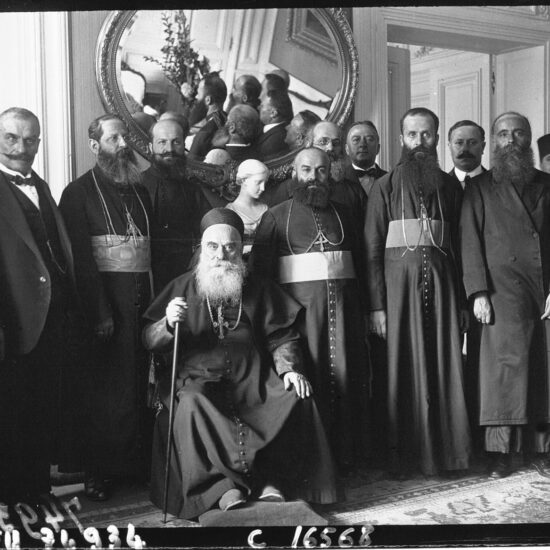
At the Paris Peace Conference, which opened in January 1919, the reinstated Council was recognized as the official representative of the Lebanese, at a time when its positions aligned with French interests. The Council sent three delegations to the Conference, carrying demands for independence, expansion, and French support. Meanwhile, France was negotiating with Emir Faisal, son of Sharif Hussein, who had obtained a British promise of an Arab Hashemite kingdom. When the two reached a preliminary agreement in April 1919, the Administrative Council responded by declaring Lebanon’s independence “in its capacity as representative of the people of Lebanon”. The Council then asked Patriarch Elias Hoayek to lead the second delegation to France. In November 1919, the Patriarch’s mission, remembered in the Lebanese narrative as a historic founding mission, obtained only vague guarantees of independence from the French Prime Minister, Georges Clemenceau, with no firm commitment.
As relations between Emir Faisal and the French deteriorated, the Syrian General Congress proclaimed the independent Syrian Kingdom on 7 March 1920, with Faisal as king. It recognized Mount Lebanon’s right to independence provided it avoided foreign influence and kept its pre-war borders, a decision the Maronite Church and the Administrative Council rejected. The Syrian government soon shifted its position, accepting full Lebanese independence and expanded borders on condition that Lebanon renounce the French Mandate.
When France intervened militarily in the Mountain’s administration and disregarded its autonomy, the Council defied French rule and declared Lebanon’s complete independence on 10 July 1920. The declaration called for expanded borders, neutrality, and peaceful coexistence, and rejected the French Mandate. Most of its signatories held a liberal vision of Lebanon: independent, at peace with itself and its neighbours, and reconciled across its sectarian communities, with the government resting on civic foundations.
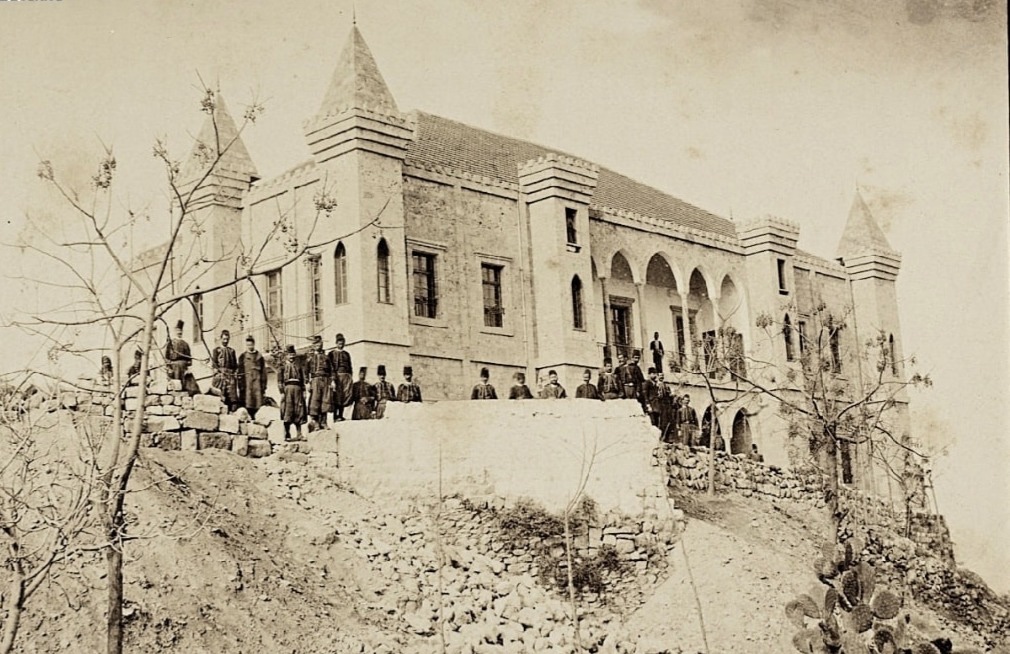
The Baabda Serail, seat of the Mutasarrifiyya of Mount Lebanon and its Administrative Council. Saadallah would have worked from his offices there.
Following the declaration, a seven-member delegation of the Council set out for Damascus: Saadallah Hoayek, Khalil Akl, Suleiman Kanaan, Fouad Abdel Malek, Elias Shuwayri, Mahmoud Jumblatt, and Muhammad Muhsin. Representing the Mountain’s confessional diversity, the delegates hoped to reach an agreement affirming the independence of Lebanon and Syria and their cooperation, to take the question to the Peace Conference, and to win international support. French forces stopped and arrested them on the Damascus road. The French authorities then dissolved the Administrative Council, removing the principal institutional voice of opposition in Mount Lebanon. Brought before a French military tribunal, the delegates faced charges of conspiracy and high treason: of handing Lebanon over to the Hashemite project by pledging allegiance to Emir Faisal as king of a Syria that included Mount Lebanon, and of abandoning France, “the eternal protector of Lebanon and the Lebanese”. Convicted and publicly labelled traitors, they were exiled to Corsica, where Saadallah stayed for nearly two years. Their defeat revealed the limits of their position: in 1920, supporters of this vision lacked the means to rally opinion against the combined political weight of France and the Maronite and Melkite church hierarchies in Lebanon.
Meanwhile, General Gouraud issued an ultimatum to Faisal, which led to the Battle of Maysalun on 24 July 1920 and to the imposition of the French Mandate on the region by military force. Gouraud redrew the political map and proclaimed the State of Greater Lebanon on 1 September 1920. Gouraud thereby fulfilled one principal Maronite demand, the creation of the Lebanese state. Yet he set aside the other demand, independence, and placed Lebanon under direct French military rule. Later, with the adoption of the 1926 Constitution, the Lebanese Republic was proclaimed. The Constitution enshrined political sectarianism and gave religious institutions authority over personal status and education. This arrangement suited French interests. Under the Mandate, sectarianism gained new life as a pillar of the political system, on the assumption that it was an organic trait of the Lebanese. Thus, since the Mandate period, the communities have remained separate, sharing power and rejecting secularism as an existential threat to their political and socio-economic dominance.
A century after Elias Hoayek’s vision became a state, perhaps it is time to give his brother Saadallah’s vision the attention it deserves.
The national memory that took shape since the Mandate explains why Saadallah has been forgotten. The photograph of September 1, 1920, with the Patriarch standing beside Gouraud on the steps of the Résidence des Pins, became the founding image of Greater Lebanon, and the Patriarch’s mission to Paris became its founding story. Within that account, the historical record turned Elias Hoayek into the sole representative of the Lebanese people and his brother Saadallah into a traitor to Lebanon and to his brother’s vision. The Council that had governed the Mountain for half a century, and that had first declared Lebanon’s independence, disappeared from the narrative together with its members. The label of treason outlived the exile, and the liberal project they carried was remembered, when it was remembered at all, as a betrayal.
Saadallah was pardoned at the end of 1921 and returned to Lebanon. He died on 14 June 1928 at his daughter’s house in Haret Sakher. His brother the Patriarch led the prayers over his body, which was carried to the church of Haret Sakher, where he was buried.
Saadallah and his associates were grassroots politicians who worked within a multi-confessional structure. The Patriarch was a churchman whose state was his Church and whose nation was his flock, and the Lebanon he demanded could, in Akarlı’s words, “at best be a confederation of theocratic mini-states”. Since 1926, the sectarian system enshrined in the Constitution has been reproduced after every crisis or civil conflict.
The current crisis and the struggle over Lebanon’s identity, role, and system raise many questions. Was the vision of these liberals better suited than the sectarian model to building a modern state? And does it deserve to be revisited, as a way to reconcile with history and to build another Lebanon? Akarlı invites us to do exactly that. The Long Peace calls for a re-evaluation of Lebanese historiography that gives civic, secular politicians the same attention and agency long reserved for religious figures and the French-backed elites who entrenched Lebanon’s sectarian system. Historians can lead the wider public in recovering the overlooked legacy of men like Saadallah Hoayek, who sought to build a secular, modern, democratic, and free Lebanon. A century after Elias Hoayek’s vision became a state, perhaps it is time to give his brother Saadallah’s vision the attention it deserves.
Charles al-Hayek is a public historian and the founder of Heritage and Roots.
The views in this story reflect those of the author alone and do not necessarily reflect the beliefs of NOW.