Dear Sheikh Naim Qassem,
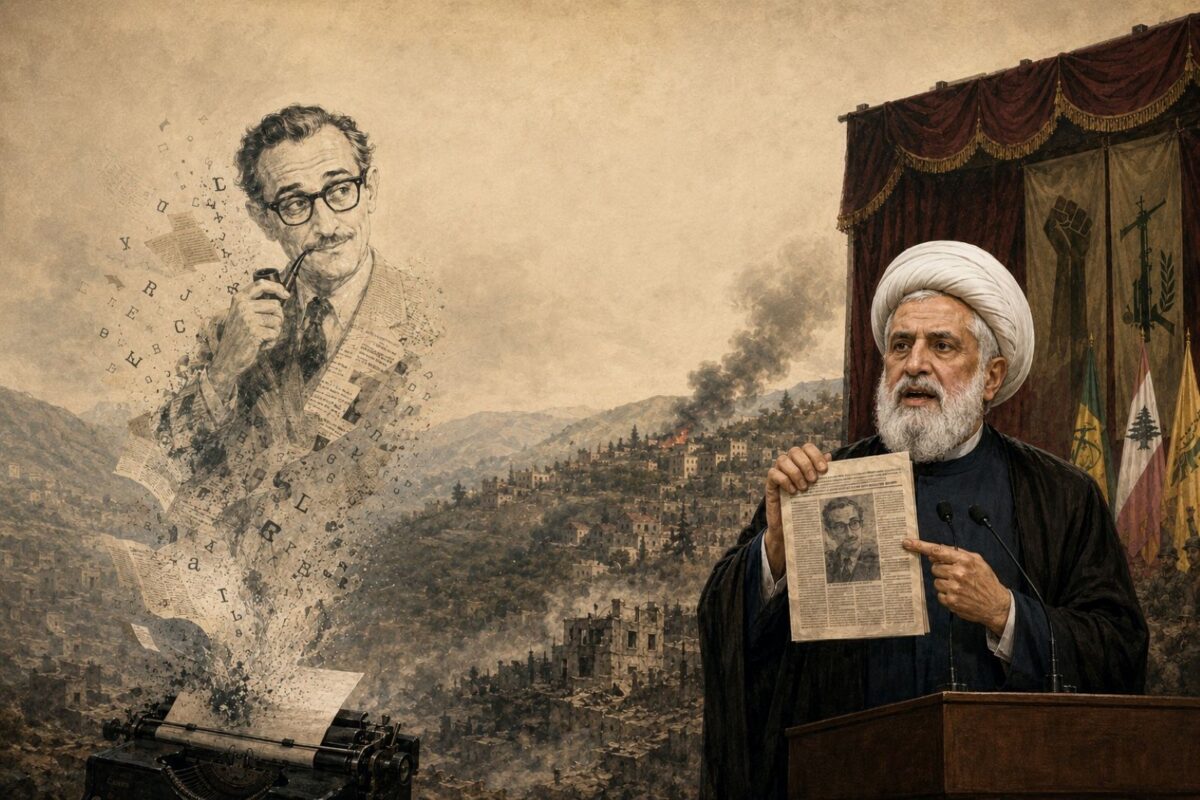
Greetings from the realm of fiction, where I have resided ever since you so generously invented me—and since your advisers apparently concluded that a “Jewish thinker” need not actually exist, provided that his words could be used to accuse the Lebanese negotiating delegation of treason.
Allow me to introduce myself. I am Moshe Yair—or Moshe Meir, or perhaps Yair Moshe—depending on which website is quoting me, how quickly the text was copied and the enthusiasm of the person doing the copying.
I write for Yedioth Ahronoth, although the newspaper appears never to have heard of me. My article cannot be found in its archives, and the Arabic text attributed to me was circulating before the date on which you claimed I had written it. But these are minor details that should not be allowed to disturb a useful narrative.
In your world, a source requires no origin, an article requires no author and a victory requires no country left standing after it.
Still, I must thank you. In the space of a single minute, you granted me a degree of fame that I could never have achieved during the lifetime I never lived. The secretary-general of Hezbollah quoted me before a public audience and read my supposed words as evidence—not because I am real, but because I am Jewish, Israeli and politically useful.
Apparently, the testimony of an enemy is more persuasive to you—even when the enemy is imaginary—than the testimony of a Lebanese citizen watching his home burn, his village being demolished and his future disappearing beneath the rubble.
Do not worry, Sheikh Naim. Your credibility and that of your party remain as solid as my biography: without an origin, without evidence and without a witness other than the person who invented it and then chose to believe it.
Do not worry, Sheikh Naim. Your credibility and that of your party remain as solid as my biography: without an origin, without evidence and without a witness other than the person who invented it and then chose to believe it.
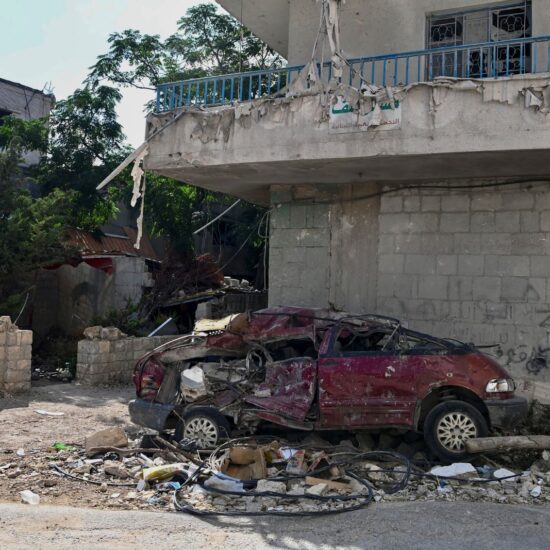
The most beautiful feature of this episode is that you quoted me during a speech commemorating what you continue to call the “Divine Victory.” I cannot imagine a more appropriate stage for my first public appearance: a victory that requires an imaginary character to explain its meaning while the real South burns, its villages are destroyed, its inhabitants are displaced and the banners of triumph are raised over land to which many of its people can no longer return.
There is a certain dark elegance to the spectacle. You celebrate a victory achieved twenty years ago while the destruction of everything that victory supposedly protected continues in the present. You speak of the July War as though it were the Battle of Badr, while the people of southern Lebanon experience every new July as another appointment with displacement, death and the endless wait for reconstruction.
The “Divine Victory” has survived intact in speeches. The homes, livelihoods and villages of the South appear not to have enjoyed the same divine protection.
You have, however, given us an innovative definition of victory: the leader remains while the people disappear; the weapon survives while the land burns; and the podium is rebuilt before the house.
If anyone asks what Lebanon gained, the answer is ready: the resistance was victorious. If he then asks where this victory can be seen, you can always point to the smoke. Smoke, like my alleged article, is open to interpretation.
Even more impressive is the logic by which you condemned the Lebanese delegation for serving Israel. Your evidence was an Israeli article that was not written by an Israeli, published after an agreement that had not yet been signed.
This must be an advanced form of psychological warfare: you invent an Israeli writer, attribute words to him, become outraged by those words and then use them as proof that your Lebanese opponents are traitors.
This must be an advanced form of psychological warfare: you invent an Israeli writer, attribute words to him, become outraged by those words and then use them as proof that your Lebanese opponents are traitors.
I must confess that we in Israel have not yet reached this level of genius. We still generally require a writer before publishing an article.
Perhaps I should also thank you for demonstrating that Hezbollah’s relationship with the truth resembles its relationship with the Lebanese state: you summon it when it serves you and disregard its existence when it stands in your way. For you, truth is merely another “support front.” It enters the battle on your orders and retreats when its cost becomes embarrassing.
Please do not apologize for the mistake. That could open a dangerous precedent.
If you begin by verifying the existence of Moshe Yair, people may eventually demand that you verify the “Divine Victory” itself. They may ask about the usefulness of the weapons, the fate of the villages and the reasons why southern Lebanon has been transformed into a seasonal crematorium above which candles are lit in celebration of Hezbollah’s heroism.
They may even ask the most dangerous question of all: what exactly has the resistance protected?
Not Lebanon’s sovereignty, which Hezbollah has repeatedly violated. Not the Lebanese state, whose authority the party has systematically undermined. Not the people of the South, who continue to pay with their homes, their livelihoods and their lives. Not even the land, which is now scarred, occupied and emptied of many of its inhabitants.
What has been protected, with extraordinary consistency, is the weapon itself—and the political order built around it.
This is why my fictional existence is more than a comic incident. It reveals the intellectual machinery of Hezbollah’s propaganda. Facts are not examined; they are recruited. Sources are not verified; they are weaponized. And when reality becomes inconvenient, an imaginary Israeli can be summoned to discipline real Lebanese citizens.
The enemy must always be present, even if Hezbollah has to invent him. Without the enemy, the party would have to answer for its own choices. Without perpetual confrontation, it would have to explain why its weapons remain beyond the authority of the state. And without the mythology of victory, it would have to confront the ruins produced by its victories.
The enemy must always be present, even if Hezbollah has to invent him. Without the enemy, the party would have to answer for its own choices. Without perpetual confrontation, it would have to explain why its weapons remain beyond the authority of the state. And without the mythology of victory, it would have to confront the ruins produced by its victories.
So I understand why you needed me, Sheikh Naim. You did not quote Moshe Yair because you believed he existed. You quoted him because Hezbollah’s political project increasingly depends upon things that do not exist: an unbroken chain of victories, a deterrence that somehow produces devastation, a sovereignty defended by violating sovereignty and a resistance that claims to protect people while demanding that people be sacrificed to protect it.
In this sense, I may be the most authentic Hezbollah intellectual ever created. I am imaginary, but politically indispensable.
In this sense, I may be the most authentic Hezbollah intellectual ever created. I am imaginary, but politically indispensable.
Let me conclude by proposing that we meet for coffee one day—perhaps in Tel Aviv, since you seem eager to bring Israelis into your speeches whenever your arguments fail you.
Should you be unable to attend, I can always come looking for you in one of the underground bunkers. As a fictional character, I possess a rare privilege: I can enter places that the truth finds difficult to reach.
Yours sincerely,
Moshe Yair
Jewish thinker and columnist for a newspaper that has never heard of him
This article originally appeared in Elaph.
Makram Rabah is the managing editor at Now Lebanon and an Assistant Professor at the American University of Beirut, Department of History. His book Conflict on Mount Lebanon: The Druze, the Maronites and Collective Memory (Edinburgh University Press) covers collective identities and the Lebanese Civil War. He tweets at @makramrabah