This year Lebanon celebrates its eighty-third year of independence in the midst of a crisis that threatens its very statehood. Beyond the folkloric flag-waving and the ill-fitting association with the military, an army that was only instituted in 1945, what actually happened in 1943? What are we celebrating, and what brought the French mandate to an end? Answering these questions means retelling the forgotten story of independence.
That story begins with the Second World War. Lebanon had become a state in 1920 and a republic in 1926, both under the French mandate, when the war that broke out in 1939 reached the Levant. In 1940 Nazi Germany defeated and occupied France, and the Vichy regime, allied with Berlin, extended its rule over Lebanon and Syria. Vichy and the Nazis used both countries as a base to support the anti-British al-Kaylani revolt and coup in Iraq, threatening the two pillars of British strategy in the Middle East: the Iraqi oil fields and the Suez Canal. Britain answered first with a blockade of Lebanon and Syria, then in 1941 with Operation Exporter, a campaign by British and Free French forces against the Vichy troops. Most of the soldiers who fought it were colonial forces under British high command: Australian, Indian and Senegalese.
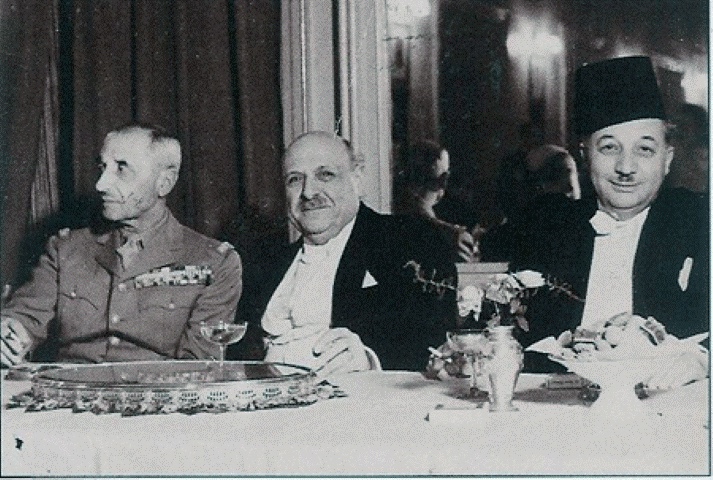
The Allied victory of 1941, commemorated by an inscription at Nahr al-Kalb, restored French authority in theory, while British troops held the ground. Lebanon’s economy was now tied to the Middle East Supply Centre and the sterling zone, and the country produced goods for the Allied armies. As France weakened, the Lebanese elites set out to free themselves from its control. On 26 November 1941, under pressure from the Lebanese and from Britain’s General Spears, General Catroux proclaimed Lebanon’s independence in the name of Free France, on condition that a treaty modelled on that of 1936 be signed. The declaration brought international recognition, diplomatic relations and ministries of Defence and Foreign Affairs. The opposition led by Bechara el-Khoury and Riad el-Solh nonetheless called it fake as long as the Constitution remained suspended.
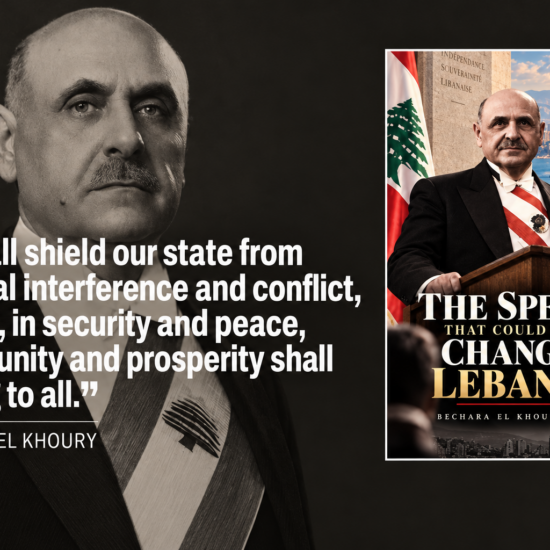
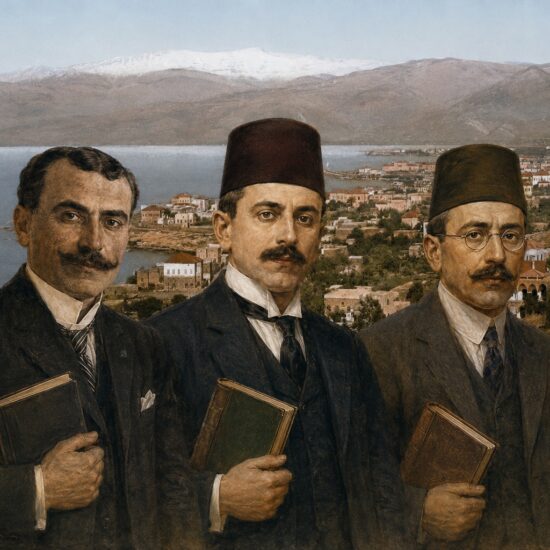
That demand needed a political foundation. Between 1941 and 1943, Khoury and Solh sealed the National Pact, an unwritten agreement between the two men by which Christians renounced Western intervention and Muslims renounced Arab or Syrian unity, making Lebanon a sovereign and neutral state governed through sectarian balance. The road to power opened in March 1943, when Catroux dismissed President Alfred Naccache, who had objected to his attempt to bring back the old parliament, and restored the Constitution. After two amendments to the electoral law, the Chamber was set at 55 seats. The elections that followed carried the opposition to power, and on 21 September 1943 Bechara el-Khoury became President, promising an independent Lebanon “open to the world… at the service of international life”.
This year Lebanon celebrates its eighty-third year of independence in the midst of a crisis that threatens its very statehood. Beyond the folkloric flag-waving and the ill-fitting association with the military, an army that was only instituted in 1945, what actually happened in 1943?
Khoury entrusted Riad el-Solh with forming the independence government, whose composition reflected the sectarian balance: Solh himself for the Sunnis, Camille Chamoun for the Maronites, Habib Abou Chahla for the Greek Orthodox, Selim Takla for the Greek Catholics, Adel Osseiran for the Shiites and Majid Arslan for the Druze. In his ministerial statement of 7 October 1943, Riad el-Solh announced:
“We want this independence to be a genuine independence, and we want our national sovereignty to be complete, disposing of our resources as we wish and as our national interest alone requires’.
The government then translated these words into a series of acts that defied French mandate authorities. It omitted the customary visit to the High Commissioner, treating him as France’s ambassador and the Delegation as an embassy like any other. It decreed that Arabic alone would be the official language of government departments, a decision that paralysed the work of the French advisers. It demanded that France hand over the Common Interests (Customs, railroads, ports…) , a request the French government refused on the grounds that these shared interests required an agreement with the Syrians. It refused to sign a treaty with France along the lines of the 1936 treaty. Above all, it prepared a bill amending the Constitution to end the mandate, and this step precipitated the crisis.
The French Delegate General, Jean Helleu, travelled to Algiers, seat of the government of Free France, to consult General de Gaulle. The decisions taken there were published on the morning of 5 November 1943 in a statement known as the Communiqué of 5 November:
“The French authorities cannot recognise the legitimacy of any (constitutional) amendment made without their consent”.
The Lebanese government responded the same afternoon. Meeting in an emergency session, it declared that amending the Constitution was a right belonging to the constitutional authorities of Lebanon, referred the bill to Parliament and asked the Chamber to convene at the earliest possible opportunity.
Parliament was summoned to meet on 8 November 1943. Helleu cut short a visit to Cairo and returned to Beirut, sending the Lebanese government a memorandum that requested a postponement of the session, asked that he be spared a fait accompli, and warned that he would “retain full freedom to assess matters and to act”.The government’s reply was immediate:
“The government expresses its regret to the Delegate General at the impossibility of meeting his wish, and considers that discussion of the matter must be closed”.
The mandate authorities then tried to prevent the session by breaking its quorum, without success. The Chamber met and unanimously adopted the amendments, abolishing the constitutional articles relating to the mandate, the mandatory power and the League of Nations, and declaring Arabic the sole official language of the country. The President of the Republic signed the amendment at once, and its publication in the Official Gazette the following day brought it into force.
A little-known detail adds to the drama of the moment. The minutes of this historic session were hidden inside the statue of the Virgin Mary in the Capuchin Cathedral in the heart of Beirut, the church of the Latin parish where the officials of the mandate themselves attended Mass, and the last place any French official would think to search.
The French reaction opened the eleven days that would end on 22 November. Helleu announced the suspension of the Constitution, the annulment of the constitutional amendment and the dissolution of Parliament, and he cancelled the Armistice Day celebrations of 11 November. He appointed Émile Eddé President of the Republic, assisted by a government of directors, and ordered the arrest of the President of the Republic, the Prime Minister and the ministers Adel Osseiran, Selim Takla and Camille Chamoun, together with Abdel Hamid Karami, deputy for Tripoli. All were imprisoned in the citadel of Rashaya. On 12 November the front page of Lisan al-Hal carried Helleu’s appeal to the Lebanese alongside Eddé’s statements asking the people to remain calm. Eddé, however, proved unable to form a government.
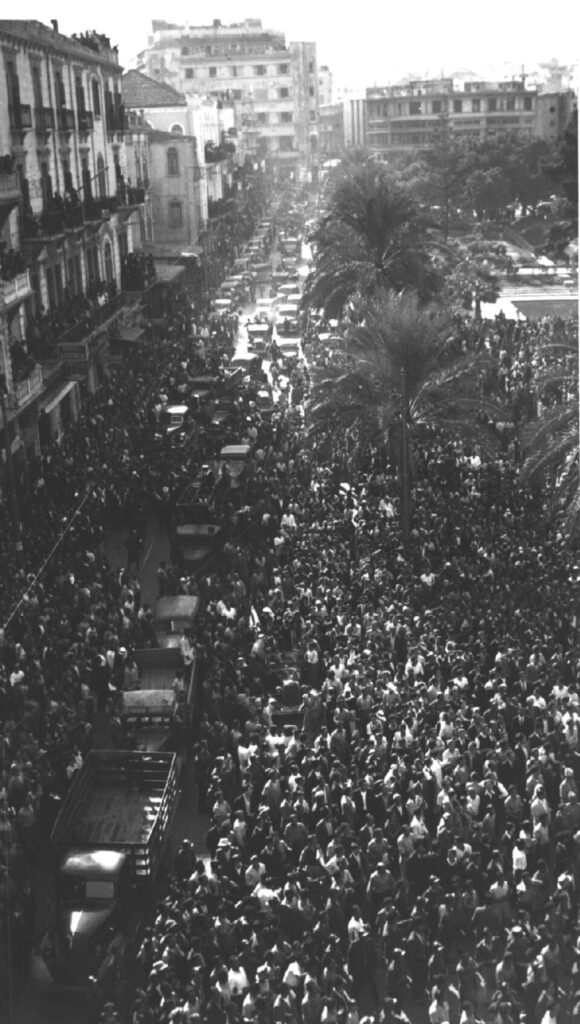
Beirut’s Martyrs’ Square during celebrations marking the French government releasing the Lebanon political leaders from Rashayya prison on November 22.
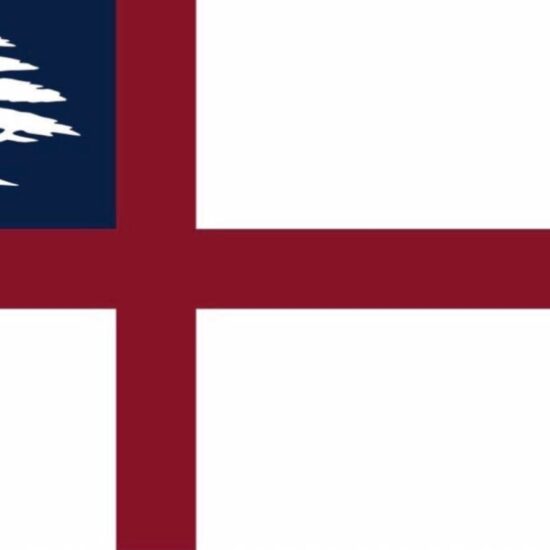
The Lebanese response was swift. On the morning of 11 November, the two ministers who had escaped arrest, Habib Abou Chahla and Majid Arslan, met the Speaker, Sabri Hamadeh, at the house of the President of the Republic and decided to form a government to take the place of the President and the cabinet. The deputies were called to a parliamentary session, yet only Hamadeh and six deputies managed to reach the Chamber. Given the exceptional circumstances, those present considered the quorum legal. They addressed a petition of protest to the representatives of the Great Powers and the independent Arab states, and they changed the Lebanese flag to its present design, replacing the mandate flag that set the cedar on the French tricolour. The deputies then met at the house of Saeb Salam, where a parliamentary majority granted its confidence to the government of Abou Chahla and Arslan.
To escape French pursuit, this government moved to the village of Bchamoun, which gave it the name by which it is remembered: the Bchamoun government. The village was surrounded by rocky terrain that kept tanks away, and the government made the house of Druze Sheikh Hussein al-Halabi its headquarters, a house since known as the “House of Independence”. From there it sent notes of protest against the actions of the French Delegation to the Arab and friendly states, instructed the director of the Banque de Syrie et du Liban to refrain from dealing with Eddé and his government, ordered civil servants to cooperate with the legitimate government alone, and formed a Guard to defend the government and its institutions.
It was at Bchamoun that the battle for independence claimed one of its martyrs, Said Fakhreddine. An official account recorded the events:
“Armed French forces attacked the seat of the legitimate government in Bchamoun on the evening of Monday 15 November 1943, and units of the National Guard repelled them without loss of life. On the morning of the following day the French forces launched a violent assault on the said position and were driven back four consecutive times until three in the afternoon. Some Senegalese soldiers were killed or wounded, and we lost one martyr, named Said Fakhreddine, from Ain Anoub”.
Meanwhile the crisis had crossed Lebanon’s borders. Arab leaders in Egypt, Iraq and Saudi Arabia voiced their displeasure with French policy and supported the Lebanese position. The United States, Britain and the Soviet Union condemned the French measures and demanded the release of the detainees. Britain’s role proved decisive: through General Spears, it delivered an ultimatum to the government of Free France, threatening military intervention should the detainees remain in prison.
Under this pressure, de Gaulle sent Catroux back to Lebanon to manage the crisis. Catroux arrived on 14 November, met the detainees in Rashaya, and recommended that they be released and restored to their posts. The government of Free France adopted his recommendation in a statement issued on 21 November 1943. The next day, 22 November, the detainees were released and travelled to Beirut amid popular demonstrations. That day was declared Independence Day, and Lebanon has celebrated it every year since.
Until we restore this full story, Lebanon will be left with a thin, kitsch folklore that has sadly come to stand in for historical understanding and public memory.
Contrary to popular belief, 1943 marked only the beginning of independence. Long negotiations and diplomatic efforts, at times conducted jointly by Lebanon, Syria and France, gradually brought the French mandate to an end in 1946. Independence came in phases: a relative political independence in 1943, financial independence through control of state revenue in 1944, a national army in 1945, and finally the evacuation of British and French troops in 1946.
Yet this account, as it is usually told, remains incomplete. It overlooks an essential actor in the eleven days that produced November 22: the citizens. How did they experience those days? What did they make of them? How did they actually take part, beyond the folkloric mentions in our textbooks? And how did they live the complexity of a Lebanese nationality that was now independent yet still taking shape? Until we restore this full story, Lebanon will be left with a thin, kitsch folklore that has sadly come to stand in for historical understanding and public memory.
Charles al-Hayek is a public historian and the founder of Heritage and Roots.
The views in this story reflect those of the author alone and do not necessarily reflect the beliefs of NOW.