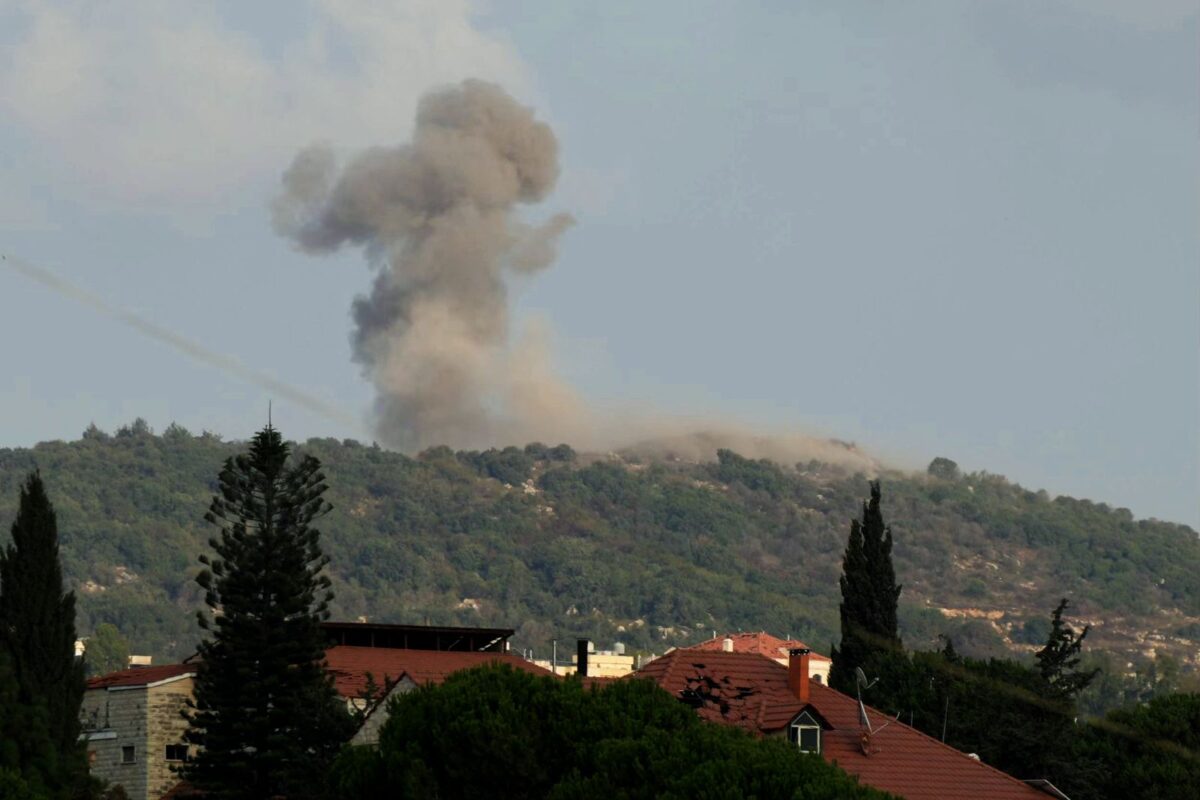
Nabatieh, Lebanon. Photo by - / AFP. A photograph taken from the southern Lebanese area of Nabatieh shows smoke as it rises from the site of Israeli strikes that targeted the hilltops of the mountainous area of the strategic Ali al-Taher Ridge on August 14, 2026.
The capture of Ali al-Taher was never simply about a hill.
For Hezbollah, the ridge was a fortified military position and part of a broader defensive architecture. For Israel, it was a commanding piece of terrain overlooking Nabatieh and a gateway into the geography Hezbollah has spent decades building into a military stronghold. But the significance of Ali al-Taher has now moved beyond the battlefield.
The question is no longer simply whether Hezbollah can hold the ridge.
It is whether Israel’s campaign is gradually producing a new political and geographic reality inside Lebanon, one in which Hezbollah is weakened, the Lebanese state is pressured, and territory increasingly becomes a bargaining instrument in negotiations over Lebanon’s future.
That is the more consequential story emerging from Ali al-Taher.
From Hezbollah’s position to Lebanon’s geography
Israel announced in early September that it had established operational control over Ali al-Taher and neutralized Hezbollah’s underground infrastructure beneath the ridge. Israeli officials described the capture as the completion of their control over the security zone in southern Lebanon. The claim came after weeks of fighting around the heights, which overlook Nabatieh and several key roads and settlements.
The military value of the ridge is clear.
Its elevation provides observation and fire-control advantages, while the underground network beneath it reportedly included command facilities, weapons storage areas, living quarters and other infrastructure. Its loss therefore represents a genuine operational setback for Hezbollah, even if it does not by itself threaten the survival of the organization.
But the larger significance lies elsewhere.
Ali al-Taher sits north of the Litani River, the very area where the dispute over Hezbollah’s weapons, Lebanese sovereignty and Israeli withdrawal becomes most politically sensitive.
That is why the hill became a test not only of military power, but of who ultimately controls the post-war map of Lebanon.
The state caught between two powers
The Lebanese Army was reportedly offered as an alternative mechanism for taking control of Ali al-Taher. Hezbollah rejected the proposition.
That refusal is strategically understandable from the party’s perspective.
Handing the position to the Lebanese state would not merely mean losing a military installation. It would reinforce the principle that territory vacated by Hezbollah should automatically revert to exclusive state control.
That principle lies at the heart of the broader disarmament debate.
But Israel’s subsequent seizure of the ridge produces a radically different outcome.
Instead of the Lebanese Army inheriting a position previously controlled by Hezbollah, Israel controls the terrain.
The distinction is enormous.
For Hezbollah, an Israeli takeover can be presented as occupation and therefore as evidence that its military role remains necessary. A transfer to the Lebanese Army would strengthen the opposite argument: that Lebanese institutions can assume responsibility for security without Hezbollah’s independent military infrastructure.
This may explain why the party can regard territorial loss as preferable to institutional displacement.
But there is a paradox.
The more territory Israel controls, the more Lebanon’s sovereignty is weakened, and the more difficult it becomes for Beirut to establish the very state authority that Israel says it wants to see strengthened.
The target is moving
This is where the developments around Nabatieh become critical.
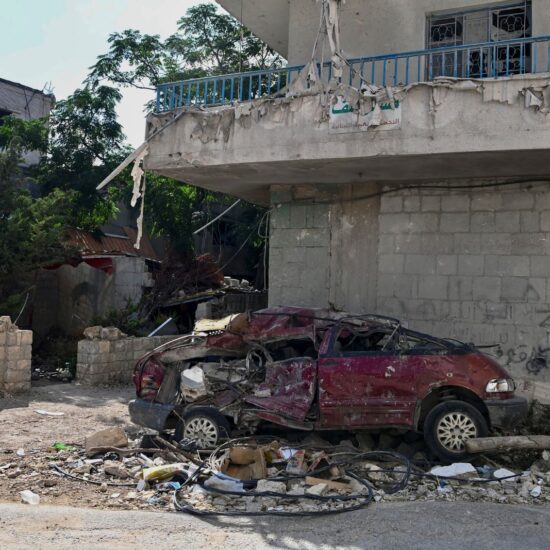
In recent days, Israeli strikes have expanded beyond the immediate battlefield around Ali al-Taher. Nabatieh and surrounding communities have come under intense pressure, with strikes hitting areas north of the ridge and, according to Lebanese authorities and international reporting, civilian infrastructure including a hospital building and a Ministry of Finance facility. Israel says some of these locations were being used by Hezbollah: those claims have not always been independently verified.
Whatever the justification for individual strikes, the geographic pattern matters.
Nabatieh is not a peripheral village on the edge of the battlefield.
It is one of the principal urban, economic and administrative centers of southern Lebanon.
A campaign that progressively destabilizes the area therefore affects more than Hezbollah’s military infrastructure. It affects roads, commerce, municipal administration, public services and the ability of civilians to remain in their communities.
That changes the nature of the conflict.
A campaign initially presented as an effort to remove Hezbollah’s military threat can, through cumulative territorial pressure, begin to reshape the conditions under which Lebanon itself functions.
Lebanon’s sovereignty is becoming the battlefield
This is the strategic contradiction at the heart of the current moment.
Israel says that its military presence is necessary because Hezbollah must be prevented from rebuilding its capabilities.
Lebanon says that Israeli forces must withdraw and that the Lebanese Army must become the sole authority responsible for security.
Hezbollah argues that Israeli military pressure proves that disarmament cannot be separated from guarantees against continued Israeli attacks.
All three positions contain an element of strategic logic.
But they are fundamentally incompatible.
The result is a dangerous vacuum.
Israel creates facts on the ground in the name of security. Hezbollah retains an armed structure in the name of resistance. And the Lebanese state is left attempting to negotiate sovereignty that neither side is prepared to fully entrust to it.
The June framework was supposed to reverse this dynamic: Israeli withdrawal, Hezbollah’s disarmament and the gradual restoration of exclusive Lebanese state authority. Instead, implementation has stalled while military pressure has continued.
That is why the latest developments should concern Beirut far beyond the question of Hezbollah.
The Iranian dimension
Iran remains central to understanding Hezbollah’s calculations, but the Iranian role should not be reduced to the question of individual advisers or fighters.
There is insufficient public evidence to establish that Ali al-Taher’s evacuation resulted from a specific Iranian agreement to extract personnel. Hezbollah representatives have also denied the presence of Iranian advisers at the position.
The broader strategic calculation, however, is easier to identify.
Iran’s interest is not necessarily the preservation of every individual Hezbollah position. Its interest is the preservation of Hezbollah as a functioning strategic asset: politically embedded in Lebanon, militarily capable of regeneration and sufficiently autonomous to retain deterrent value.
That means Hezbollah can potentially afford to lose exposed terrain if its wider military and political architecture survives.
Israel, by contrast, has an incentive to ensure that the loss of terrain becomes the loss of infrastructure, and eventually the loss of Hezbollah’s ability to regenerate.
Lebanon is where these two strategies collide.
The danger of a new map
The greatest risk is not that Ali al-Taher becomes permanently Israeli.
The greater risk is that a temporary military reality becomes the foundation for a permanent political reality.
Once a security zone expands, roads are controlled, homes are demolished, populations are displaced and military infrastructure is established, the cost of reversing those facts increases.
Recent reporting indicates that Israel has continued operations beyond the immediate occupation zone while simultaneously signaling that its military presence is tied to Hezbollah’s disarmament.
This creates a potential cycle:
Hezbollah’s continued armed presence justifies Israeli military pressure.
Hezbollah’s continued armed presence justifies Israeli military pressure.
Israeli military pressure strengthens Hezbollah’s argument that resistance remains necessary.
The resulting instability weakens the Lebanese state’s authority.
A weaker Lebanese state becomes less capable of implementing the very framework intended to end the conflict.
That is the trap.
And Lebanon, not Hezbollah alone, is caught inside it.
The real strategic objective
The battle over Ali al-Taher therefore marks a transition.
The immediate target may have been Hezbollah’s military infrastructure.
The next target may be the political environment that allows that infrastructure to survive.
And the ultimate arena is Lebanon itself.
This does not necessarily mean that Israel has adopted a formal objective of occupying or controlling Lebanon as a whole. There is no evidence to support such a sweeping conclusion.
But strategy does not require a declared objective to produce a consequence.
A sustained campaign that destroys infrastructure, displaces communities, fragments territorial control and weakens state institutions can reshape a country even without a plan to formally govern it.
That is precisely why Beirut should be looking beyond the battlefield.
The central Lebanese question is no longer simply whether Hezbollah will retain its weapons, or whether Israel will withdraw from the south.
It is whether Lebanon will remain capable of determining its own security architecture.
If Israel continues to transform military gains into territorial leverage, and Hezbollah continues to preserve an autonomous military structure outside the state’s exclusive command, Lebanon risks becoming the space in which two competing security doctrines are permanently negotiated through force.
Ali al-Taher was the hill where that process became visible.
Nabatieh is where its consequences are now becoming harder to ignore.
The target may have begun as Hezbollah. But the battlefield is increasingly Lebanon, and the prize is the country’s sovereignty.
The target may have begun as Hezbollah. But the battlefield is increasingly Lebanon, and the prize is the country’s sovereignty.
Ibrahim Rihan is a Lebanese journalist and writer focusing on Arab and international affairs. He is particularly interested in U.S., Saudi, and Egyptian policies in the Middle East.
The views in this story reflect those of the author alone and do not necessarily reflect the beliefs of NOW.