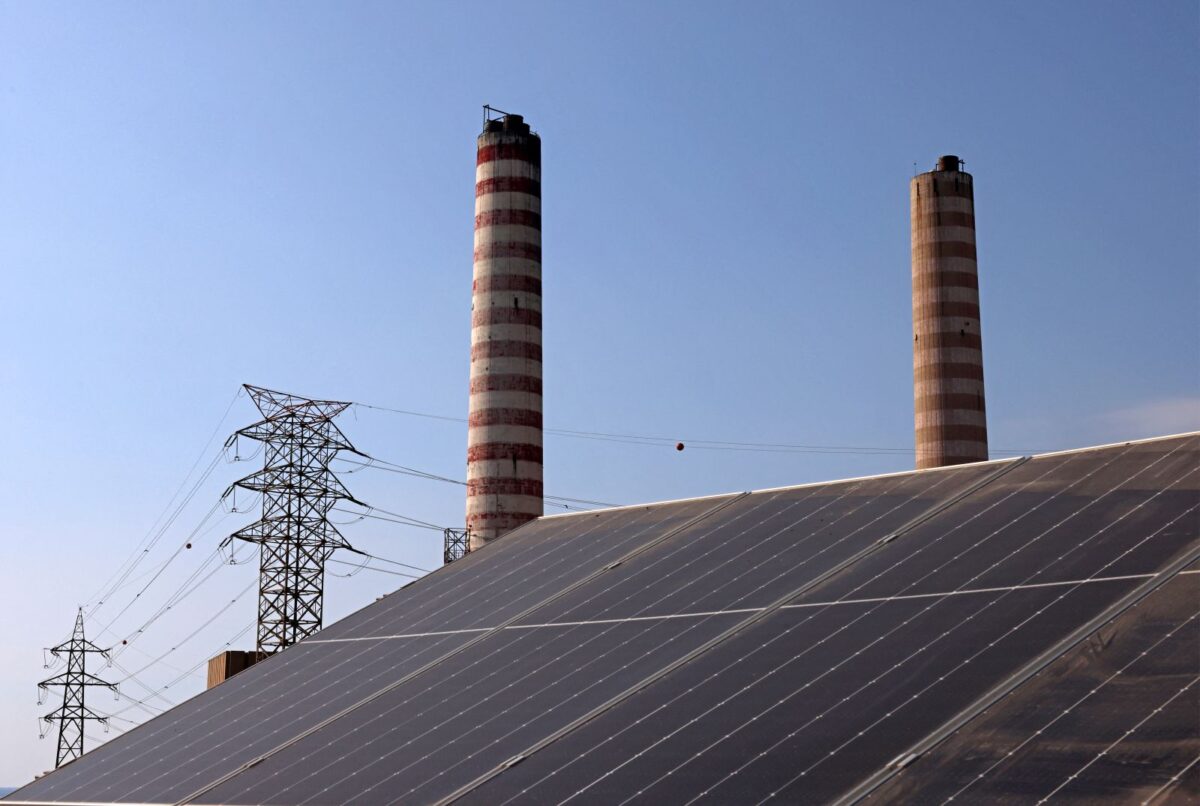
Photo by JOSEPH EID / AFP. Solar panels are installed on a rooftop near the red-and-white chimneys of a power plant in the industrial district of Zouk Mikael, where residents believe they are more likely to develop cancer than elsewhere in the country because of air pollution, north of Lebanon's capital Beirut on October 10, 2022.
Lebanon still debates decentralised electricity as if it were a choice about the future. However, for more than three decades the country has been decentralising electricity out of necessity, and today it is almost the only model that works. The problem is that it has taken the least efficient and least equitable forms possible: private diesel generators and disorganised household solar photovoltaic systems.
These systems have powered households and businesses and kept them running through years of near-total blackout from the national grid. But consumers turned to them in response to policy and institutional failure, not as part of any vision or action plan. The result is disorganized and costly decentralization. Consumers have been forced to procure their own alternative electricity supply, paying separate bills to the national utility -Électricité du Liban- and private diesel generator operators while also financing solar panels, batteries, and inverters themselves.
Lebanon now needs to move from this fragmented survival model to organized local hybrid mini-grid systems.
Lebanon now needs to move from this fragmented survival model to organized local hybrid mini-grid systems. A hybrid mini-grid is simply a managed electricity system serving a community, such as a village or an industrial zone. It combines solar photovoltaic generation, battery storage, diesel backup and EDL supply -when available-, and delivers it through a shared distribution network with proper meters, clear tariffs, and a company responsible for running and maintaining it.
Qabrikha was a decade ahead of its time
The concept is not new to Lebanon. In 2014, UNDP’s CEDRO project, funded by the EU, built Lebanon’s first community solar system in Qabrikha, in the south. It became the basis for the Village 24 initiative, a framework for supplying Lebanese villages with electricity from a centralized renewable system tied into the available national and local networks.
Qabrikha deployed 250 kilowatts-peak (kWp) of solar paired with the municipal generator network and smart meters, feeding approximately 120 households. The mini-grid resulted in savings of approximately $40,000 per year. An agreement with EDL was meant to introduce community net-metering for these households, so that surplus solar production could be credited across multiple electricity bills.
That concept was ahead of its time. It revealed the obstacle that still constrains efficient decentralised electricity in Lebanon: public institutions never picked these models up and scaled them.
Three models, one clear winner
Since then, three models have emerged: 1) community-owned, 2) municipality-managed, and 3) private-developer-led. These models have moved mini-grids from the pilot phase to commercially viable, replicable models.
They have also exposed where the weaknesses lie. Community- and municipally managed systems place an additional burden on already overstretched municipalities and often require non-specialists to manage, operate, and maintain complex technical infrastructure, which can eventually compromise service quality. Of the three, the private-developer model has the strongest record on technical standards, reliability, quality of service and consumer protection, and offers the most sustainable path to scale.
Bcheeleh: The model that pays for itself
A flagship private model implemented by ME Green in Bcheeleh shows how far the concept has come from donor-funded pilots. ME Green’s model is built to deliver affordable and reliable electricity to the village while still returning profit to investors, which is what makes it replicable. The Bcheelehmini-grid supplies around 150 households with approximately 250 kWh each per month. Diesel generators account for only around 5% of total electricity supply, significantly reducing the village’s exposure to fuel costs, air pollution, and generator noise.
At standard consumption, a household pays $30 a month -including a $10 subscription fee- for 250 kWh and can draw more power if needed.
At standard consumption, a household pays $30 a month -including a $10 subscription fee- for 250 kWh and can draw more power if needed. The same volume would cost approximately $50 under EDL’s tiered electricity tariff and $135 at the official private-generator tariff. That translates into savings of around 41% compared with EDL and 77% compared with diesel generation, without accounting for additional subscription and fixed fees, or the fact that generator tariffs across Lebanon often exceed the official rate.
Across 150 households, the model could collectively save approximately $36,900 annually relative to EDL and $189,000 relative to diesel generators. Just as important, a system like this can be built in three to six months, instead of the multi-year timeframe for a conventional generation project.
Beyond the bill: better air quality, fairer access, smarter demand
The case for mini-grids goes beyond cost. These systems provide improved air quality and health from reduced diesel use. Moreover, Lebanon’s rooftop solar boom has largely worked for those who own suitable roof space and could afford the upfront cost, creating a new inequity in access to electricity. Mini-grids spread access across a whole community, reduce costs through economies of scale, and provide long-term maintenance and operation to consumers.
Mini-grids can also assist in managing demand. Consumers can monitor their actual consumption and be notified as they approach their allowance, which encourages more efficient use. Productive consumers, including farms, workshops and small businesses, can provide daytime demand for solar electricity and strengthen project economics.
Mini-grids can also assist in managing demand. Consumers can monitor their actual consumption and be notified as they approach their allowance, which encourages more efficient use. Productive consumers, including farms, workshops and small businesses, can provide daytime demand for solar electricity and strengthen project economics.
The market still needs a utility
The technology is commercially viable, yet Lebanon’s market realities of weak accountability and oversight remain unchanged. A promising sector can easily attract developers with no track record, and low-quality, cheap equipment and installations. Consumers would carry the cost. Any system worth building must be designed for the long term, with effective battery storage, efficient use of the solar yield and diesel backup.
None of this makes the national utility redundant. Lebanon will always need EDL for transmission, system planning, balancing and interconnection. The reduced load from villages and towns deploying mini-grids will enable higher supply to large cities such as Beirut.
From pilot to policy
Lebanon was early to prove that solar mini-grids work, but it failed to move from pilot to scale. More than a decade after Qabrikha, the technical experience, the consumer demand and the business models are all in place. The government has a clear choice: continuing with unmanaged decentralisation and costly diesel generators, or providing incentives and support for mini-grids to serve the public interest.
The models already exist. Lebanon must now deploy them: professionally, sustainably, and at scale.
Jessica Obeid is the Founding Partner of New Energy Consult, a Dubai-based consultancy, and an electrical engineer and strategist with nearly two decades of international experience across the power sector value chain. She holds board and senior advisory roles across the public and private sectors and international institutions.
The views in this story reflect those of the author alone and do not necessarily reflect the beliefs of NOW.