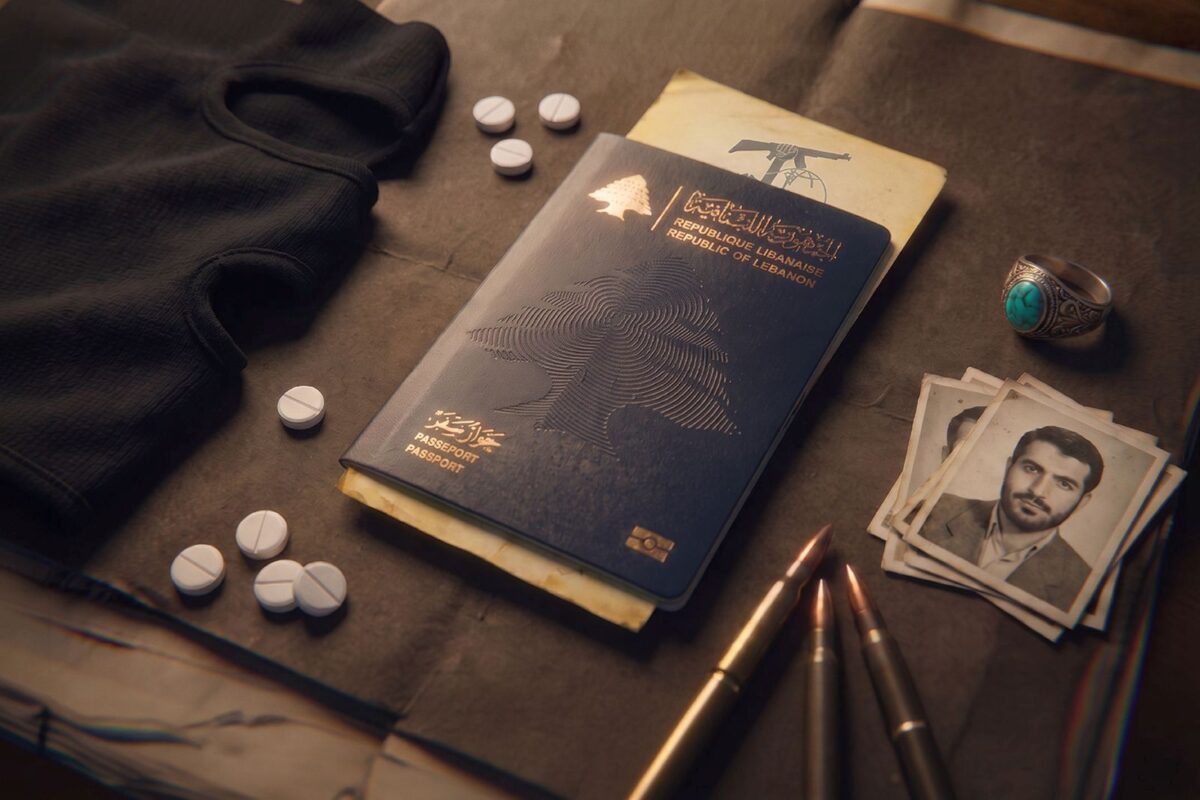
Drawing on regional reporting, interviews, court documents, and insider accounts, this report traces how forged and fraudulently obtained identities, allegedly linked to Hezbollah, the Islamic Revolutionary Guard Corps (IRGC), and wider transnational networks, stretched from Beirut to Syria, Egypt, and Latin America, turning passports into instruments of concealment, covert movement, and geopolitical survival.
How Lebanon’s passport crisis opened the door to covert networks
In recent years, Lebanon has increasingly found itself at the intersection of regional conflict, intelligence operations, and illicit cross-border networks. Beyond the visible political and military confrontations dominating headlines, another quieter and more dangerous battlefield has emerged: the manipulation of identity itself through forged passports, recycled records, and alternative identities.
Reports of forged passports, false identities, unregulated hotel registrations, and covert travel routes have resurfaced repeatedly amid the recent wars between Israel and Hezbollah. Lebanese media investigations, intelligence assessments, court rulings, and international research institutions have all pointed to the growing use of forged or fraudulently obtained documents by organized criminal networks, smugglers, and individuals allegedly linked to armed groups and regional actors.
The issue gained renewed attention following Israeli strikes targeting figures reportedly tied to the IRGC and its Quds Force inside Lebanon. Questions quickly emerged over how foreign-linked operatives were allegedly able to move across borders, register in hotels, rent apartments, and operate discreetly inside a country already struggling with institutional collapse and weakened oversight.
At the same time, investigations into the escape routes of former Syrian regime figures following the fall of Bashar al-Assad have further highlighted Lebanon’s role as a transit corridor for covert movement and forged identities. The issue extends far beyond Lebanon itself, touching networks that reportedly stretch into Syria, Iraq, Europe, West Africa, and Latin America.
While many allegations remain politically contested and difficult to verify independently, the broader pattern reflects a dangerous convergence of regional conflict, corruption, organized crime, and fragile state institutions.
In modern conflict zones, passports are no longer simply documents of citizenship. They have become operational tools.
The forgotten old passports
One of the most troubling questions surrounding Lebanon’s passport crisis does not begin with forged documents, but with real ones.
At the center of growing scrutiny are hundreds of older Lebanese passport booklets, specifically the pre-biometric 2003 model, which reportedly remained in storage for years instead of being destroyed after the transition to biometric systems.
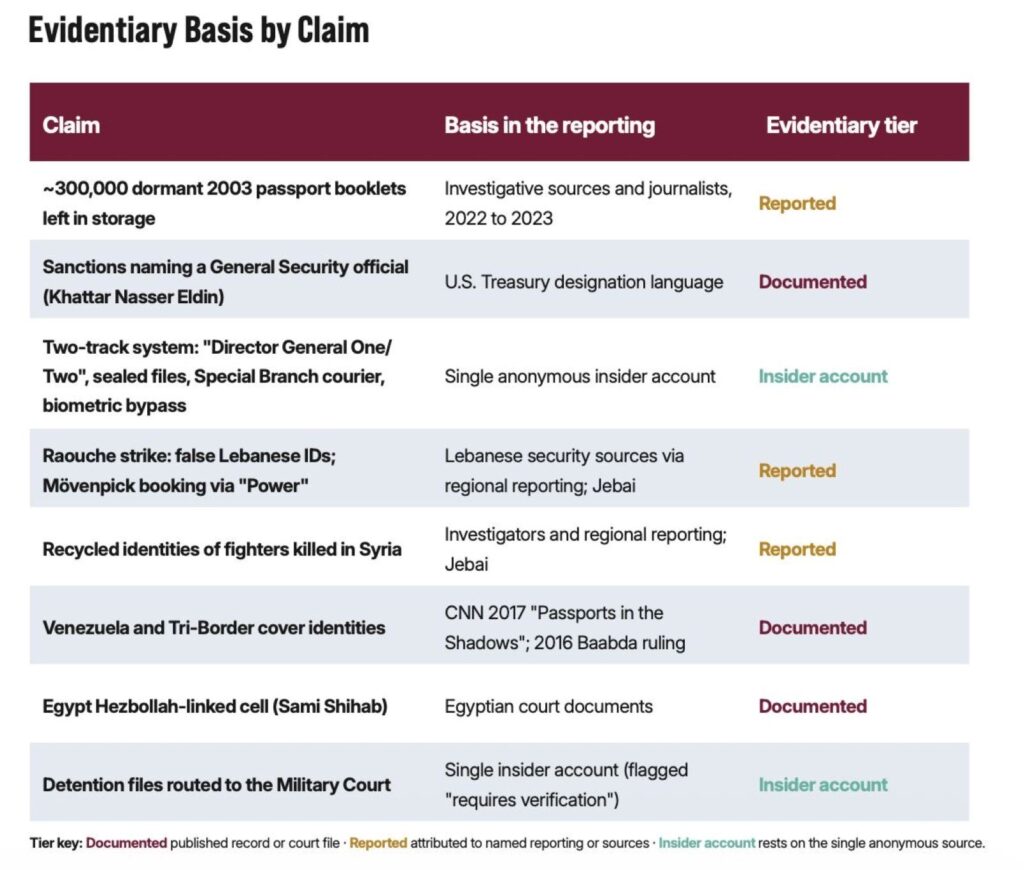
According to investigative sources and journalists who examined the issue during Lebanon’s passport crisis between 2022 and 2023, roughly 300,000 unused passport booklets allegedly remained archived inside state storage facilities long after they were meant to be withdrawn from circulation.
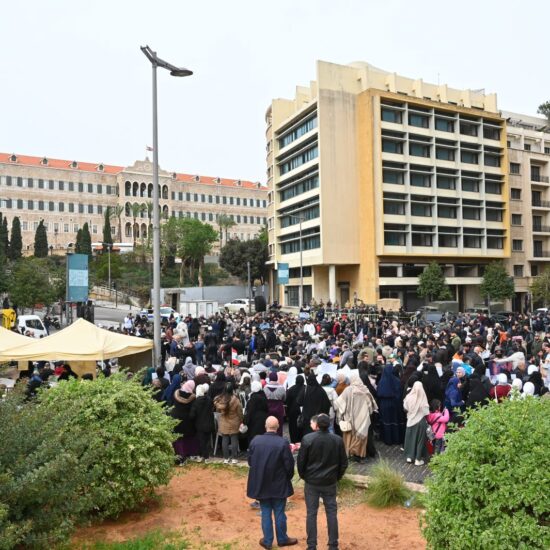
The crisis coincided with a period of severe state collapse. Long queues formed outside General Security offices as Lebanese citizens struggled to renew passports amid shortages, delays, and widespread allegations of corruption. During this period, multiple reports pointed to the continued use of the older 2003 passports despite their planned phase-out in favor of biometric alternatives.
According to Randa Jebai, an investigative correspondent at Alhurra television, the existence of the stored passports was reportedly rediscovered almost by accident.
“Why were they never destroyed?” she asked during her interview with NOW. “Who knew they existed? And why did they remain stored during such a sensitive period?”
Jebai described the overlap between the passport crisis, the post-2019 institutional collapse, and mounting regional conflict as “a massive vulnerability inside the Lebanese security system.”
She also pointed to the ease with which older passports could allegedly be obtained during the height of the crisis. While biometric passports involve stricter procedures and fingerprint registration, the older 2003 model, she argued, remained far easier to exploit through influence, corruption, or administrative shortcuts.
According to Jebai, even former officials privately acknowledged confusion surrounding the stored documents and how they resurfaced during the crisis years. The issue, she argued, was no longer simply one of administrative negligence, but of a broader failure of oversight at a time when Lebanon’s institutions were already collapsing under political and economic pressure.
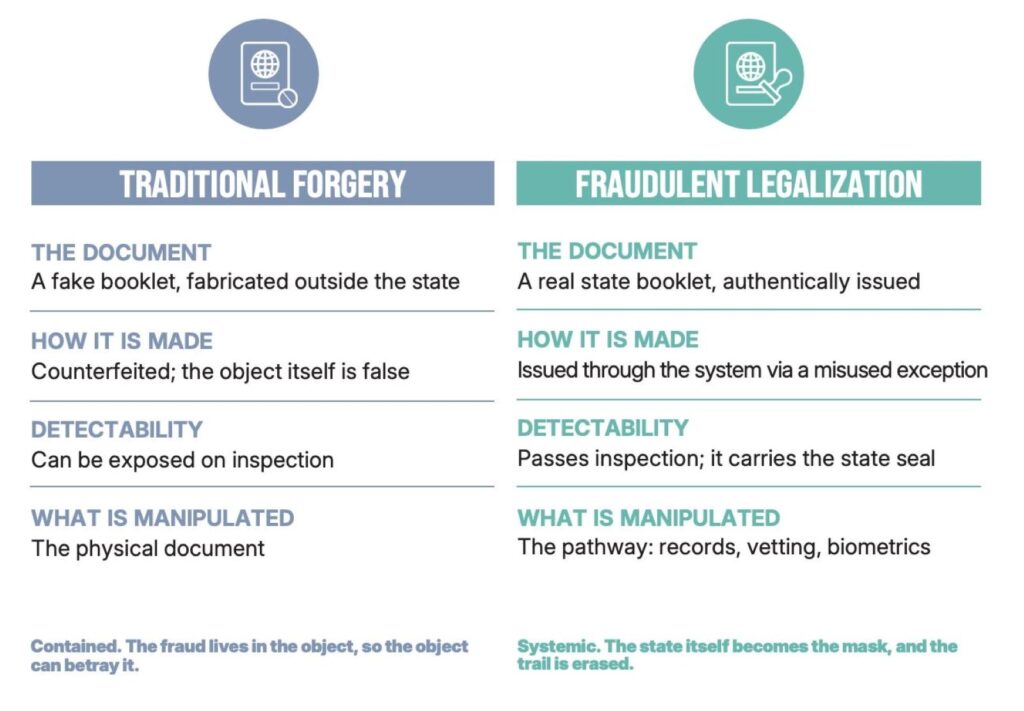
The distinction between forged documents and authentic documents obtained through manipulation is central to understanding the issue. Investigators stress that many networks do not necessarily rely on completely fake passports. In some cases, genuine passports may allegedly be issued through fraudulent civil records, bribery, manipulated identity files, or the exploitation of weak administrative systems. This distinction matters because genuine state-issued documents are far more difficult for international authorities to detect than entirely fabricated forgeries.
The controversy surrounding the dormant passports also exposed deeper questions about transparency inside Lebanon’s institutions. Investigative journalists repeatedly asked why the passports remained stored years after they were meant to be destroyed, who maintained knowledge of their existence, and whether authorities fully tracked their circulation during the crisis years. To date, few public answers have been provided.
These questions also point back to the period in which the passport crisis took shape, under the leadership of former General Security chief Abbas Ibrahim. Institutions such as General Security, State Security, the Lebanese Army, and the Internal Security Forces have historically been presented as organs of the state rather than openly partisan instruments, with their leadership expected, at least formally, to remain above direct political alignment and sectarian competition. That image, however, has become much harder to sustain. Ibrahim was long regarded as a key intermediary with Hezbollah and other regional actors, and Hezbollah itself pushed to keep him in office, facts that have only sharpened retrospective doubts about how neutral the institution truly remained during his tenure. The point is not that one can prove, in a direct or definitive way, that General Security itself was transformed into a partisan arm. It is that the combination of opacity, political proximity, and the extraordinary vulnerabilities exposed by the passport crisis makes such questions unavoidable.
Nor does the unease stop with General Security alone. Recent developments have widened the circle of concern to other security bodies that were also historically treated as non-partisan pillars of the state. The latest U.S. Treasury sanctions marked a qualitative escalation by explicitly targeting officials from within Lebanon’s security apparatus, among them General Khattar Nasser Eldin of General Security, accusing him, alongside other designated individuals, of having “materially assisted, sponsored, or provided financial, material, or technological support for, or goods or services to or in support of, Hizballah.” The implication was difficult to ignore: the concern is no longer confined to isolated individuals on the margins, but to whether elements within the security apparatus itself have become entangled, directly or indirectly, with Hezbollah and Amal’s wider political and operational agenda. Domestic controversies have only deepened that impression. In the Saqiet el-Janzir incident, State Security officer Mohammad Shreim became associated in the public debate with an operation widely criticized for relying on coercive field action rather than normal judicial procedure, reinforcing the broader perception that some officers act with a degree of impunity and political cover that sits uneasily with the traditional image of these institutions as neutral extensions of the state. None of this proves total institutional capture. But it does make the absence of answers far more troubling, because it raises broader questions about whether the boundaries separating state administration, security oversight, and partisan networks have become far more blurred than officials are willing to admit.
That backdrop gives added weight to a decision announced in the summer of 2026. On June 25, the General Directorate of General Security declared that 2003-model non-biometric passports, those whose serial numbers begin with “RL,” would no longer be valid for entry into Lebanese territory. The directorate framed the measure in strictly technical terms, citing the global adoption of biometric travel documents and the refusal of many countries to accept the older booklets under standards set by the International Civil Aviation Organization. It called on all holders of the 2003 model to apply at its regional offices for biometric replacements, and set October 1, 2026 as the date after which the old passports would be discontinued for use inside the country and could no longer be used to leave it.
Read against everything that precedes it, the decision is more than bureaucratic housekeeping. The 2003 booklet is the same document investigators describe as the softer target: the model without fingerprints or biometric anchoring that could allegedly be obtained through influence, run through the biometric bypass, or attached to identities the system could never afterward verify. To retire it, and to push the entire passport-holding population onto a biometric standard, is to close, at least on paper, the very loophole through which the shadow system is said to have operated. In that sense the move can be read as an effort by the state to reclaim a core attribute of sovereignty: the exclusive power to say who a person is. It arrives at a moment when the state is under sustained pressure to reassert its monopoly over the instruments of sovereignty, from weapons to border crossings, and when President Joseph Aoun has insisted that security must fall under the authority of the state alone. Against the backdrop of Hezbollah’s parallel structures, a decision about passport booklets becomes, however quietly, a decision about who controls Lebanese identity.
Yet reclaiming the document is not the same as reclaiming the function. The decision speaks to the future of the booklet, not to the past that produced the crisis. It does not say what became of the roughly 300,000 dormant 2003 passports, whether they were destroyed, counted, or quietly absorbed. It does not explain how the biometric exception was used, or by whom, or reveal whether any of it was ever investigated. A biometric passport is only as trustworthy as the procedure that issues it, and the allegations at the heart of this account concern precisely the manipulation of procedure, not the technology of the booklet. The state can change the document overnight. Whether it can change the system that issues it, and wrest identity back from the networks said to have colonized it, is the harder question, and the one on which this story ultimately turns.
Inside the machinery: how official procedures allegedly became tools of concealment
The concern over General Security does not rest only on unanswered questions about old passport booklets, expedited documents, or the political proximity of senior officials. It also rests on a more sensitive allegation: that some of the most serious abuses may not have occurred outside the system, but through the system itself.
According to an insider account reviewed for this report, the publicly exposed cases of passport fraud inside General Security represent only the visible layer of a much deeper structure. Those cases, involving ordinary employees, drug traffickers, or lower-level administrative corruption, may have drawn public attention. But they do not, according to the account, capture the most dangerous dimension of the scandal.
The deeper issue, the source claimed, was the alleged use of General Security’s own procedures to facilitate the movement, legalization, and protection of individuals linked to Hezbollah and, in some cases, to the IRGC.
This distinction is essential. In ordinary forgery, the document is fake. In the system described by the testimony, the document could be real. The fraud allegedly lay not in the passport booklet itself, but in the pathway through which it was issued.
That is what made the mechanism so difficult to detect. A false passport can be exposed. A genuine passport issued through manipulated procedures carries the seal of the Lebanese state, even if the identity behind it was improperly vetted, politically protected, or deliberately shielded from biometric scrutiny.
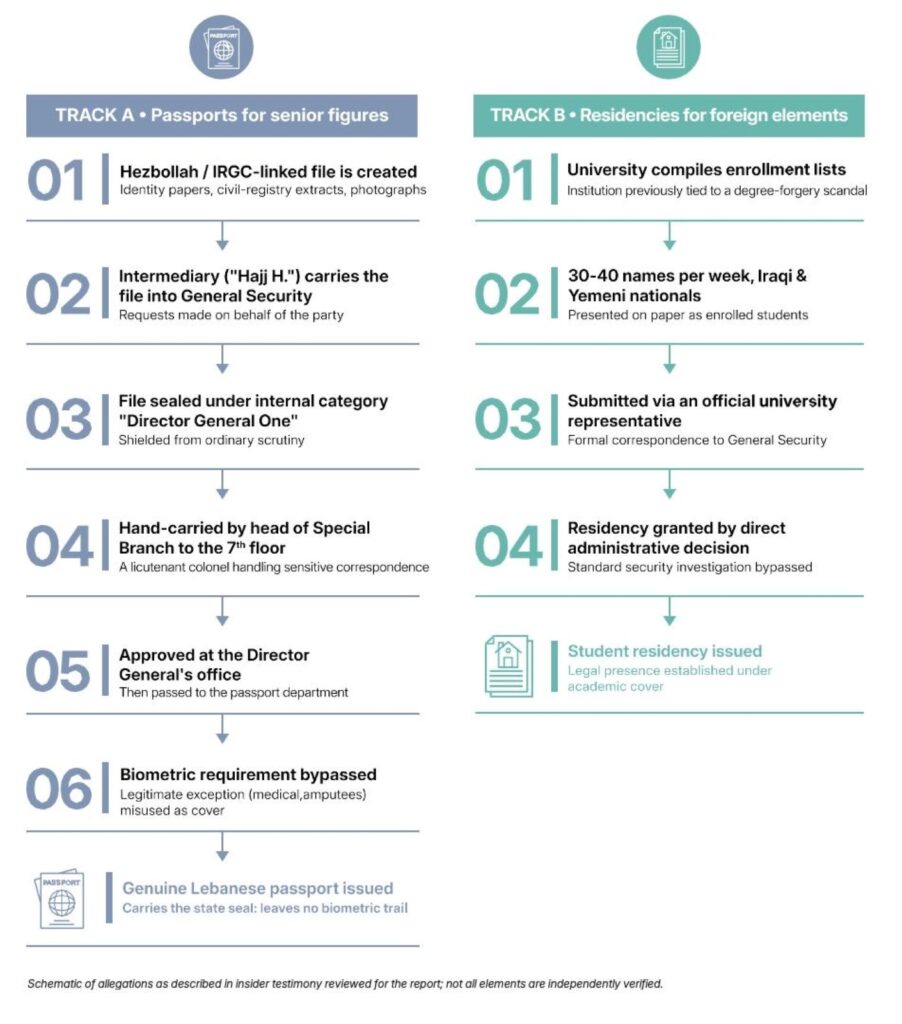
The account describes two principal tracks. The first allegedly involved passports issued to senior figures or advanced-level operatives linked to Hezbollah and the IRGC. The second involved residency permits granted to lower-ranking foreign elements, especially Iraqis and Yemenis, under the cover of student status.
Together, these tracks suggest that Lebanon’s identity system may not only have been exploited from the outside. It may have been repurposed from within.
The biometric loophole
At the center of the first track was an administrative exception known as “bypassing the biometric requirement.”
Under normal procedure, passport applicants are expected to submit biometric data, including fingerprints and other identifying markers. These requirements are designed to prevent identity substitution, duplicate identities, and the use of fraudulent records. In a country where civil registries are vulnerable and political interference is common, biometric safeguards are among the few tools capable of anchoring a passport to a verifiable person.
But General Security also maintains exceptions. In legitimate cases, the biometric requirement can be bypassed for people who cannot physically provide fingerprints, such as those with amputated fingers, as well as for urgent medical cases or exceptional files involving senior political figures. Such exemptions are supposed to be narrow, documented, and rare.
According to the insider account, this mechanism was allegedly transformed into a channel of concealment. Files linked to Hezbollah- or IRGC-connected individuals were allegedly processed through the biometric bypass, allowing passports to be issued without ordinary biometric safeguards. The result was not a visibly forged document, but a Lebanese passport produced by the system itself.
This is the core vulnerability. When the exception becomes routine, the safeguard collapses. When the state allows a person to bypass biometric registration without legitimate grounds, it creates an identity that cannot be properly traced, compared, or challenged later. In such cases, the passport does not merely help someone travel. It erases the trail that should prove who that person is.
The sealed files
The insider account also described a protected administrative channel inside General Security. According to the testimony, sensitive files were allegedly divided into special categories known internally as “Director General One” and “Director General Two.”
“Director General One,” the account claimed, was associated with Hezbollah. “Director General Two” was associated with the Amal Movement. The focus of the testimony was the first file.
According to the account, files marked under this channel were sealed, protected from ordinary scrutiny, and delivered directly to the office of the director general. They allegedly contained the documents needed to issue passports: identity papers, civil registry extracts, photographs, and other supporting material.
The files were not treated like ordinary applications. They allegedly moved through a privileged route, carried by hand through internal channels and delivered to the upper level of General Security’s hierarchy. The testimony specifically named a lieutenant colonel, then head of the Special Branch and responsible for sensitive correspondence, as the officer who allegedly handled such files and carried them to the seventh floor, where the director general’s office was located.
Once there, the account claimed, the files would receive approval through the director general’s office. They would then be sent to the passport department and processed under the biometric bypass exception.
The significance of this allegation lies in its bureaucratic logic. The process, as described, did not require dismantling the state. It required using the state exactly as it existed: its files, its stamps, its exceptions, its hierarchy, its discretion, and its culture of opacity.
This is how a shadow system survives inside an official institution. It does not always need to forge the state’s documents. It only needs access to the state’s authority to issue them.
The student residency channel
The second track described by the insider account involved residency permits rather than passports.
According to the testimony, lower-ranking foreign elements were allegedly brought into Lebanon and legalized through student residencies. The main institutional channel identified in the account was a university previously implicated in a scandal involving the forgery of thousands of degrees for Iraqi students.
The university allegedly submitted regular files to General Security containing the names of individuals presented as enrolled students. The lists reportedly included Iraqi and Yemeni nationals and were submitted with formal university correspondence through an official representative. In some cases, the account claimed, these lists included between 30 and 40 names per week.
The process allegedly allowed residency permits to be issued under student status by direct administrative decision, without the ordinary security investigations usually required for foreign students. In normal circumstances, foreign student residency files are supposed to undergo background checks and verification. These procedures can be lengthy, intrusive, and bureaucratically difficult. In the cases described by the testimony, they were allegedly bypassed.
The importance of this mechanism is that it provides not only entry, but legal presence. A foreign national entering Lebanon under suspicious circumstances might attract attention. A foreign national holding a student residency issued by General Security appears, on paper, to be ordinary.
The account further claimed that many Iraqi and Yemeni elements later killed in Lebanon had held student residencies issued through this pathway. If substantiated, this would suggest that the cover of education was allegedly used to absorb foreign-linked operatives into Lebanon’s legal residency system.
Here again, the issue is not only forgery. It is legalization. The system did not merely hide people. It allegedly gave them paperwork.
The difference between corruption and collusion
The insider account repeatedly drew a distinction between ordinary corruption and systematic collusion.
Lebanon is no stranger to bribery, influence, and administrative manipulation. Passports can be expedited. Files can be delayed or accelerated. Employees can be bought. Political references can interfere. In a collapsing state, bureaucratic corruption becomes almost routine.
But the account described something more serious. Ordinary corruption serves private gain. The mechanism described in the testimony allegedly served an armed political-security network. It did not merely exploit weak institutions. It allegedly used those institutions as instruments of operational cover.
This distinction matters because it changes the nature of the scandal. If junior employees forged passports for money, the issue is corruption. If protected files linked to Hezbollah were routed through the director general’s office, approved through exceptional procedures, and shielded from biometric scrutiny, the issue becomes something far more severe: the capture of state function.
The testimony does not suggest that every official inside General Security was involved. Nor does it prove that the institution as a whole was formally transformed into a partisan arm. But it does raise a more troubling possibility: that specific channels inside the institution may have been accessible to Hezbollah in ways unavailable to ordinary citizens, foreign residents, or even other political actors. That is precisely where the line between state administration and parallel power begins to disappear.
Hezbollah intermediaries and parallel access
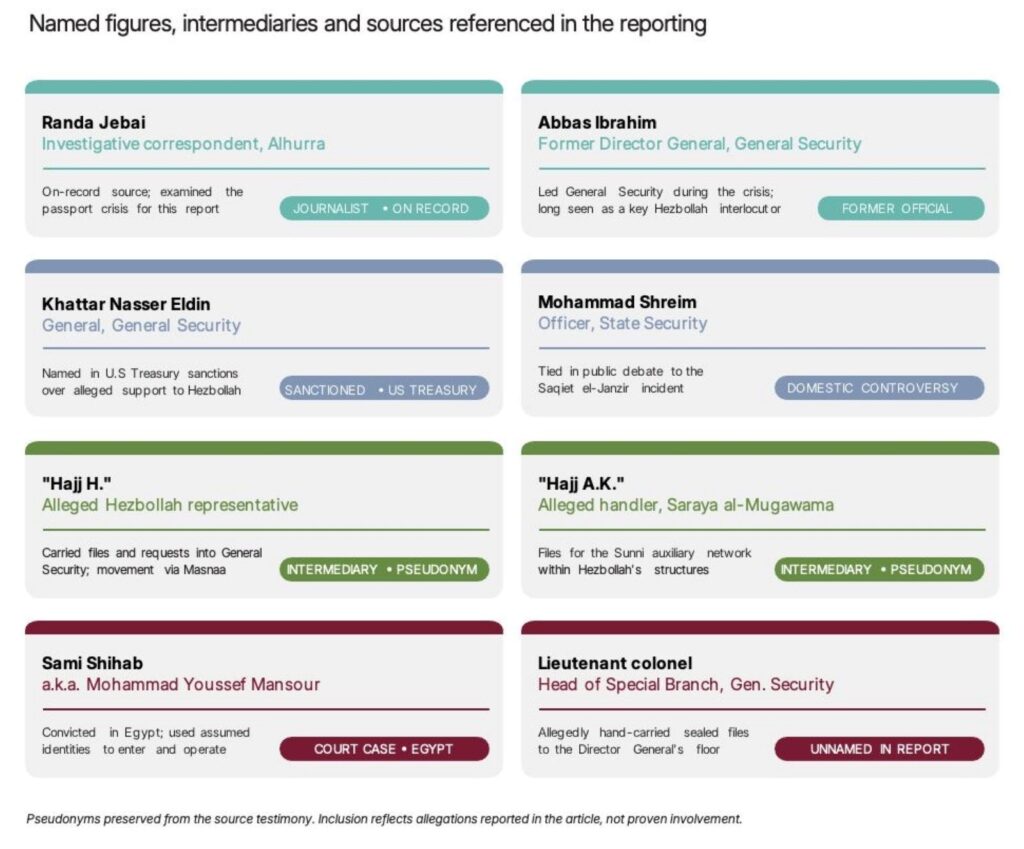
The testimony also described alleged intermediaries who operated between Hezbollah and General Security.
One figure named in the account was Hajj H., described as a Hezbollah-linked representative who allegedly entered General Security carrying files and requests on behalf of the party. These requests reportedly included facilitating the movement of individuals, circulating names, or easing passage through border points such as Masnaa.
Another figure mentioned was Hajj A.K., allegedly responsible for files connected to Saraya al-Muqawama, Hezbollah’s auxiliary network of Sunni factions operating within its wider support structures.
The importance of these names is not simply personal. They point to the existence of multiple access channels. One channel allegedly handled passports for senior figures. Another handled student residencies through the university. A third handled security requests. A fourth was allegedly related to Saraya al-Muqawama. Together, they suggest a bureaucratic ecosystem, not an isolated favor.
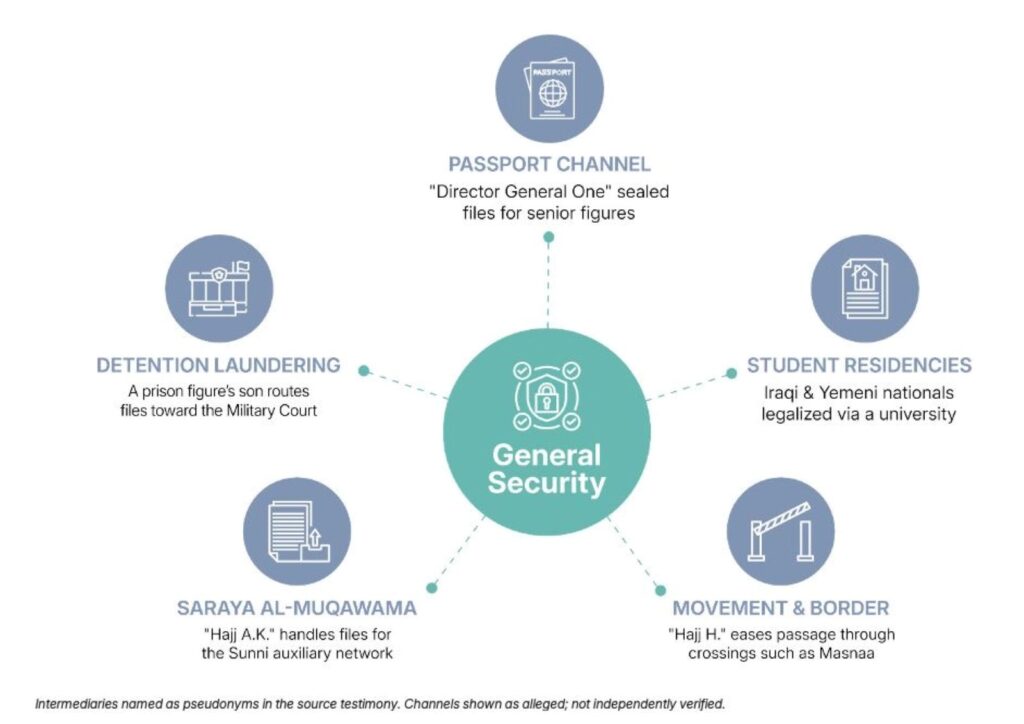
In that ecosystem, Hezbollah did not need to stand outside the state and pressure it from afar. It allegedly had pathways into the state: people who knew where to go, which files to carry, which references to invoke, and which exceptions to activate.
Beyond passports: detention files and the Military Court
The testimony also raised a separate but related allegation involving Hezbollah’s detention and interrogation apparatus.
According to the account, a Hezbollah figure responsible for prisons allegedly had a son working inside General Security. Files related to individuals detained, abducted, or interrogated by Hezbollah were allegedly delivered by hand to this person inside the institution. The files, according to the testimony, could then move toward the Military Court, with investigators allegedly pressured to record military identification numbers on documents rather than the individuals’ names.
This allegation requires further verification. But its significance is clear. If accurate, it would suggest that the problem extended beyond travel documents and residency permits. It would mean that material originating in a non-state security apparatus may have been routed through official institutions and given the appearance of state procedure. That would represent a deeper form of institutional contamination: not only the manipulation of identity, but the laundering of coercive power through state structures.
The lower-level fraud
The insider account also described more conventional forms of passport fraud.
In some cases, vulnerable people were allegedly exploited: poor individuals, medically impaired people, or citizens who had never issued biometric passports and were unlikely to travel. Their names, civil records, or identity files could be used while another person’s photograph was inserted into the application.
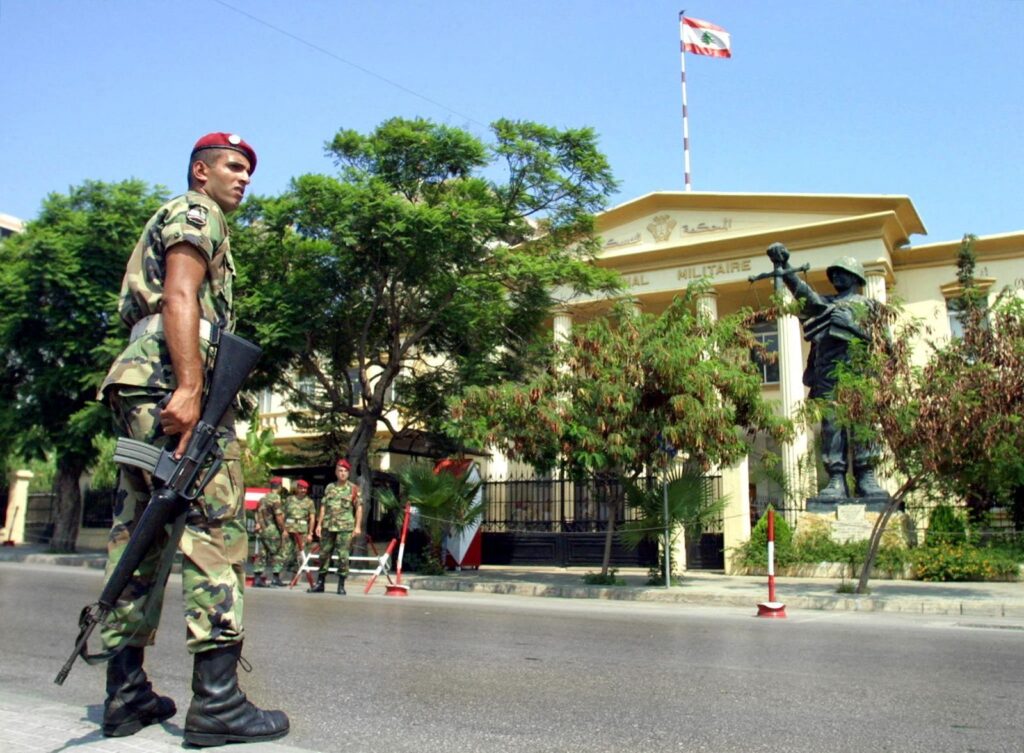
Lebanese soldiers stand guard outside the military court in Beirut 11 August 2001 during the trial of three anti-Syrian Christian militants, including a lawyer, seized in army intelligence raids this week. The three were arrested 09 August after heated scuffles with anti-riot police during a demonstration against an army mass crackdown, which also left several protestors wounded. AFP PHOTO/Joseph BARRAK (Photo by JOSEPH BARRAK / AFP)
This form of fraud resembles the more familiar pattern of identity substitution. It depends on poverty, weak oversight, local complicity, and gaps in the civil registry.
But the testimony distinguished these cases from the higher-level track. Senior Hezbollah-linked or IRGC-linked figures, the account claimed, were not processed through crude substitution schemes. They allegedly moved through protected files, official decisions, and biometric exemptions.
This distinction reveals the layered nature of the alleged system. At the bottom were ordinary fraud and corruption. At the top were protected political-security files. Both exploited the same institutional weakness, but not with the same level of access or protection.
Why the biometric audit matters
The most important investigative path, according to the logic of the testimony, is the biometric bypass.
Every file processed through this exception should be auditable. Every applicant who bypassed biometric registration should have a documented reason. Every medical exemption should be supported by evidence. Every political or exceptional case should be identifiable. Every passport issued without biometrics should be explainable.
If the legitimate cases are stripped out, namely amputees, medical emergencies, and genuinely exceptional official files, what remains may reveal the scale of the abuse. This is why the biometric bypass matters more than the public understands. It may be the administrative fingerprint of the shadow passport system.
It is also why the scandal has been so difficult to expose. The documents may not look forged. The signatures may be real. The stamps may be valid. The procedures may have been followed on paper. The illegality lies in the deliberate misuse of the exception. In such a system, the state itself becomes the mask.
Behind the Raouche strike: false identities and the machinery of covert movement
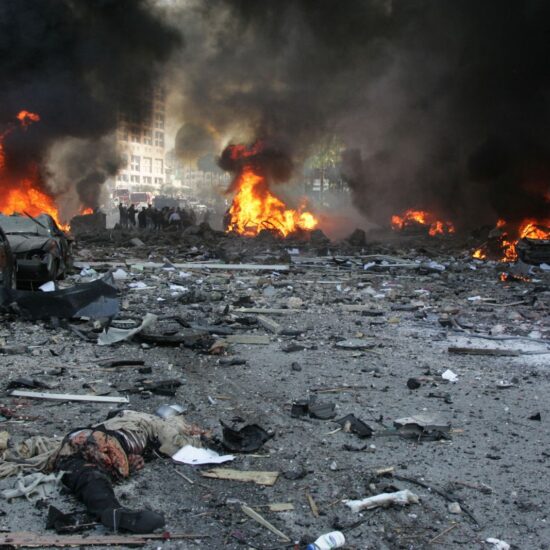
The investigation into forged Lebanese identities escalated dramatically following the Israeli strike on Raouche that reportedly targeted officers linked to the IRGC.
According to Lebanese security sources cited in regional investigations, passports and Lebanese identity documents bearing false names were allegedly discovered in connection with individuals targeted in the strike.
“The issue stopped being about a few forged passports,” Jebai explained. “It became a question of how foreign operatives were moving, residing, and operating under false Lebanese identities during wartime conditions.”
According to her reporting, the investigation expanded after hotel booking records connected to the targeted individuals emerged. Bookings linked to rooms at the Mövenpick Hotel Beirut had allegedly been made through a company identified as “Power,” rather than directly by the individuals involved. The detail raised additional questions about intermediary logistical networks and operational concealment.
Security concerns intensified because Lebanese authorities routinely require hotels to submit guest identities to General Security and military intelligence, particularly during periods of heightened conflict. Investigators therefore began questioning how individuals allegedly connected to sensitive regional operations were able to register and move using false Lebanese identities without detection.
Jebai argued that the broader regional context added another layer to the story. Following the weakening of Hezbollah’s operational command structure during the 2024 war, members of the IRGC allegedly became more directly involved in logistical and operational management on the ground inside Lebanon.
“The Revolutionary Guard always had influence,” she said. “But after 2024 their involvement became much more direct operationally because Hezbollah’s command structure had been severely weakened.”
She also suggested that the forged documents may not have been used solely inside Lebanon. “I believe these passports were used internationally as well,” she said. “Their problem is not only in Lebanon. They have operational issues in Yemen, Iraq, and Europe, across multiple fronts.”
Many aspects of the case remain politically sensitive and difficult to verify independently. What remains undeniable, however, is that the Raouche strike exposed the existence of a hidden operational infrastructure functioning beneath Lebanon’s already fragile security landscape.
The walking dead
Among the most disturbing claims emerging from investigations into forged Lebanese identities is the reported reuse of identities belonging to Hezbollah members killed in Syria but never officially registered as deceased.
According to investigators and regional reporting, the mechanism allegedly relied on gaps within Lebanon’s civil registration and passport systems. Fighters killed during the Syrian war reportedly remained active within official records, allowing their identities to continue existing administratively despite their deaths.
The Syrian war created conditions in which such ambiguities became increasingly possible. Hezbollah suffered significant casualties throughout the conflict, yet the handling of death registrations often remained opaque and politically sensitive.
Jebai noted that many fighters killed in Syria may never have possessed passports or biometric travel records during their lifetimes. This allegedly created vulnerabilities, because identities without fingerprints, travel history, or prior passport issuance were easier to exploit for new documentation.
“If someone had never issued a passport before, there would be fewer biometric records and fewer traces inside the system,” she explained.
The allegations also brought renewed attention to the role of local registration systems and mukhtars, the village-level officials who often serve as informal guarantors of identity and residency documentation.
“In every village, the mukhtar usually knows the families and residents personally,” Jebai said. “So investigators began asking how unfamiliar individuals were able to obtain documentation without basic questions being raised.”
She added that the issue pointed to possible institutional complicity or, at minimum, severe negligence within parts of the administrative system.
The issue extends beyond simple forgery. It reveals how wartime secrecy, weak civil oversight, and parallel political structures can gradually distort the integrity of identity systems themselves.
Venezuela and the globalization of cover identity
The forged and fraudulent identity issue extends far beyond Lebanon’s borders.
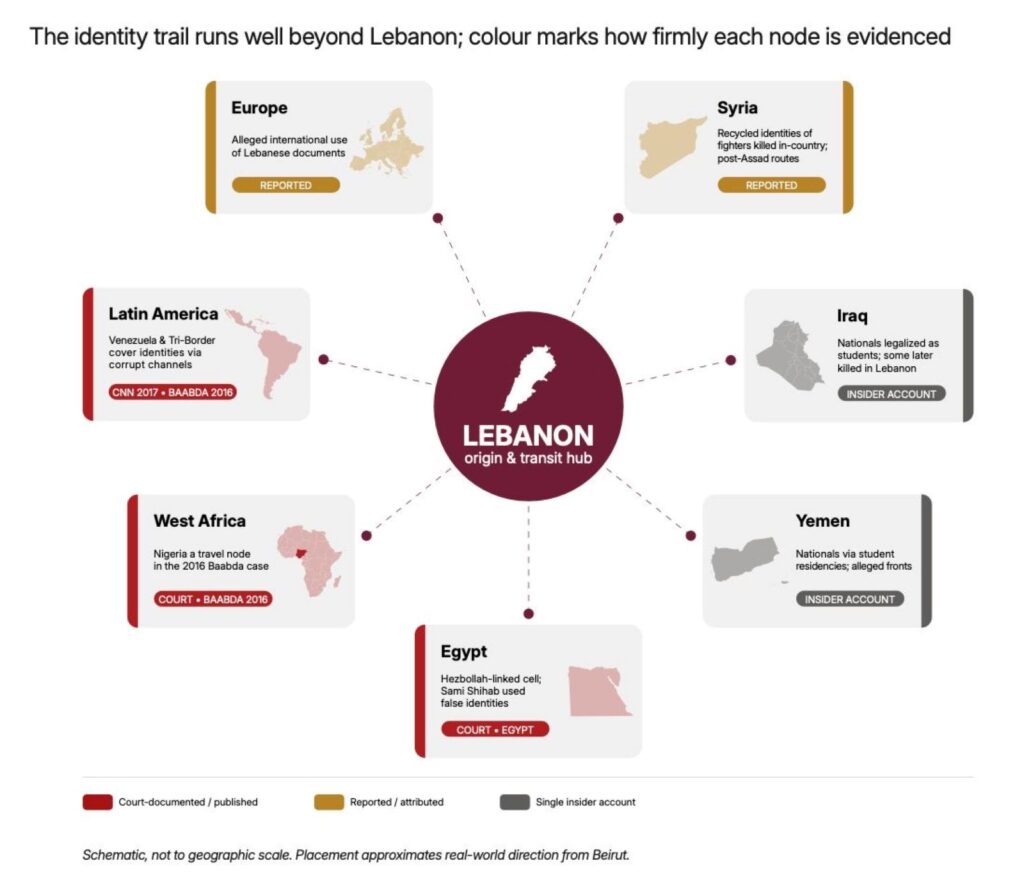
For years, intelligence reports, investigative journalists, and Western research institutions have examined alleged links between Hezbollah and wider transnational facilitation networks operating across Latin America, particularly in Venezuela and the Tri-Border Area connecting Brazil, Argentina, and Paraguay. In many of these accounts, Hezbollah is not described as operating in isolation, but within a broader ecosystem of cooperation involving Iranian-linked structures and, in some assessments, facilitation channels associated with the IRGC, particularly in logistics, movement, and identity support systems.
Unlike traditional passport forgery operations, Venezuela-related allegations often center on something more difficult to detect: genuine state-issued passports and identity documents allegedly obtained through corrupt, politicized, or intermediary-controlled administrative channels.
Investigations and court records cited in international reporting have described how such documents were reportedly used to enable travel and financial mobility for individuals linked, in various assessments, to Hezbollah-associated networks, sometimes operating under entirely legal Latin American identities. U.S. and regional intelligence analyses have further alleged that these identity systems overlapped with broader Iran-Venezuela cooperation frameworks, where state institutions, diplomatic cover, and diaspora structures created an environment in which IRGC-linked operatives and Hezbollah facilitators could allegedly access documentation, banking, and travel routes with reduced scrutiny.
A 2016 Baabda criminal court ruling offers a rare judicial example illustrating how these systems allegedly functioned in practice. The case involved a Lebanese national convicted of using a Venezuelan passport issued under a different identity after traveling across multiple countries, including Nigeria and Brazil. According to court documents, he later obtained Venezuelan identity papers through connections allegedly tied to officials within Venezuela’s Interior Ministry.
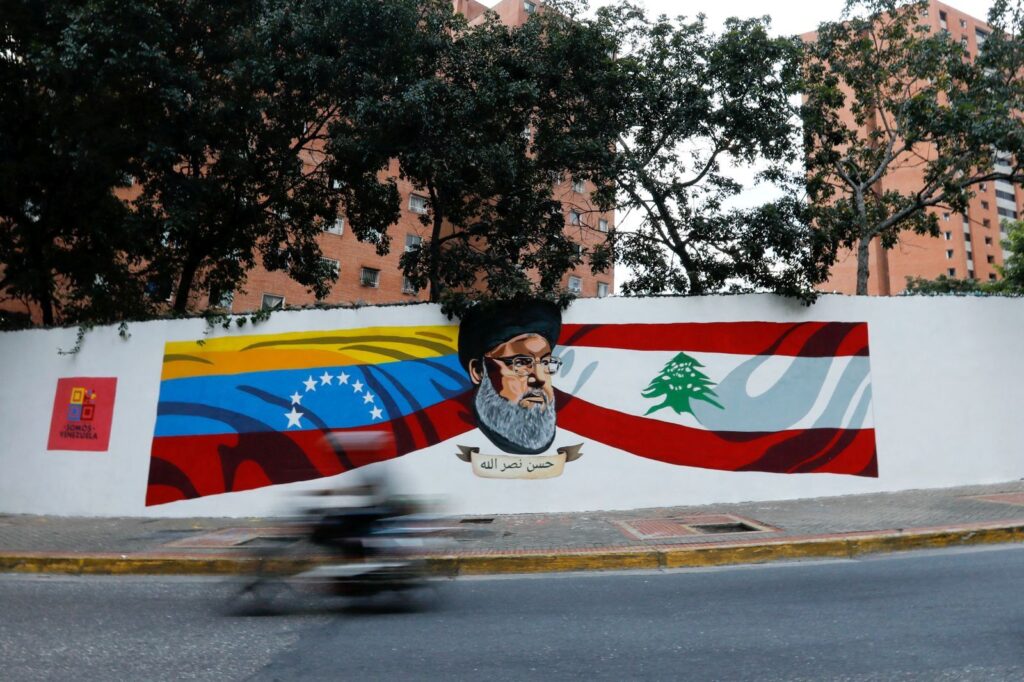
TOPSHOT – A motor vehicle passes in front of a mural painted by the “Somos Venezuela” Movement depicting the Lebanese leader of Hezbollah, Hassan Nasrallah, in Caracas on October 17, 2024. (Photo by Pedro MATTEY / AFP)
While the defendant claimed an administrative error, the court concluded that he knowingly continued using the alternative identity for repeated international travel, convicting him under Lebanese forgery laws. Although the ruling does not explicitly mention Hezbollah, it closely mirrors patterns identified in broader international investigations into Venezuelan passport issuance systems, which have repeatedly been linked in reporting to Hezbollah-linked mobility networks and Iran-aligned facilitation structures.
These findings align with multiple investigative reports, including CNN’s 2017 “Passports in the Shadows,” which examined allegations that Venezuelan officials issued passports and identity documents to Middle Eastern nationals, including individuals allegedly connected to Hezbollah. Other U.S. and regional security assessments have similarly raised concerns that Venezuela’s documentation system became a tool for sanctions evasion, illicit finance, and cross-border movement between Latin America and the Middle East, often intersecting with Iran-aligned networks and Hezbollah’s external operational infrastructure.
Regional infiltration networks linked to Hezbollah
Although the case dates back several years, Egyptian court documents and investigative reporting have regained relevance amid renewed scrutiny over forged Lebanese passports and broader identity fraud systems. The proceedings described an alleged Hezbollah-linked cell operating in Egypt, with defendants reportedly admitting to using forged identities and false travel documents to enter and operate within the country. Key suspects, including Sami Shihab, also known as Mohammad Youssef Mansour, were said to have relied on assumed identities to bypass border controls and embed within civilian settings.
Beyond the operational allegations, the case highlights how identity manipulation functioned as a core mechanism of mobility and concealment. The network was reportedly involved in surveillance of strategic areas in Sinai, Nuweiba, Taba, and the Suez Canal, alongside logistical preparations and encrypted communications.
A state losing control of identity
Ultimately, the issue confronting Lebanon extends far beyond forged and fraudulent passports and identification documents alone.
The deeper concern is not merely that forged documents exist. Nearly every country confronts some form of identity fraud. The greater danger lies in the emergence of parallel systems capable of bypassing official institutions altogether.
Investigators say the lack of transparency only deepens public suspicion. Questions remain unanswered regarding how many passports were issued during Lebanon’s crisis years, how many were expedited under exceptional circumstances, and why few official investigations publicly progressed despite repeated revelations.
Jebai repeatedly pointed to the absence of accountability as one of the most alarming aspects of the entire affair. “The danger is not only the forgery itself,” she warned. “It is the absence of accountability afterward.”
She also questioned why authorities had not publicly disclosed key data, including how many expedited passports were issued during the crisis years, how many passport holders never traveled, and whether investigations were launched into suspicious irregularities. “Why were no serious investigations announced?” she asked. “Why are basic numbers still unavailable?”
According to Jebai, Lebanon’s deeper crisis is not only institutional weakness, but also the absence of transparency itself. Despite laws theoretically guaranteeing access to public information, investigators and journalists continue to face enormous difficulty obtaining official records, company registrations, administrative data, or security statistics. “There is no real access to information,” she said. “Even when the laws exist, implementation does not.”
In the end, this is not just about forged passports or false identities. It is about what happens when people lose faith in the systems meant to verify who is who, at a moment when war, corruption, secrecy, and geopolitical conflict have blurred the line between the official state and the hidden systems operating beneath it.