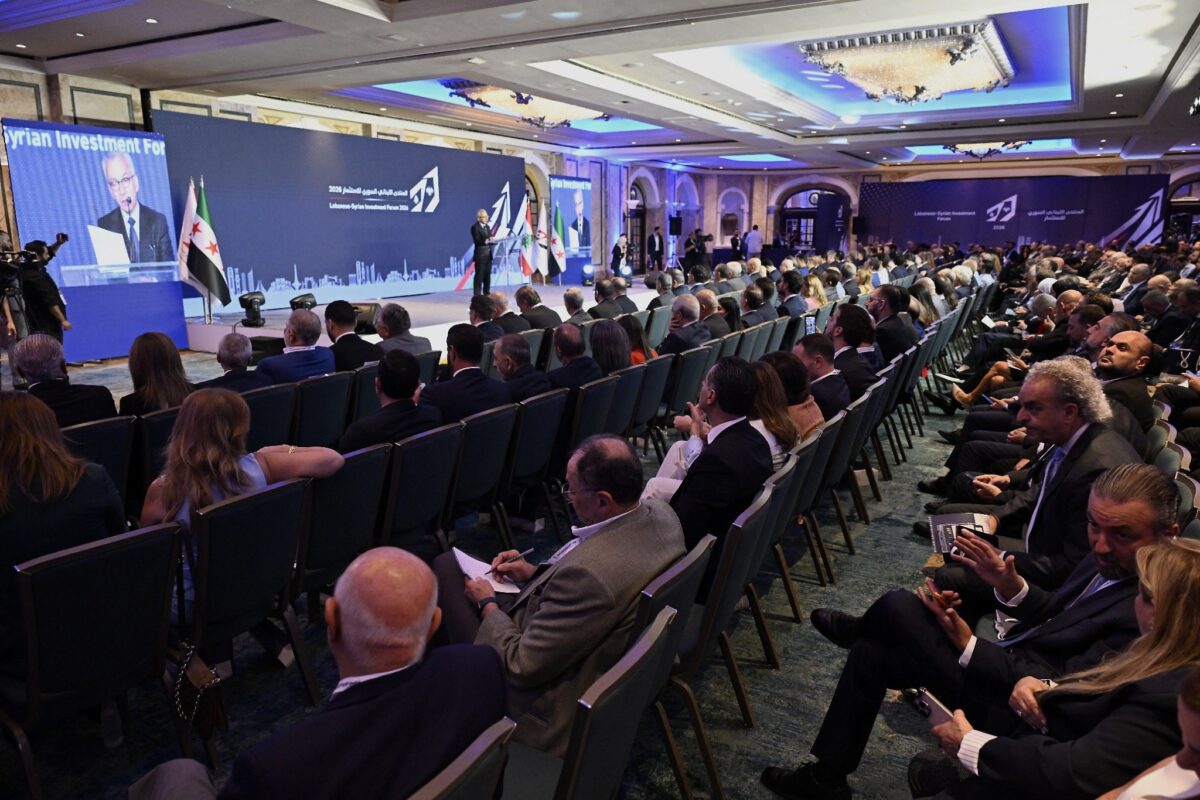
The visit brought together Syrian and Lebanese government officials alongside representatives from the private sector, marking an effort to move bilateral relations toward greater economic cooperation after years of strained ties.
The first Lebanese-Syrian Investment Forum focused on investment opportunities, reconstruction, sustainable development, transport, ports and regional trade. Discussions also examined ways to improve the movement of goods and create stronger links between businesses in the two countries.
For Lebanon, the renewed economic relationship could create opportunities across agriculture, logistics, engineering, construction management, banking-related expertise, food production, pharmaceuticals and other professional services.
But Lebanese businessman and Port of Beirut board member Karim Chebaklo told NOW that Lebanon’s opportunity may not lie in competing directly for the largest reconstruction contracts in Syria.
“Lebanon’s strength is services, not capital,” Chebaklo said, pointing to engineering, construction management, logistics, insurance, banking know-how, food, pharmaceuticals and professional services as areas where Lebanese companies could contribute.
He said much of the financing for Syrian reconstruction was likely to come from larger regional players, particularly the Gulf and Turkey, meaning Lebanon could instead position itself as a service and supply hub supporting those investments.
For Lebanon, the renewed economic relationship could create opportunities across agriculture, logistics, engineering, construction management, banking-related expertise, food production, pharmaceuticals and other professional services.
“Reconstruction money will mostly come from the Gulf and Turkey,” Chebaklo said. “Lebanon should aim to be the service and supply hub behind it, not chase the big contracts.”
Agriculture as an entry point
For the Syrian side, agriculture is one of the sectors where cooperation could begin producing practical results.
Speaking to NOW, Syrian Agriculture Minister Basel Al-Sweidan said Syrian and Lebanese officials had already begun discussions over a potential joint agricultural agreement aimed at facilitating the movement of agricultural products and coordinating policies between the two countries.
“We have had joint meetings with the Lebanese side, the Ministry of Agriculture in Lebanon, to prepare a joint agreement,” Al-Sweidan said.
He said the proposed agreement would cover issues including agricultural calendars, information-sharing and the movement of agricultural products between the two markets.
Agricultural calendars regulate the periods during which certain products can be imported, allowing governments to manage domestic supply while protecting local producers.
For Lebanon and Syria, where agricultural markets have historically been closely connected, greater coordination could make cross-border trade more predictable and reduce some of the administrative obstacles facing producers and exporters.
Al-Sweidan also pointed to cooperation in agricultural research, including the exchange of expertise and personnel to address pests and other agricultural risks affecting both countries.
“There would be an exchange of expertise and personnel in agricultural research to confront pests and risks that could affect both countries, given that they share a wide border,” he said.
The agricultural relationship could also create opportunities for Lebanese companies with established marketing and export networks.
Al-Sweidan said Damascus was particularly interested in Lebanese companies involved in marketing agricultural products, including companies with established export networks.
He said Lebanese companies could potentially source Syrian agricultural products during periods when Lebanese production is insufficient to meet export demand.
“For example, there may be periods when these products are not available, or when they have export orders larger than what is available in Lebanon, and they could export Syrian products,” he said.
Such arrangements could allow Syrian producers to access established Lebanese commercial and export networks while giving Lebanese companies additional sources of agricultural products.
However, Al-Sweidan said no agricultural investment agreement with Lebanese investors had yet been signed.
“Practically, nothing has been signed so far regarding agricultural investment by Lebanese investors in Syria,” he said.
The relationship therefore remains at an early stage, with the two sides discussing mechanisms that could eventually facilitate greater commercial activity.
Expanding trade and investment
Agriculture is only one component of the broader economic relationship being discussed between Beirut and Damascus.
The forum brought together officials and business representatives to discuss investment, financing, reconstruction, transport, ports and regional markets. Its program also examined challenges facing companies seeking to operate and invest across the two markets.
President Joseph Aoun separately met the Syrian ministerial delegation, which included the ministers of economy, tourism, agriculture and transport, as well as officials from investment and aviation authorities and representatives of the Syrian-Lebanese Business Council.
For Lebanon, potential areas of cooperation extend beyond bilateral trade. Greater economic coordination could involve transport and logistics, ports, agricultural production, food industries, tourism, healthcare, technology and professional services.
Chebaklo said Beirut could also have a geographic advantage because of its proximity to Damascus and southern Syria.
“Beirut is the natural gateway for Damascus and southern Syria,” he said, adding that Syrian investors could potentially use Lebanon as a regional platform for warehousing, re-export and trade finance.
He said Lebanon should nevertheless focus on areas where it has a genuine advantage rather than attempting to compete directly with other regional ports.
For Lebanon, potential areas of cooperation extend beyond bilateral trade. Greater economic coordination could involve transport and logistics, ports, agricultural production, food industries, tourism, healthcare, technology and professional services.
“The north of Syria will mostly use Latakia and Tartus. Lebanon should compete where it has a real advantage,” he said.
This could place the Beirut port and Lebanon’s wider logistics sector at the center of discussions about the future movement of goods between Syria, Lebanon and regional markets.
Turning proximity into trade
Geographic proximity alone, however, does not guarantee increased trade.
Chebaklo said speed and predictability would be more important than simply signing new agreements between the two governments.
“Beirut is the closest major port to Damascus and the south. That is a real cost and time advantage,” he said.
But he argued that this advantage would only translate into additional trade if border procedures become more efficient.
“It only becomes trade if the border works,” Chebaklo said, pointing to the need for a single clearance process, pre-clearance of documents, scanning and a clear transit regime.
He also proposed a bonded corridor for commercial traffic, with tracked trucks moving goods between the two countries.
“A bonded corridor with tracked trucks cuts delays and smuggling at the same time,” he said.
Customs procedures would also need to be predictable across border crossings.
“Customs valuation and tariffs must be the same at every crossing,” Chebaklo said. “Traders will not choose a route where the rules change by border post.”
Digital documentation, he added, could provide a relatively immediate way of reducing administrative delays.
“Digital documents are the cheapest quick win,” he said.
The potential expansion of the Port of Beirut could also increase Lebanon’s capacity to handle regional trade. Chebaklo said the port’s expansion aims to lift container capacity to more than three million TEUs a year.
But he stressed that physical capacity alone would not determine whether additional Syrian-related cargo passes through Beirut.
“Capacity helps, but the border and transit rules decide whether the cargo comes,” he said.
Ports, transport and regional markets
Transport and logistics could therefore become a major component of the renewed economic relationship.
The Beirut forum included a dedicated session on transport, ports, investment and overcoming challenges, reflecting the importance of infrastructure to any expansion in bilateral trade.
The potential relationship therefore extends beyond goods crossing the Lebanese-Syrian border.
If economic cooperation expands, it could involve ports, shipping, logistics, warehousing and transport companies, as well as agricultural and industrial supply chains.
For Syria, the economic opening also comes as the country seeks investment for reconstruction and development.
For Lebanon, stronger trade ties could provide opportunities for companies already active in regional markets, particularly in agriculture, logistics, food production, engineering and professional services.
But businesses will still need to assess whether the financial and regulatory environment allows those opportunities to become commercially viable.
Banking, sanctions, and border risks
Banking and compliance remain among the most significant practical obstacles facing companies considering increased commercial activity with Syria.
Chebaklo said there are currently no reliable payment channels for all potential transactions involving Syrian businesses, while international correspondent banks can be reluctant to take on the associated risks.
He said correspondent banks would need clear compliance protections before becoming comfortable with transactions involving Syrian counterparties.
For Lebanese companies, the issue extends beyond individual transactions.
“One wrong counterparty can cost a Lebanese company its international banking relationships,” Chebaklo said.
Sanctions and compliance requirements therefore remain an important consideration for companies seeking to enter the Syrian market, particularly those dependent on international banking channels.
Border control presents another challenge.
Sanctions and compliance requirements therefore remain an important consideration for companies seeking to enter the Syrian market, particularly those dependent on international banking channels.
Chebaklo said smuggling and informal trade could undercut companies operating through official channels, making predictable customs procedures and effective border controls important to the development of legitimate trade.
He also stressed the importance of transparency and institutional oversight in future economic agreements.
“Deals must be state to state, published, and in Lebanon’s interest, not run through intermediaries,” he said.
Political and security developments could also affect the pace of private-sector investment.
Chebaklo said businesses should therefore consider investing in stages, rather than making large commitments immediately.
“Politics and security can change fast, so businesses should invest in stages,” he said.
The concerns illustrate the difference between announcing new economic cooperation and creating the conditions necessary for companies to act on it.
The next stage will therefore be measured not only by the agreements announced between Beirut and Damascus, but by whether those agreements translate into predictable rules, investment and actual movement of goods between the two countries.
The Syrian government has presented economic cooperation as part of a broader effort to rebuild relations with Lebanon.
Al-Sweidan said economic forums and trade relations could eventually help address wider bilateral issues and overcome the effects of the previous period of strained relations.
“These economic forums and economic relations can be a gateway, to resolving many files, breaking the isolation between the two countries and addressing the old effects of the previous regime and the damage inflicted on the peoples of both countries,” he said.
At the same time, some of the most sensitive bilateral issues remain outside the economic discussions, including the return of Syrian refugees, border demarcation and broader security questions.
The next stage will therefore be measured not only by the agreements announced between Beirut and Damascus, but by whether those agreements translate into predictable rules, investment and actual movement of goods between the two countries.