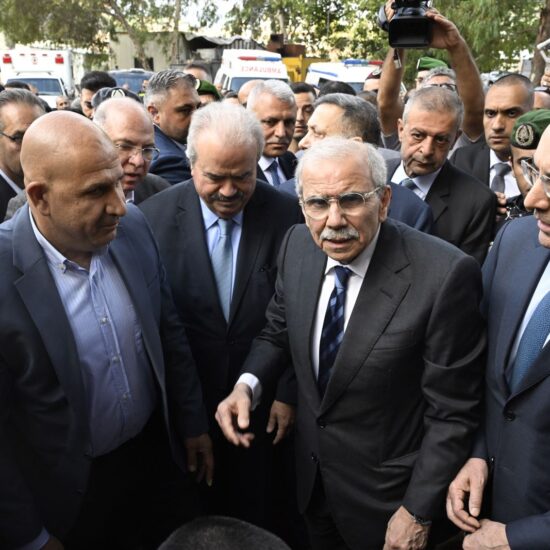
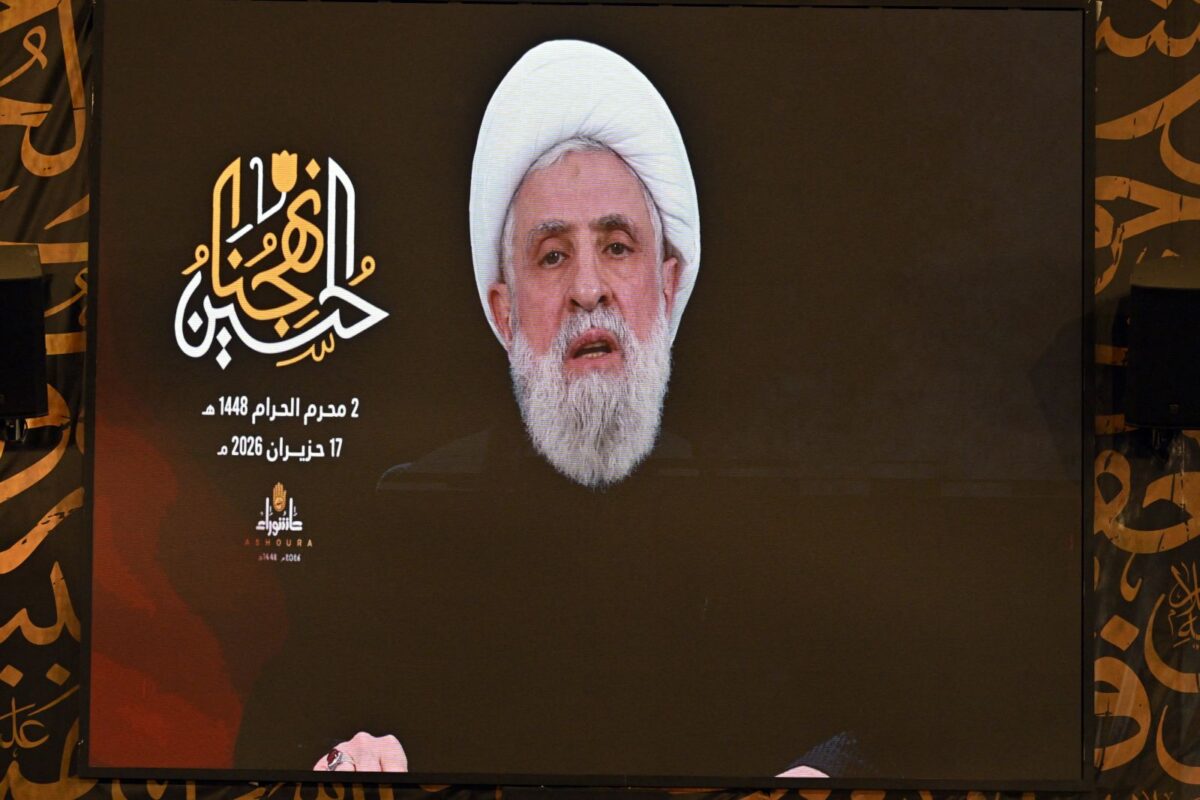
BEIRUT, LEBANON - JUNE 17: Hezbollah Secretary-General Naim Qassem addresses participants via video conference during an event marking the Day of Ashura at the tomb of former Hezbollah chief Hasan Nasrallah in the Dahieh district, south of the capital Beirut, Lebanon on June 17, 2026. Houssam Shbaro / Anadolu (Photo by Houssam Shbaro / ANADOLU / Anadolu via AFP)
There are days on which political decency requires silence.
August 4 is one of them.
Yet on the sixth anniversary of the Beirut port explosion, Naim Qassem chose not to remain silent. Instead, Hezbollah’s secretary-general appeared before the Lebanese people to lecture them about sovereignty, reconstruction, national unity, the strength of the Lebanese Army and, most obscenely, the importance of investigation and justice.
Qassem instructed the Lebanese authorities to “care about sovereignty,” strengthen the army, prioritize reconstruction and pursue investigations so that the people might receive justice. He even spoke sympathetically about those who had lost their homes, children and families, presenting Hezbollah as their compassionate protector.
It was not merely hypocritical. It was grotesque.
For Naim Qassem to speak about justice on August 4 is like an arsonist lecturing firefighters about fire safety. It is an attempt to erase history while its victims are still standing before the ruins.
The Beirut port explosion killed more than 200 people, injured thousands and devastated entire neighborhoods of the capital. Six years later, families are still waiting for an indictment, a trial and a definitive account of who imported the ammonium nitrate, who benefited from it, who allowed it to remain at the port and why so much of the original shipment apparently disappeared before the explosion. Judge Tarek Bitar only submitted his report to the public prosecutor in March 2026, after years in which the investigation was repeatedly paralyzed by political interference and legal obstruction.
Those years were not an unfortunate bureaucratic accident. They were the product of a political system determined to prevent the truth from reaching a courtroom.
And no party worked more openly to intimidate that courtroom than Hezbollah.
A senior Hezbollah official reportedly delivered a warning to Judge Bitar that the party would “remove” him from the investigation. Hezbollah led the campaign demanding his dismissal, accused him of politicizing the case and mobilized alongside its allies against the investigation. Its supporters demonstrated outside the Justice Palace, while accused officials and political figures buried the inquiry beneath lawsuits, recusals and procedural challenges.
This is why Qassem’s sudden concern for “investigation” is so insulting.
Which investigation does he mean? The investigation his party threatened? The judge it sought to remove? The judiciary it intimidated whenever its questions approached politically protected figures?
There remain serious allegations and unanswered questions concerning Hezbollah’s possible relationship to the ammonium nitrate, the port’s security networks and the missing portion of the shipment. Hezbollah has not been judicially convicted of importing or storing the nitrate. But that is hardly an exoneration when the same party helped prevent the judicial process from reaching its conclusion.
The accusation that Hezbollah participated in storing, diverting or protecting the nitrate must ultimately be tested in court. Yet the most firmly established political fact is that Hezbollah fought the mechanism capable of proving or disproving that accusation.
In other words, the absence of a verdict is not proof of Hezbollah’s innocence. It is evidence of Lebanon’s enforced impunity.
In other words, the absence of a verdict is not proof of Hezbollah’s innocence. It is evidence of Lebanon’s enforced impunity.
The unanswered questions surrounding the explosion also extend beyond Hangar 12. Human Rights Watch documented the killings of individuals believed to possess information connected to the port, including retired customs officer Mounir Abou Rjeily and photographer Joseph Bejjani. No court has conclusively established that their deaths were connected to the explosion, but the pattern deepened public fear that information about the port could carry a death sentence.
Then there is my friend Lokman Slim.
Weeks before he was assassinated, Lokman publicly raised allegations concerning Hezbollah, the Syrian regime and the ultimate destination of the ammonium nitrate. He had already endured threats and intimidation because of his opposition to Hezbollah. On February 4, 2021, he was found murdered in southern Lebanon, shot repeatedly in the head and back. More than five years later, his killers have not been identified or prosecuted.
No responsible writer can establish a direct connection between Lokman’s assassination and the port explosion, at least for now. But no honest Lebanese can ignore the political environment surrounding both crimes: witnesses silenced, critics threatened, judges intimidated and investigations permitted to die slowly beneath the weight of fear.
Qassem also has no standing to lecture Lebanon about reconstruction or the suffering of the South.
His organization made the unilateral decision to fire rockets at Israel on March 2 in support of Iran, without consulting the Lebanese government, parliament, army or the residents whose villages would become the battlefield. The resulting war displaced more than 1.2 million people, damaged tens of thousands of homes and left large areas of southern Lebanon devastated.
Israel is responsible for the bombs it dropped, the civilians it killed and the destruction its military inflicted. But Hezbollah is responsible for confiscating Lebanon’s decision of war and peace and gambling with other people’s homes in the service of Iran.
Naim Qassem did not defend the people of the South. He used them.
Naim Qassem did not defend the people of the South. He used them.
He turned their villages into military geography, their houses into potential targets, their displacement into propaganda and their suffering into evidence of Hezbollah’s supposed heroism. Having helped produce the catastrophe, he now promises to pressure the Lebanese state to pay for reconstruction.
This is Hezbollah’s preferred economic model: Iran chooses the war, Hezbollah opens the front, Israel destroys Lebanon, Lebanese citizens lose their homes and then the Lebanese state is ordered to pay the bill.
A leader whose militia helped displace more than a million people has no right to speak about protecting the displaced. A party that obstructed the port investigation has no right to demand investigations. An armed organization that has spent decades weakening the army has no right to lecture the government about strengthening it. And a movement whose weapons exist outside the authority of the state has no right to define sovereignty for anyone.
On August 4, Qassem should not have delivered a sermon. He should have answered questions.
He should have told the families of the port victims why Hezbollah threatened the investigating judge. He should have explained why his party feared an independent investigation. He should have demanded the surrender of every official, minister, security officer or party member summoned by Judge Bitar. He should have called for the prosecution of Lokman Slim’s assassins and the reopening of every politically sensitive murder file buried by Lebanon’s machinery of impunity. He did none of this.
Instead, he offered the Lebanese another performance in which Hezbollah is simultaneously the armed authority above the state, the victim of every conspiracy and the innocent observer of every disaster.
Six years after Beirut was torn apart, the dead do not need another speech. They need names. They need indictments. They need trials.
Six years after Beirut was torn apart, the dead do not need another speech. They need names. They need indictments. They need trials.
And Lebanon needs to reclaim its judiciary, its army and its right to decide its own future from the militia that has obstructed all three.
Makram Rabah is the managing editor at Now Lebanon and an Assistant Professor at the American University of Beirut, Department of History. His book Conflict on Mount Lebanon: The Druze, the Maronites and Collective Memory (Edinburgh University Press) covers collective identities and the Lebanese Civil War. He tweets at @makramrabah