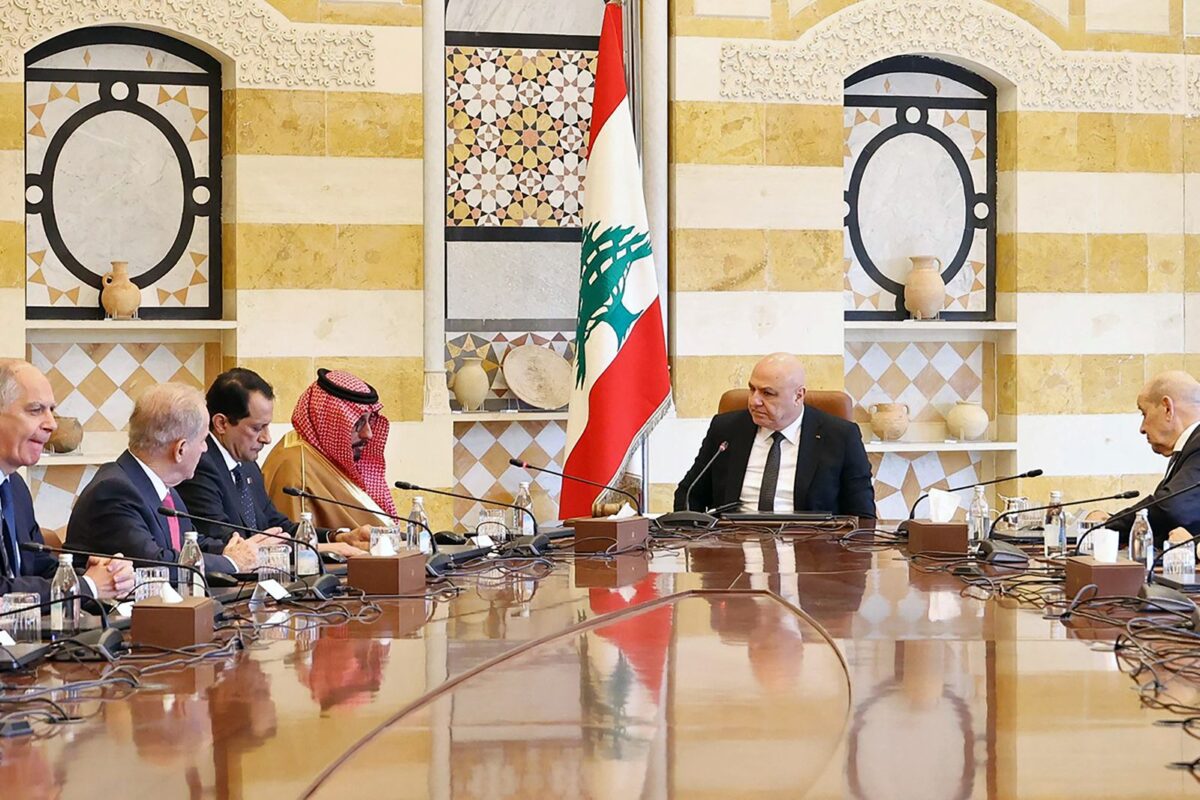
This handout photograph released by the Lebanese Presidency Press Office on Januray 14, 2026 shows Lebanese President Joseph Aoun (C) speaking with Saudi Arabia's envoy to Lebanon, Yazid bin Farhan (C left) and French envoy Jean-Yves Le Drian (R) during their meeting at the Presidential Palace in Baabda, east of Beirut. (Photo by Lebanese Presidency Press Office / AFP)
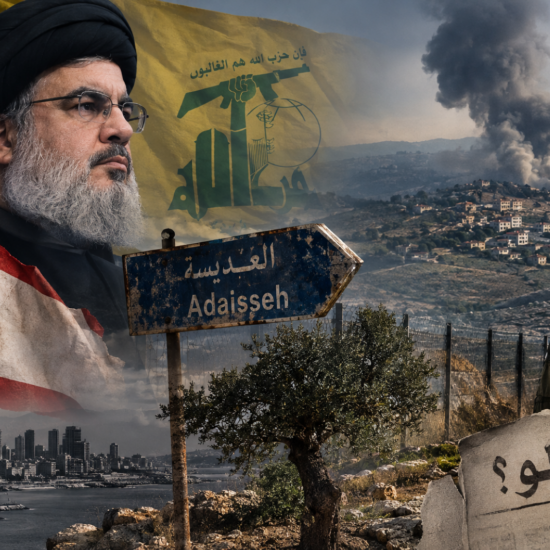
For years, Saudi Arabia approached Lebanon with caution, preferring distance over direct entanglement in a political system it viewed as compromised and structurally incapable of reform. That posture has now shifted, not toward open-ended engagement, but toward a far more conditional and disciplined form of involvement, one that places a single, non-negotiable principle at its core: there will be no meaningful recovery in Lebanon without the restoration of state sovereignty, and there will be no sovereignty as long as Hezbollah retains its arms.
This is not a rhetorical escalation, nor is it part of a broader campaign to impose normalization or force Lebanon into premature political alignments. On the contrary, Saudi officials have been explicit in decoupling the question of disarmament from the debate over peace with Israel, making clear that their concern is not ideological positioning but institutional coherence. In their view, Lebanon’s crisis is not simply economic, nor even primarily political, but fundamentally structural, rooted in the existence of a parallel military authority that distorts governance, undermines accountability, and ties the country’s fate to external strategic calculations.
The significance of this position lies in its clarity. Unlike previous moments when regional actors offered support in the hope that internal reforms would follow, Riyadh is now reversing the sequence. Assistance, whether financial or political, will not precede change; it will follow it. This recalibration reflects a broader regional consensus that has emerged in recent years, one shaped by the recognition that investments in fragile states cannot succeed when those states do not exercise a monopoly over the use of force. Lebanon, in this framework, is no exception, and its longstanding reliance on ambiguity as a governing strategy is no longer tenable.
From Riyadh’s perspective, Hezbollah’s arsenal is not merely a domestic issue, nor is it viewed solely through the prism of Lebanese politics. It is understood as part of a wider regional architecture in which non-state actors serve as instruments of Iranian influence, extending Tehran’s reach while insulating it from direct accountability. As long as Lebanon remains embedded in this architecture, it cannot position itself as a credible partner for reconstruction or reform, because its decision-making autonomy remains compromised. Disarmament, therefore, is not an end in itself but a prerequisite for reestablishing Lebanon as a sovereign actor capable of engaging with the region on its own terms.
This approach also reshapes the internal Lebanese debate. By setting a clear external benchmark, Saudi Arabia is effectively narrowing the space for political maneuvering within Lebanon, forcing local actors to confront a choice they have long sought to avoid. The language of coexistence between state and militia, once presented as a pragmatic compromise, is now increasingly exposed as a source of perpetual instability. The idea that Hezbollah’s weapons can be managed, regulated, or gradually integrated without fundamentally altering the balance of power is no longer taken seriously by those whose support Lebanon urgently needs.
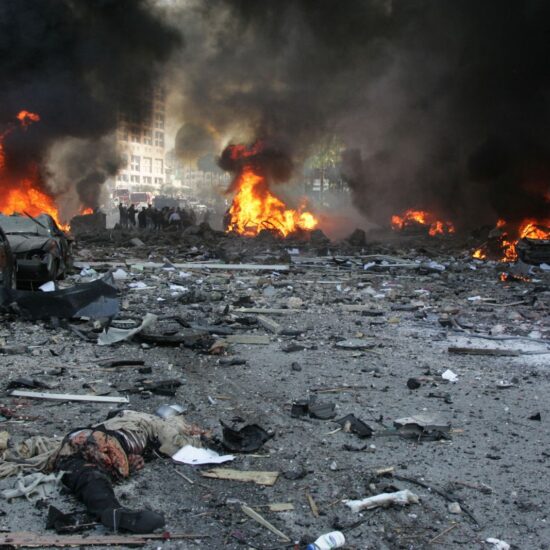
Yet the challenge is not simply one of policy but of political will. The Lebanese state has, for decades, deferred the question of Hezbollah’s arms, either by framing it as part of a broader regional conflict or by invoking internal fragility as a justification for inaction. This strategy has reached its limits. The current war, with its devastating impact on infrastructure and its repeated displacement of civilian populations, has demonstrated that the cost of deferral is no longer abstract. It is measured in destroyed towns, shattered economies, and a deepening sense of national vulnerability.
In this context, the role of Saudi Arabia, and by extension, that of other Arab states, is not to dictate Lebanon’s choices but to clarify their consequences. The message is straightforward: a Lebanon that asserts its sovereignty and reclaims its decision-making authority will find partners willing to invest in its recovery, while a Lebanon that remains captive to armed actors operating outside state control will face continued isolation. This is not coercion in the traditional sense; it is conditional engagement grounded in a clear assessment of risk and viability.
What remains uncertain is whether Lebanon’s political leadership is prepared to act on this reality. The path toward disarmament is neither simple nor immediate, and it cannot be reduced to a technical process of weapons collection. It requires a comprehensive reconfiguration of the relationship between the state and its citizens, one that reestablishes trust in public institutions and redefines the meaning of security beyond the logic of armed deterrence. It also demands a willingness to confront entrenched interests that have long benefited from the status quo.
Nevertheless, the alternative is increasingly untenable. As long as Hezbollah retains its military autonomy, Lebanon will continue to oscillate between periods of fragile calm and sudden escalation, its economy will remain hostage to external perceptions of risk, and its political system will struggle to assert even the most basic functions of governance. The choice, therefore, is not between confrontation and accommodation, but between reclaiming sovereignty and accepting permanent subordination.
Saudi Arabia’s reengagement, limited and conditional as it may be, offers Lebanon a framework within which this choice can be made. It does not guarantee success, nor does it eliminate the complexities involved, but it does establish a clear linkage between internal reform and external support. In doing so, it shifts the burden of decision back to where it belongs: within Lebanon itself.
This article original ran in Elaf
Makram Rabah is the managing editor at Now Lebanon and an Assistant Professor at the American University of Beirut, Department of History. His book Conflict on Mount Lebanon: The Druze, the Maronites and Collective Memory (Edinburgh University Press) covers collective identities and the Lebanese Civil War. He tweets at @makramrabah
Follow NowLebanon on social media: X , Instagram and Facebook