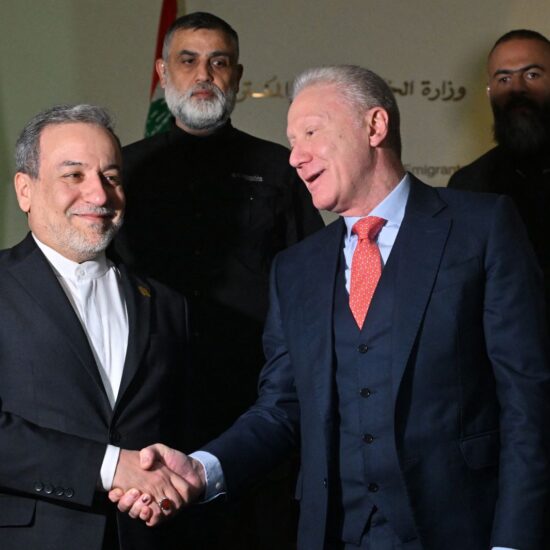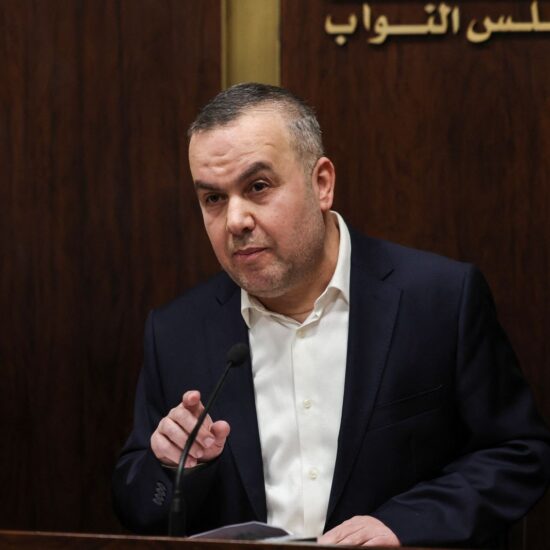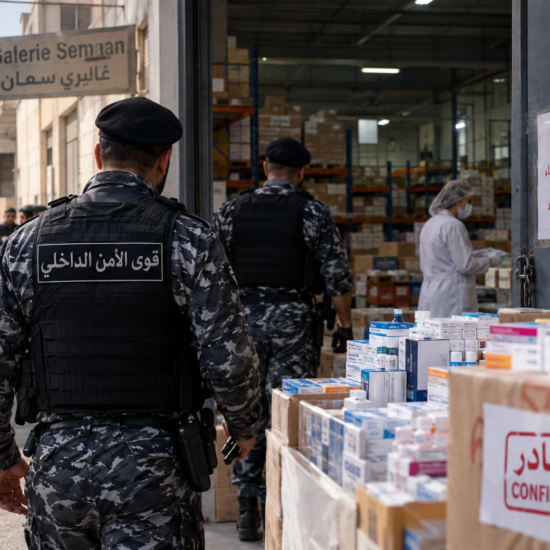
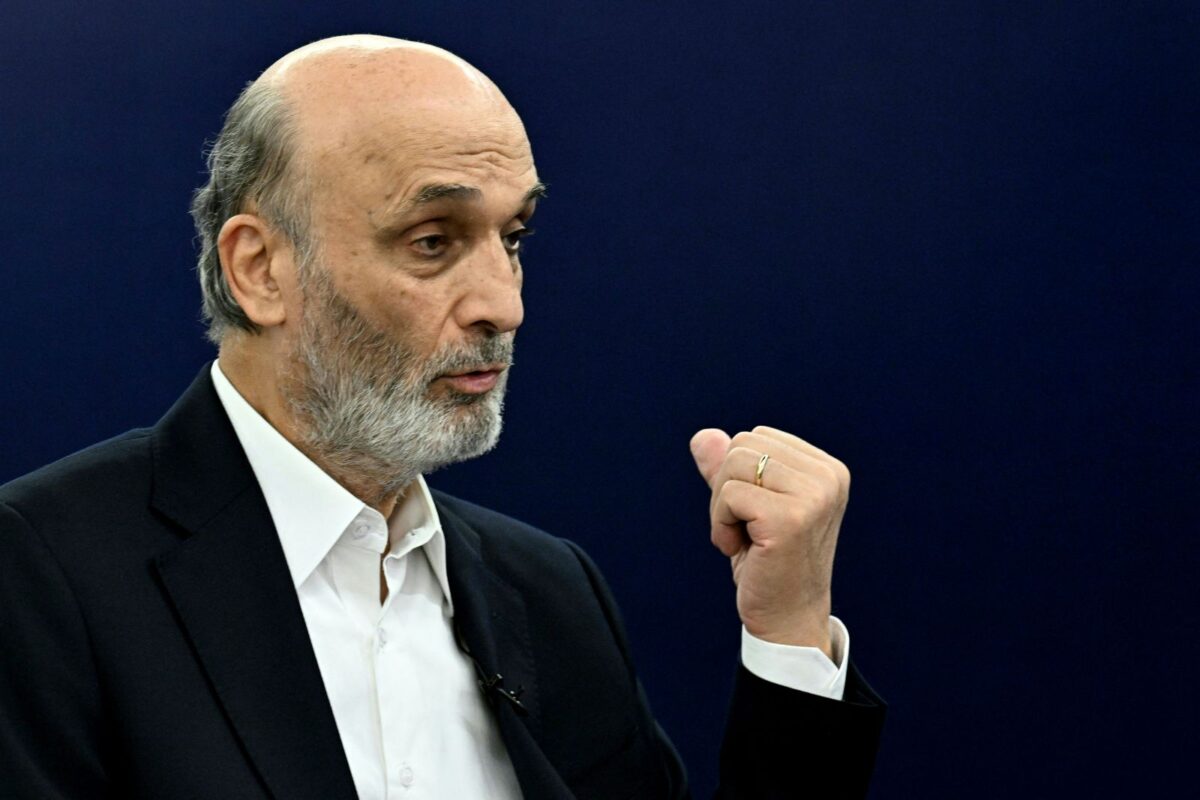
Photo by JOSEPH EID / AFP. Samir Geagea, head of the Lebanese Forces and parliament's main Christian bloc, speaks during an interview with AFP at his residence in Maarab, north of Beirut on October 7, 2025.
For the past year and a half, many who believe in the project represented by President Joseph Aoun and Prime Minister Nawaf Salam have treated criticism as a risk. The presidency and government appeared to be Lebanon’s best opportunity to restore constitutional authority. They therefore had to be defended and given time.
Samir Geagea’s speech at the Lebanese Forces’ Martyrs’ Mass broke with that protective instinct. He described the president’s framework agreement as the only available route to ending the current war and the cycle of wars on Lebanon’s southern border. But he also said something their supporters need to hear: agreement with their objectives cannot become an excuse for silence about their performance.
His most consequential argument was not that Hezbollah must surrender its weapons. Geagea has said that many times, as have others. It was that the state has already taken the decision, and responsibility has therefore moved from declaration to implementation.
Supporting state institutions does not require suspending judgment about the people running them. It requires demanding that they exercise the authority those institutions give them.
Cabinet decisions cannot remain ink on paper. The presidential oath and ministerial statement cannot continue functioning as evidence of a state that has yet to materialize. If Hezbollah refuses to dismantle its military and security structures, Geagea argued, the political authorities must take practical steps. The president, government and Parliament were not elected merely to express the correct position. They were entrusted with producing consequences. Supporting state institutions does not require suspending judgment about the people running them. It requires demanding that they exercise the authority those institutions give them.
Lebanese politics has rarely understood this distinction. We tend to alternate between two destructive relationships with authority. We either treat officials as enemies whose every decision must be opposed, or as fragile symbols whose failures must continually be explained away. One approach destroys institutions through permanent confrontation. The other empties them through permanent excuses.
Aoun and Salam deserve recognition for what has changed. The Lebanese state has formally reclaimed the decision of war and peace, entered negotiations in its own name and committed itself to the monopoly of arms. But political credit cannot be renewed indefinitely without delivery.
The difficulties are real. Hezbollah remains armed and embedded inside a frightened community. Israel continues to occupy and attack Lebanese territory. The Army must avoid an internal confrontation that could tear apart the institution expected to protect the country. Responsibility is distributed so widely that no one is finally held responsible. Prudence is therefore necessary. But prudence must have a direction, a timetable and observable results. Otherwise, it becomes another name for postponement.
This is particularly important in the relationship between political authority and the Army. Military leadership must determine how orders can be implemented safely. It cannot determine whether constitutional decisions should apply. Protecting internal stability is legitimate, but it cannot replace policy established by elected institutions. When politicians delegate the decision to generals, they transfer their own responsibility to them.
The same pattern appears outside the weapons file. Geagea acknowledged that the government has remained free of the corruption scandals that defined many of its predecessors. He then made an essential distinction: integrity is not measured only by the absence of theft. It is also measured by the speed of reform, the transparency of decisions and the willingness to pursue implementation.
A government cannot declare its work complete because it sent a necessary law to Parliament. If the financial-gap law remains blocked while depositors wait, the executive must identify the obstruction, pursue the legislation publicly and force every institution to carry its share of responsibility. Administrative procedure should not become political disappearance.
Geagea’s criticism is not above politics. His party is represented in government, and he has an interest in distinguishing its ministers from the wider cabinet. None of that invalidates the question he raised.
His speech also left one issue insufficiently developed. Ending Hezbollah’s military autonomy is necessary, but it is not the same as constructing the order that follows it. The state must offer Lebanese Shia more than demands and assurances. It must provide security, reconstruction, services and political inclusion as rights of citizenship. Disarmament without integration risks dismantling an organization while preserving the fear and alienation from which it can regenerate. That responsibility also belongs to Aoun and Salam. They must enforce the sovereignty they promised while ensuring that no community experiences the state’s arrival as its defeat.
The government’s opponents will attack it whatever it does. Its friends serve it better when they refuse to defend what it has not done.
The importance of Geagea’s speech is not that a party leader demanded a stronger state. Lebanon has heard that speech for decades. It is that he directed the demand toward those entrusted with building one, including allies with whom he shares the objective. The government’s opponents will attack it whatever it does. Its friends serve it better when they refuse to defend what it has not done.
Aoun and Salam do not need another year of applause for intentions. They need a constituency that supports their project strongly enough to hold them accountable for it. If we protect a government from judgment until the state becomes strong, we may guarantee that it never does.
Ramzi Abou Ismail is a Political Psychologist, Researcher and Analyst.
The views in this story reflect those of the author alone and do not necessarily reflect the beliefs of NOW.