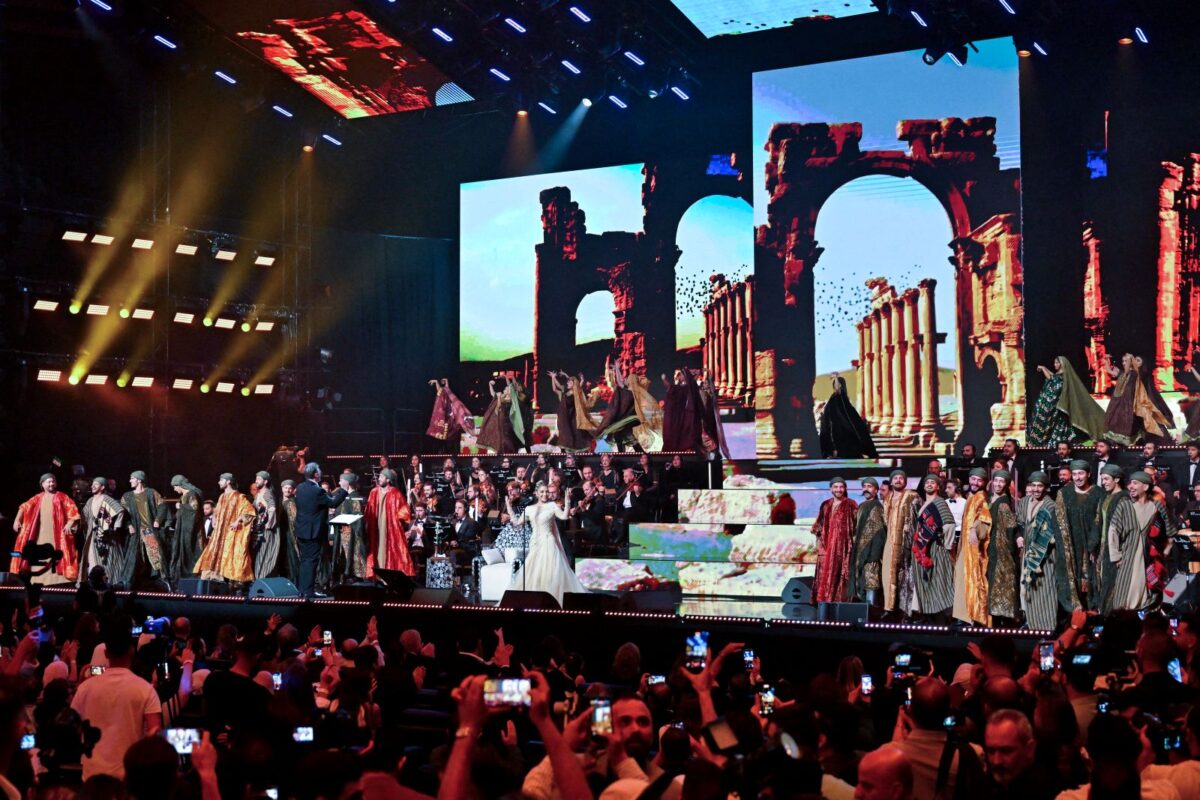
Syrian singer Assala Nasri performs during her concert - held after a 15-year hiatus - at the Al-Fayhaa Sports City in Damascus on September 17, 2026. (Photo by LOUAI BESHARA / AFP)
Thirty-two years separate Fairuz’s concert in downtown Beirut from Asala’s return to the stage in Damascus. Yet, watching the crowds gather to hear Asala sing, I could not escape the feeling that I was witnessing the same act of collective defiance: a wounded city reclaiming its right to live.
On September 17, 1994, Fairuz stood in Martyrs’ Square, in the heart of a Beirut still carrying the physical and emotional scars of fifteen years of war. The square had once been a front line. The buildings surrounding it were shattered, and much of the city remained divided by memory, suspicion and grief. Yet tens of thousands came to listen.
That concert was not simply an evening of music. It was a declaration: Beirut was not dead.
Fairuz’s appearance was also attacked. There were those who viewed the concert as a spectacle intended to conceal the wounds of war or promote Rafik Hariri’s reconstruction project. They argued that music could not compensate for unresolved grievances, missing persons, destroyed homes or an incomplete peace. Some could not—or would not—understand why anyone should sing while the country was still grieving.
But the late martyr Rafik Hariri understood something his critics often missed: rebuilding a country requires more than repairing roads and raising buildings. People must be persuaded to believe in their country again. They must be given a reason to return to its public squares, to imagine a future there and to bring their children into spaces once ruled by snipers and militiamen.
Fairuz did not erase Lebanon’s war. She broke its monopoly over the Lebanese imagination. Asala’s concert in Damascus carries a similar meaning
Fairuz did not erase Lebanon’s war. She broke its monopoly over the Lebanese imagination.
Asala’s concert in Damascus carries a similar meaning. After sixteen years away from a Syrian stage, she returned to sing in a capital that had been held hostage for decades by a regime that feared every independent voice. Her return was especially meaningful because Asala did not remain silent when silence was safer. She stood with Syrians who demanded dignity and freedom and paid for that position with exile from her own country.
To see her singing in Damascus today, before an audience celebrating rather than whispering, is to see history answer tyranny in its own language.
Naturally, the usual chorus of critics has appeared. Some say it is too early to celebrate. Others point to poverty, insecurity, injustice and the immense work still ahead. Syrians, they argue, should not dance while so many wounds remain open.
But who decided that grief and joy cannot inhabit the same country—or even the same heart?
No Syrian needs to be reminded of the destruction. We carry it in our families, in our cities and in the empty chairs at our tables. We know the fate of the disappeared has not been settled. We know that rebuilding Syria will require justice, institutions, accountability and years of difficult work. A concert cannot replace any of this.
No Syrian needs to be reminded of the destruction. We carry it in our families, in our cities and in the empty chairs at our tables. We know the fate of the disappeared has not been settled. We know that rebuilding Syria will require justice, institutions, accountability and years of difficult work. A concert cannot replace any of this.
But neither does suffering oblige us to surrender music to our killers.
For decades, the Assad regime tried to convince Syrians that the country belonged to one family and that culture existed only to glorify its rule. It turned theatres, television screens and public celebrations into instruments of obedience. Even joy had to receive security approval. The regime did not merely kill Syrians; it tried to control what they were permitted to feel.
That is why dancing in Damascus matters.
The men who killed Syria are no longer standing triumphantly in its squares. Some are hiding in Russia. Others have gone to their graves. Many of their accomplices are scattered, frightened or exposed. But the Syrians who wagered everything on liberty are still here. They are singing, dancing and insisting that their country belongs to life rather than to prisons, mass graves and inherited fear.
As a Syrian and a Lebanese, I see Asala’s Damascus concert through the memory of Fairuz in Beirut. Both moments remind us that rebuilding is not a betrayal of the dead. On the contrary, rebuilding is a promise to them: that those who destroyed our countries will not be allowed to define their future.
As a Syrian and a Lebanese, I see Asala’s Damascus concert through the memory of Fairuz in Beirut. Both moments remind us that rebuilding is not a betrayal of the dead. On the contrary, rebuilding is a promise to them: that those who destroyed our countries will not be allowed to define their future.
Fairuz sang while Beirut was still wounded. In time, even many of those who attacked that evening came to recognize it as one of the defining moments of Lebanon’s return to life. Asala has now sung before a wounded Damascus. Perhaps her concert, too, will be remembered not as an escape from reality but as the moment Syrians began imagining a different one.
Syria still has a long and difficult road ahead. But on this night, its voice was louder than the jailer’s keys and stronger than the propaganda of its executioners.
Syria still has a long and difficult road ahead. But on this night, its voice was louder than the jailer’s keys and stronger than the propaganda of its executioners.
Damascus sang again. And Syria danced with it.