Washington, United States, Photo by SAUL LOEB / AFP
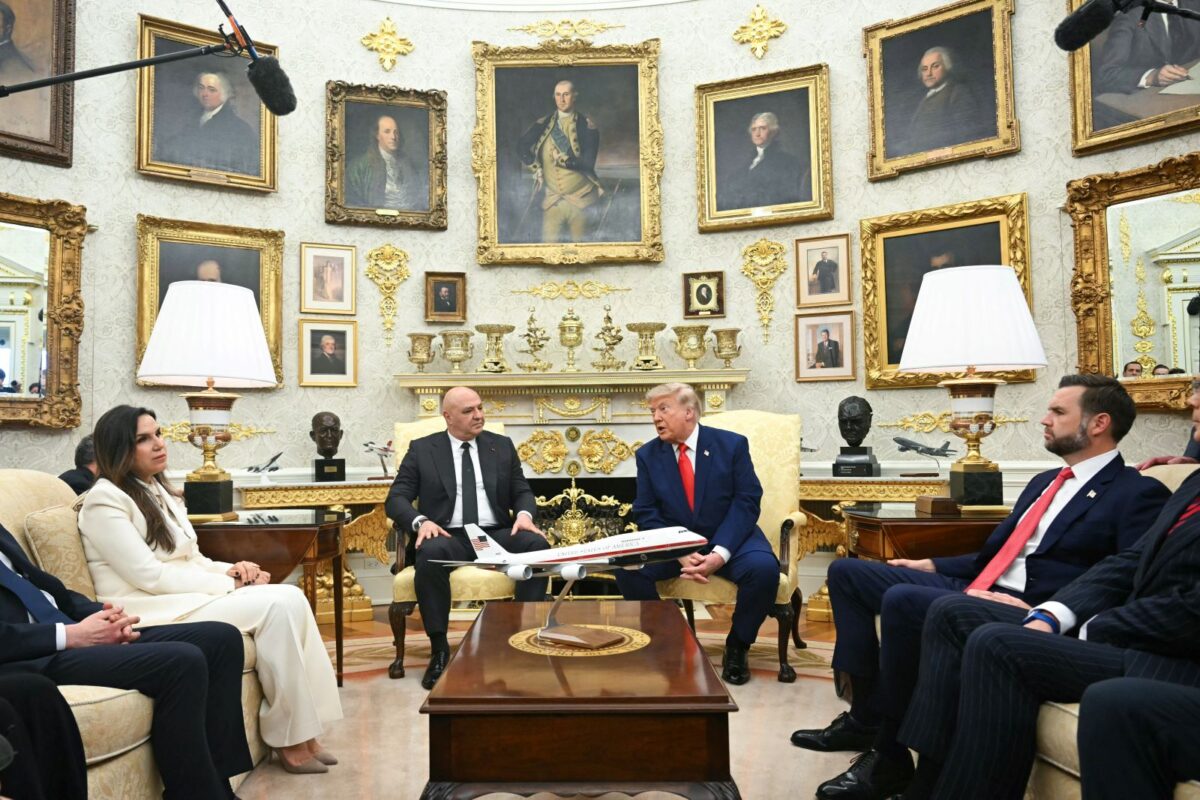
US President Donald Trump meets with Lebanese President Joseph Aoun in the Oval Office of the White House in Washington, DC, on July 21, 2026.
There are moments in Lebanese politics when the loudest criticism is not necessarily a warning but a measure of success.
In a country where political language has long been inverted—where sovereignty is denounced as submission and the state’s authority is portrayed as provocation—it is often more revealing to examine who is attacking a public official than to listen to what they are saying. Sometimes the identity of one’s adversaries offers the clearest indication that the right battle is finally being fought.
That is why President Joseph Aoun should not be alarmed by the campaign being waged against him following his visit to Washington, his embrace of negotiations, and his insistence that the Lebanese state alone must exercise the legitimate monopoly over arms. If anything, the ferocity of the attacks reflects something far more significant than ordinary political disagreement. It suggests that, for the first time in years, Lebanon’s entrenched system of parallel authority believes it may actually have something to lose.
Aoun’s visit to the White House was never about diplomatic symbolism or the ritual exchange of handshakes and photographs with President Donald Trump. It was the first visit by a Lebanese president to the Oval Office in nearly two decades, taking place at a moment when Lebanon finds itself confronting questions that have remained unresolved for a generation: Israel’s withdrawal from the south, the strengthening of the Lebanese Armed Forces, the implementation of the state’s exclusive authority over weapons, and the recovery of sovereign decision-making after decades of fragmentation.
The visit also followed the framework agreement that envisions a phased Israeli withdrawal, the deployment of the Lebanese Army throughout southern Lebanon, and a process aimed at resolving the question that has haunted the republic for decades: Hezbollah’s military autonomy.
This explains why the visit immediately became the target of a coordinated campaign of political delegitimization. Such campaigns are hardly new. Lebanon’s postwar history is filled with efforts to discredit every attempt to strengthen the state whenever those efforts threatened the interests of the country’s parallel security and political structures. Character assassination has often proved easier than constitutional debate.
Yet Hezbollah’s objection has never really been Washington.
Its own leaders and allies have travelled freely to capitals around the world whenever circumstances required. They have negotiated, coordinated, and lobbied foreign governments without ever describing such engagement as a surrender of sovereignty. The destination is therefore not the issue.
The problem is representation.
Joseph Aoun travelled to Washington as President of the Lebanese Republic rather than as the representative of Iran’s regional project. For perhaps the first time in many years, Lebanon’s national file was carried by the Lebanese state itself instead of appearing as one chapter within Tehran’s wider regional negotiations, whether in Muscat, Islamabad, or elsewhere.
That distinction changes everything.
For years, Hezbollah has insisted that Lebanon remain strategically inseparable from Iran’s regional confrontation with the United States and Israel. The country’s southern border has too often functioned less as Lebanon’s frontier than as a geopolitical pressure point through which Tehran communicates with Washington. Decisions over war and peace have repeatedly been subordinated to calculations that have little to do with Lebanon’s own national interests.
The central question confronting Lebanon today is therefore not whether negotiations should occur. Negotiations have always existed. The question is far simpler: who negotiates on Lebanon’s behalf?
The central question confronting Lebanon today is therefore not whether negotiations should occur. Negotiations have always existed. The question is far simpler: who negotiates on Lebanon’s behalf?
Is it the Lebanese Republic? Or is it an armed organization whose strategic priorities ultimately lie beyond Lebanon’s borders?
That is precisely why Hezbollah’s media apparatus has portrayed Aoun’s visit as evidence of submission, dependency, or even the abandonment of sovereignty. The accusation collapses under its own contradictions.
Sovereignty is not measured by the frequency with which Iranian officials arrive in Beirut to lecture Lebanese citizens about resistance.
Nor is sovereignty reflected in allowing an ideological armed movement to possess greater military capabilities than the state itself while independently deciding when Lebanon enters war and when it returns to uneasy calm.
Nor can sovereignty mean repeatedly exposing southern Lebanon to devastation before asking its residents to celebrate their own sacrifice.
Sovereignty begins with something far less theatrical but infinitely more important: the principle that the Lebanese state alone speaks for Lebanon, negotiates for Lebanon, and decides when Lebanon goes to war and when it remains at peace.
Sovereignty begins with something far less theatrical but infinitely more important: the principle that the Lebanese state alone speaks for Lebanon, negotiates for Lebanon, and decides when Lebanon goes to war and when it remains at peace.
It also requires that the Lebanese Armed Forces—not any political party, militia, or external patron—exercise authority across every inch of Lebanese territory.
The same logic inevitably extends to Speaker Nabih Berri.
Berri occupies one of the republic’s highest constitutional offices, and the presidency must continue dealing with him within that constitutional framework. Yet constitutional partnership cannot become an unlimited veto over the state’s recovery, nor should it permit the Speaker to continue serving as the political guarantor of a parallel system that protects Hezbollah’s military status while weakening the institutions he is sworn to uphold.
Ultimately, Berri faces a political choice that cannot indefinitely be postponed.
He can remain Speaker of Parliament, committed to preserving the Constitution and strengthening the republic.
Or he can continue acting as the indispensable intermediary between the Lebanese state and the armed state that exists alongside it.
History suggests that Lebanon can no longer sustain both roles simultaneously.
None of this implies that Washington alone can solve Lebanon’s crisis.
No foreign capital possesses a formula capable of repairing decades of institutional collapse, economic devastation, and political paralysis. International support remains essential, but it cannot substitute for domestic political will.
Joseph Aoun therefore arrives in Washington not as a petitioner seeking sympathy but as the representative of a state attempting to reclaim its constitutional responsibilities.
That distinction matters.
Donald Trump is unlikely to be persuaded by emotional appeals or narratives of perpetual Lebanese victimhood. He is far more likely to respond to a government capable of defining concrete objectives and demonstrating political resolve.
Lebanon’s message should therefore be clear.
Support the full implementation of the framework agreement.
Support Israel’s complete withdrawal from Lebanese territory.
Strengthen the Lebanese Armed Forces politically, financially, and militarily.
And support the Lebanese state’s effort to restore its exclusive authority over the country’s territory and institutions.
The real examination, however, begins only after the presidential aircraft lands back in Beirut.
Will the language of sovereignty become public policy?
Will the army receive political protection once implementation becomes politically costly?
Will the presidency resist attempts to dilute, postpone, or reinterpret commitments made in Washington?
Most importantly, will Lebanon’s national file remain in the hands of the Lebanese state, or will it once again return to becoming another bargaining chip in Iran’s regional negotiations?
These questions explain why the attacks against Aoun have become increasingly personal and increasingly intense. He should not fear them.
If anything, he should worry the day Hezbollah, Nabih Berri, and the wider Axis of Resistance begin celebrating his presidency instead. For history offers a sobering lesson.
Every Lebanese leader who eventually earned the approval of the country’s armed parallel state did so only after abandoning the difficult work of confronting it. They chose accommodation over reform, coexistence over sovereignty, and temporary political stability over the gradual reconstruction of the republic.
That path has been travelled before. It has never ended with a stronger Lebanese state.
As long as those invested in preserving the current system continue portraying Joseph Aoun as a threat, there remains reason to believe that he continues to challenge the very structures that have prevented Lebanon from becoming a fully sovereign republic.
In today’s Lebanon, that may well be the highest vote of confidence a president can receive.
This article originally appeared in Elaph.
Makram Rabah is a lecturer at the American University of Beirut, Department of History. His forthcoming book Conflict on Mount Lebanon: The Druze, the Maronites and Collective Memory (Edinburgh University Press) covers collective identities and the Lebanese Civil War.