Sovereignty does not always begin at a country’s borders. It is not forged only in cabinet meetings, military headquarters, or negotiations over weapons. Sometimes, it begins with something far more ordinary: a wall.
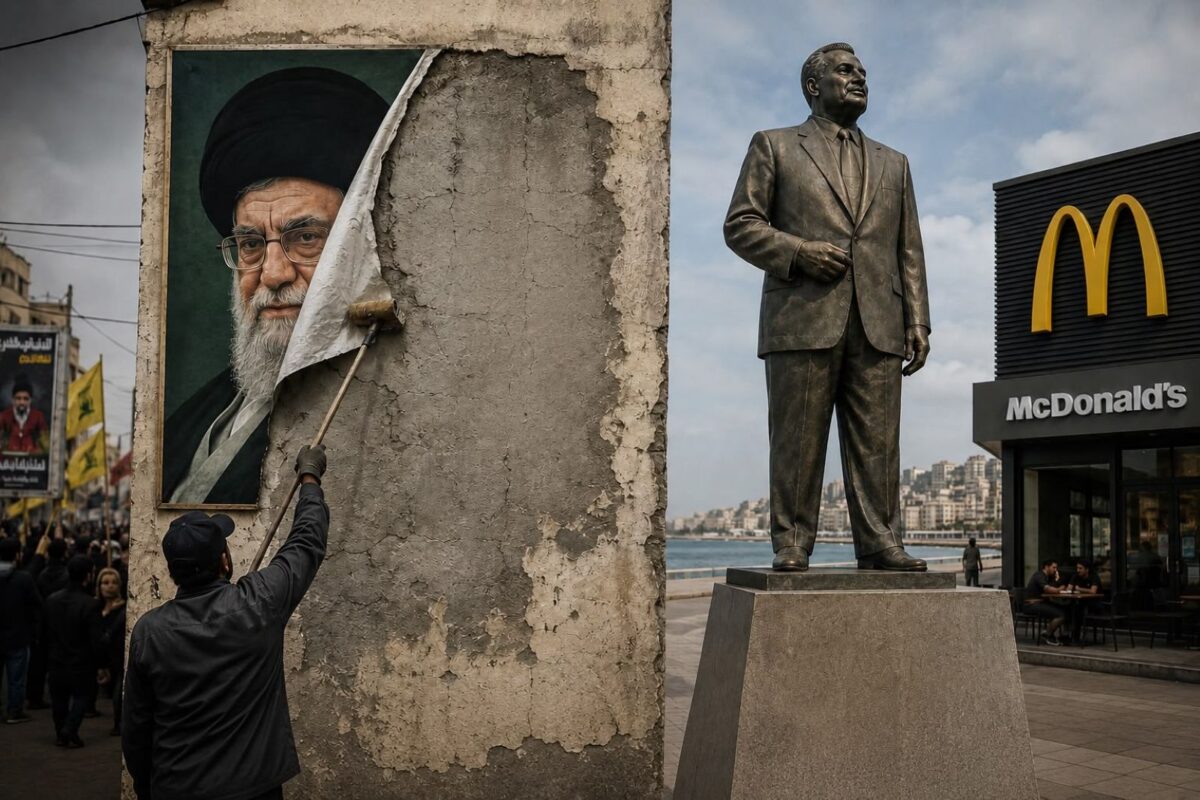
That is why the removal of Ali Khamenei’s portrait from the façade of a building in Karbala was never merely a municipal decision. According to widely circulated accounts, the owner of the building requested that the portrait be taken down, after which Iraqi security forces reportedly enforced the decision and prevented other images from being rehung. While the full circumstances remain contested and no comprehensive official account has been issued, the symbolism was unmistakable. The moment the portrait came down, the wall itself became a battlefield over sovereignty.
The controversy was never about a single image. It was about what such images represent when they are imposed upon public space.
The controversy was never about a single image. It was about what such images represent when they are imposed upon public space.
Iran’s regional project was never built through missiles, militias, and political alliances alone. It also constructed an elaborate visual architecture of power: portraits of supreme leaders, revolutionary banners, murals, street names, monuments, and shrines that gradually transformed political figures into untouchable symbols. These images were never intended simply to commemorate; they were designed to normalize domination.
When the same face appears on every street corner, every bridge, every neighborhood entrance, and every public square, citizens begin to internalize a message that extends well beyond politics. The image suggests permanence. It implies inevitability. It quietly communicates that resistance is futile because the authority behind the portrait is everywhere.
This is why removing such symbols from public spaces is not an aesthetic exercise or an act of urban planning. It is the first step in challenging a political narrative that equates ownership of the city with ownership of weapons. It is an attempt to return walls to their communities rather than to armed organizations and to reclaim national identity from the visual occupation of foreign leaders.
There is, however, an even more revealing lesson.
An abundance of portraits is not necessarily evidence of an abundance of supporters.
Indeed, it often suggests precisely the opposite.
A genuinely popular leader does not require armed men to guard his image. He does not need political organizations willing to threaten violence whenever a poster is removed or a mural painted over. Leaders who command authentic legitimacy reside in the memories of their people. Those who survive only on concrete walls require constant displays of force to keep those walls intact.
The proliferation of images associated with Iran’s regional axis therefore reveals less about public affection than about the ability of armed groups operating outside the authority of the state to occupy public space. These organizations do not ask residents whether they want the portraits. They do not seek permission from property owners. They treat streets and neighborhoods not as shared civic spaces but as conquered territory upon which their flags and symbols can be planted.
The portrait thus becomes less an expression of admiration than a declaration of control.
Lebanon has long lived with this reality.
Entire neighborhoods have been transformed into political landscapes where the images of Lebanese and foreign leaders dominate buildings, intersections, and public institutions. In many parts of the country, walking through the streets can feel less like moving through a national capital than passing through the territory of competing political fiefdoms.
Yet history has a remarkable sense of irony.
Along Beirut’s Ain el-Mreisseh Corniche stands a monument to Gamal Abdel Nasser, only a short walk from one of the city’s McDonald’s restaurants. Lebanese journalists have long pointed to the peculiar juxtaposition between the Arab nationalist leader who built his political identity around anti-imperialism and resistance to Western influence and the American fast-food chain that has become, fairly or unfairly, one of globalization’s most recognizable symbols.
Today, however, few pedestrians pause before the monument to reflect on Nasser’s promises of Arab unity or liberation. For most Beirutis, the statue has acquired an entirely different purpose. It serves as a geographical reference point.
Today, however, few pedestrians pause before the monument to reflect on Nasser’s promises of Arab unity or liberation. For most Beirutis, the statue has acquired an entirely different purpose. It serves as a geographical reference point.
Turn left at Nasser, and you will find McDonald’s.
Perhaps no political symbol could suffer a more devastating fate.
A leader who once promised to reshape the Arab world has become little more than a navigational landmark directing people toward a fast-food restaurant. The monument no longer mobilizes a movement, evokes a revolutionary vision, or sustains a political project. It survives largely because no one has found sufficient reason to remove it—not because the ideology it once embodied continues to command public imagination.
That is the ultimate limitation of political iconography.
Portraits and monuments can occupy physical space, but they cannot permanently occupy collective memory. Force may keep an image hanging on a wall, but it cannot compel belief. What appears today as overwhelming dominance can tomorrow become little more than an overlooked fixture of the urban landscape—or simply a convenient landmark on the way to lunch.
For Iraq, the significance of what happened in Karbala extends well beyond a single portrait. Prime Minister Mohammed al Zaidi’s broader effort to reduce Iranian tutelage, diversify Iraq’s foreign partnerships, and gradually restore the state’s authority will not be measured by one removed image alone. The Iraqi government continues to navigate a deeply entrenched political and security legacy while attempting to reclaim decision-making from competing centers of power.
The true test is whether incidents like Karbala become the norm rather than the exception: whether no foreign leader, regardless of ideology or alliance, enjoys symbolic supremacy over Iraqi sovereignty; whether no armed organization stands above the law; and whether no faction can claim ownership over public space simply because it possesses weapons.
Those who seek to restore national sovereignty must first restore the public square.
Those who seek to restore national sovereignty must first restore the public square.
Because sometimes, the recovery of the state begins somewhere remarkably modest: with a wall that finally belongs to its citizens once again.
This article originally appeared in Elaph.
Makram Rabah is the managing editor at Now Lebanon and an Assistant Professor at the American University of Beirut, Department of History. His book Conflict on Mount Lebanon: The Druze, the Maronites and Collective Memory (Edinburgh University Press) covers collective identities and the Lebanese Civil War. He tweets at @makramrabah