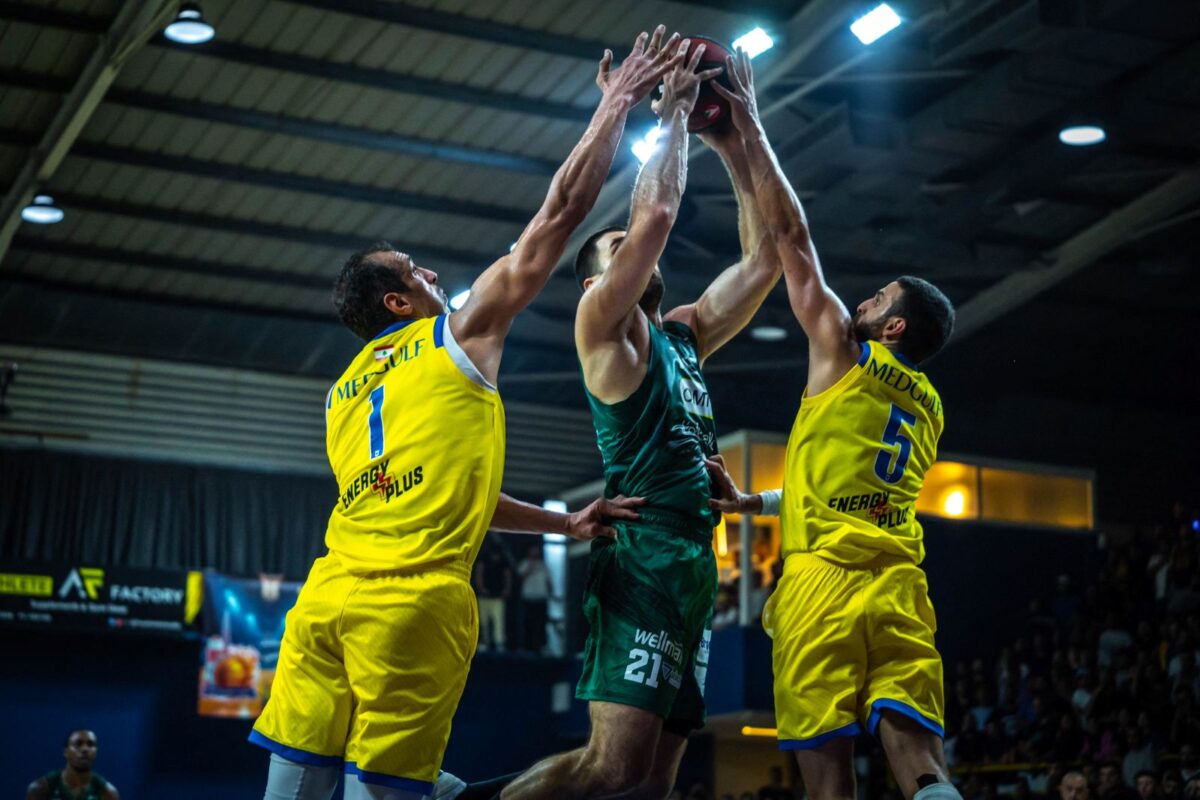
Beirut, LEBANON. 2025 - lebanese - basketball - championship
Photo by NAEL CHAHINE / MIDDLE EAST IMAGES / MIDDLE EAST IMAGES VIA AFP
The final score will say that Riyadi defeated Sages 87–85 to take a 2–1 lead in the Lebanese Basketball Championship finals. It will record another thrilling contest between two historic rivals, another sold-out arena, another chapter in what has become one of the most compelling sporting rivalries in the Middle East.
But anyone who was inside the arena knows that the real story was not the two-point margin.
It was the soundtrack.
For forty minutes, the game unfolded beneath a relentless chorus of abuse. Not competitive chanting. Not witty banter. Not passionate support. Rather, sustained insults directed at the players of the opposing team, including repeated chants cursing their mothers. The crowd became an instrument of intimidation, and the line separating passionate support from organized humiliation disappeared entirely.
As someone who has supported Riyadi since childhood, writing these words is not easy.
I have celebrated Riyadi’s victories, admired its tradition of excellence, and watched generations of extraordinary players wear its jersey. I remain proud of what the club has contributed to Lebanese basketball. That is precisely why what happened in Game Three is so disappointing.
Loving a club should never require remaining silent when it betrays the values that made us love it in the first place.
Loving a club should never require remaining silent when it betrays the values that made us love it in the first place.
Many will dismiss what happened by saying that “this is basketball,” that emotions run high during championship finals, and that hostile crowds are part of home-court advantage. They are wrong.
There is a fundamental difference between creating an intimidating atmosphere and normalizing vulgarity. A roaring crowd can inspire its own players and unsettle opponents without abandoning every standard of decency. When thousands of supporters collectively engage in abusive chants, they cease being an asset to the sport and become a liability to it.
The most troubling aspect of the evening was not simply what happened inside the arena. It was what happened afterward.
Almost nobody wanted to discuss it.
Much of the Lebanese media reduced the match to its tactical brilliance, its dramatic ending, and the intensity of the rivalry. The uglier reality barely registered. It was as though abusive behavior had become so normalized that it no longer deserved mention.
This silence reflects something much larger than basketball.
It reflects a culture in which success increasingly absolves misconduct. If the home team wins, everything else is forgiven. The result becomes the only thing that matters. The means are forgotten. Victory sanitizes behavior that, in any other context, would be universally condemned.
This mentality should concern us far beyond sport.
Because sport is never just sport.
The basketball court is one of the few remaining places in Lebanon where people from different communities gather under one roof. At a time when politics divides almost every public space, basketball has become one of the country’s rare shared civic experiences. Families attend together. Children wear their favorite players’ jerseys. Teenagers dream of becoming the next Wael Arakji or Youssef Khayat. The sport has become one of Lebanon’s genuine success stories, producing international recognition despite the country’s endless crises.
That success now risks being undermined not by poor officiating or financial problems, but by a culture of intolerance that is slowly becoming part of the spectacle itself.
That success now risks being undermined not by poor officiating or financial problems, but by a culture of intolerance that is slowly becoming part of the spectacle itself.
Young supporters learn as much from the stands as they do from the court.
If they see adults expressing passion through insults, they learn that humiliation is a legitimate form of competition. If they hear thousands of voices cursing opponents’ families, they internalize the idea that loyalty excuses indecency. The lesson is not confined to basketball. It becomes a lesson about citizenship, disagreement, and public behavior.
One cannot spend years lamenting the coarsening of Lebanese public life while simultaneously celebrating it inside sports arenas.
Even more worrying is the precedent this creates.
When one fan base successfully weaponizes abuse without consequences, the opposing side will inevitably respond in kind. The next match becomes louder, uglier, and more personal. Escalation becomes inevitable because every side feels justified by the other’s behavior. Eventually, the insults cease to be enough. History teaches us that dehumanization rarely remains verbal forever.
This is how rivalries become vendettas.
Responsibility therefore rests not only with the supporters but also with club administrations, league officials, and broadcasters. Silence is not neutrality. Looking away is not professionalism. Every institution involved in Lebanese basketball has an obligation to define the boundaries of acceptable behavior and enforce them consistently.
Riyadi may well go on to win this championship. If they do, they will almost certainly deserve it based on the quality of their basketball.
But championships are temporary.
Culture endures.
Lebanese basketball has spent years building a product that filled arenas, inspired children, and gave the country something to celebrate. It would be tragic if that achievement were sacrificed because clubs, media outlets, and supporters collectively decided that winning justified everything.
Lebanese basketball has spent years building a product that filled arenas, inspired children, and gave the country something to celebrate. It would be tragic if that achievement were sacrificed because clubs, media outlets, and supporters collectively decided that winning justified everything.
The greatest teams are remembered not only because they won trophies, but because they elevated the game itself.
Game Three reminded us that it is possible to win the match while diminishing the sport.
For the sake of Lebanese basketball—and for the generation now watching from the stands—we should make sure that never becomes our definition of victory.
Makram Rabah is a lecturer at the American University of Beirut, Department of History. His forthcoming book Conflict on Mount Lebanon: The Druze, the Maronites and Collective Memory (Edinburgh University Press) covers collective identities and the Lebanese Civil War.