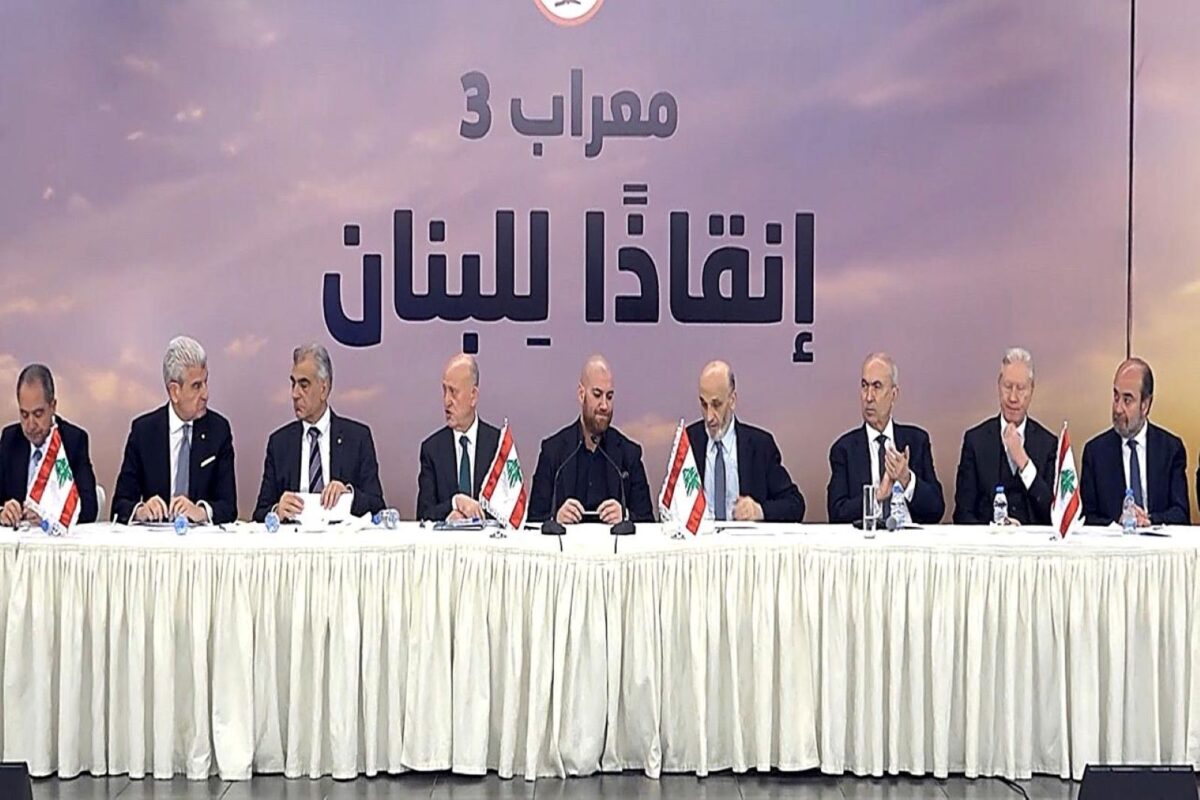
At a moment when Lebanon once again finds itself dragged to the edge of a wider regional abyss, the statement issued from the Ma’arab meeting stands out not simply for what it says—but for what it refuses to accept. It refuses ambiguity. It refuses the language of evasion. And perhaps most importantly, it refuses to continue playing by the rules imposed on Lebanon by those who benefit from its weakness.
For years, Lebanese political discourse has been trapped in a suffocating cycle of false equivalences. Every crisis is diluted, every responsibility blurred, every act of aggression reframed as part of some inevitable “balance.” The result has been paralysis—an erosion of the very idea of the state. What the Ma’arab statement does, with clarity and urgency, is break that cycle.
It begins with a simple but long-overdue assertion: silence is no longer neutrality; it is complicity. This is not rhetorical escalation—it is an accurate diagnosis of Lebanon’s condition. When decisions of war and peace are taken outside the framework of the state, when institutions are bypassed or coerced, and when entire communities are exposed to destruction without their consent, the problem is no longer political disagreement. It is the collapse of sovereignty.
The statement’s insistence on naming responsibility is equally significant. For too long, Lebanon has been asked—internally and externally—to live with a contradiction: a state that is held accountable for outcomes it does not control. By clearly identifying the chain of decision-making—linking the actions of Hezbollah to a broader Iranian strategic framework—the meeting restores a basic principle of political life: accountability must follow authority. Without this, there can be no justice, no recovery, and certainly no deterrence against future catastrophes.
Yet what makes this moment particularly important is not only the clarity of diagnosis, but the refusal to descend into the familiar traps set by Hezbollah and its allies. The politics of intimidation in Lebanon has always relied on two tools: the threat of civil war, and the accusation of treason. Raise the issue of weapons outside the state, and you are accused of inviting conflict. Demand sovereignty, and you are labeled as serving foreign agendas.
The Maarab gathering rejects this binary altogether. It reframes the debate on its own terms: the real danger to civil peace is not the restoration of the state, but the persistence of a dual system in which armed power exists beyond accountability. In other words, the path to stability does not lie in accommodating illegality—it lies in ending it.
The Maarab gathering rejects this binary altogether. It reframes the debate on its own terms: the real danger to civil peace is not the restoration of the state, but the persistence of a dual system in which armed power exists beyond accountability. In other words, the path to stability does not lie in accommodating illegality—it lies in ending it.
Equally noteworthy is the meeting’s attempt to speak directly to those most affected by the consequences of this reality: the people of the South, the Bekaa, and the southern suburbs of Beirut. This is a crucial shift. For too long, these communities have been spoken about rather than spoken to—reduced to political symbols rather than recognized as citizens with agency, interests, and rights. By affirming that the call for state authority is not directed against them but intended to protect them, the statement opens the door to a different kind of national conversation—one that moves beyond sectarian mobilization toward shared stakes.
The proposals outlined—legal accountability, international recourse for damages, the implementation of UN resolutions, and the reaffirmation of the Lebanese army’s central role—are not radical innovations. They are, in fact, the basic components of any functioning state. What has made them appear extraordinary in Lebanon is precisely how far the country has drifted from normalcy.
But perhaps the most important contribution of this meeting is its attempt to shift Lebanon from a mindset of crisis management to one of resolution. For decades, the country has survived by postponing solutions, by absorbing shocks, by negotiating temporary arrangements that leave underlying problems untouched. This approach is no longer sustainable. The cost—economic, social, and human—has become too high.
Lebanon today is indeed facing a stark choice: a state or no state. This is not a slogan; it is a reality imposed by events. And what the Ma’arab statement represents is a willingness—finally—to confront that reality head-on.
Lebanon today is indeed facing a stark choice: a state or no state. This is not a slogan; it is a reality imposed by events. And what the Ma’arab statement represents is a willingness—finally—to confront that reality head-on.
If this moment is to mean anything, however, it must not remain a declaration. It must become a trajectory. It must expand beyond one meeting, one coalition, or one political camp. It must be translated into sustained pressure—legal, political, and societal—aimed at restoring the primacy of the state.
Lebanon does not need more narratives to justify its fragmentation. It needs a project to end it. And for the first time in a long while, the Ma’arab meeting offers the outline of such a project.