May 25 has returned, not as a day of liberation, but as yet another occasion reminding the Lebanese that Hezbollah has not only confiscated the decision of war and peace, but has also confiscated joy itself. It has drained happiness from public life and made it impossible for the Lebanese to smile, breathe, or remember a national occasion without turning it into a military bulletin, a sectarian elegy, and a speech of internal intimidation wrapped in a surplus of illusion.
Liberation Day was supposed to be a shared national space. It was meant to be a moment in which the Lebanese could celebrate the Israeli withdrawal from their land in the year 2000, and affirm that the Lebanese state, despite all its weaknesses and failures, must reclaim its sovereignty over all its borders and all its territory. But Hezbollah, as always, cannot tolerate national occasions unless it transforms them into private property. Liberation, for the party, is not a Lebanese achievement. It is an exclusive franchise. The South is not a part of Lebanon, but Hezbollah’s permanent stage for bloodshed, rubble, and recorded speeches.
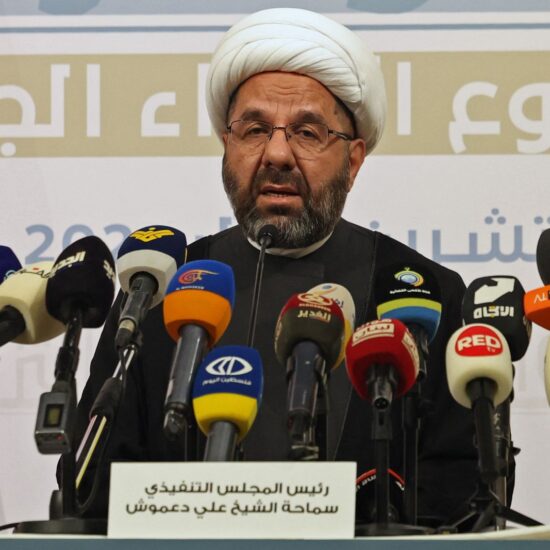
Naim Qassem, Hezbollah Secretary General’s, latest speech was not a victory speech. It was a long exercise in denial. He spoke as though Lebanon were living through a national wedding, as though the South were fine, as though hundreds of villages had not been crushed, and as though more than a million and a half Shiites from the South, the southern suburbs, and the Bekaa had not been turned into displaced people inside their own country—waiting for a promise that never arrives, compensation that never comes, and homes that will never be restored as they once were.
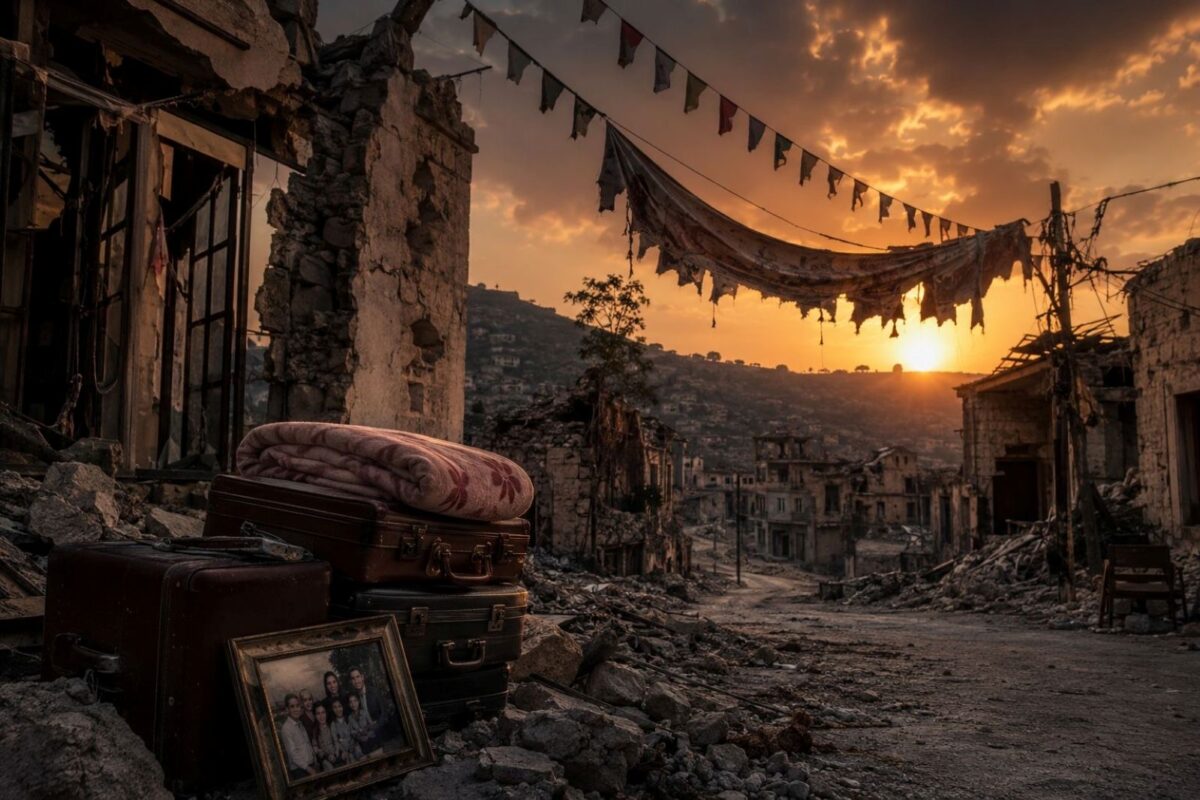
Hezbollah speaks of destroyed tanks and burned vehicles, but it refuses to answer the simplest question: who will return the people of the South to their homes? Who will give them back the memories buried under the rubble? Who will restore the smell of figs, olives, and tobacco? Who will return the photographs of grandparents that once hung on walls that no longer exist?
The party’s propaganda machine celebrates what it calls “battleground achievements.” Astonishing, this kind of celebration, while villages lie destroyed and families are scattered. What kind of steadfastness is this when homes and memories have become debris? What kind of sacrifice is this when the children of the South are outside their schools? Is this also part of the battle? As if people are expected to applaud the loss of their own lives, and thank the very force that dragged them into war because it promised them, in one speech after another, that victory was coming—or that a possible American-Iranian agreement, or some anticipated memorandum of understanding, would arrive like a miracle at the end of days.
Here lies the obscene paradox. Hezbollah curses America by day and waits for its signature by night. It insults the American mediator, yet builds its calculations on an American-Iranian understanding. It attacks the Lebanese state for not objecting loudly enough, while admitting, without realizing it, that its real decision does not lie in Beirut, Bint Jbeil, or Tyre, but in Tehran and Washington
Here lies the obscene paradox. Hezbollah curses America by day and waits for its signature by night. It insults the American mediator, yet builds its calculations on an American-Iranian understanding. It attacks the Lebanese state for not objecting loudly enough, while admitting, without realizing it, that its real decision does not lie in Beirut, Bint Jbeil, or Tyre, but in Tehran and Washington. What kind of “resistance” waits for salvation from a deal between the very power it calls the “Great Satan” and the regime it treats as its political and military guardian?
The most dangerous element in Qassem’s speech is not merely the scale of illusion, but the function of the weapon hidden between the lines. The weapon is no longer directed primarily at Israel; it has become a message to the Lebanese interior. Anyone who refuses Hezbollah’s narrative becomes, in practice, a partner in the Israeli project. Anyone who demands the monopoly of arms by the state becomes a knife in the back. Anyone who asks about sovereignty, the constitution, or the state becomes an American tool.
This is not resistance. It is armed blackmail. This is not a defense strategy. It is an open declaration that the weapon will remain above the state, above the constitution, and above people’s lives and fate—until Hezbollah alone decides when war ends, when negotiations begin, and when the Lebanese are allowed to raise their voices.
This is not resistance. It is armed blackmail. This is not a defense strategy. It is an open declaration that the weapon will remain above the state, above the constitution, and above people’s lives and fate—until Hezbollah alone decides when war ends, when negotiations begin, and when the Lebanese are allowed to raise their voices.
Hezbollah has succeeded in one thing that cannot be denied: it has turned Liberation Day into a national memory celebrated in a time of misery, calamity, and destruction caused by the party’s own practices. It has stolen from the Lebanese the meaning of victory, just as it stripped the state of its meaning. It has turned liberation into an occasion for threats rather than joy, for accusations of treason rather than reconciliation, for glorifying destruction rather than protecting people.
Even happiness has become suspicious in Hezbollah’s dictionary. Even a joke is now treason. Even a question is a conspiracy.
As for the people of the South, especially the Shiite community Hezbollah claims to protect, they are paying the heaviest price. They are not a theatrical audience. They are human beings. They have homes, livelihoods, dreams, and memories that carry all their losses
As for the people of the South, especially the Shiite community Hezbollah claims to protect, they are paying the heaviest price. They are not a theatrical audience. They are human beings. They have homes, livelihoods, dreams, and memories that carry all their losses. The people of the South cannot be reduced to the image of a fighter, a martyr’s banner, or a propaganda clip of a drone. Their dignity is not protected by keeping them displaced forever so that Hezbollah can keep its weapons forever.
Eid, in what condition have you returned, O Eid?
You have returned while Lebanon is robbed of joy, while the South is devastated, its homes destroyed, while the state has been stripped of its decision, and while Hezbollah remains trapped in its own delusion.
You have returned to remind us of the truth everyone tries to avoid: whoever corrupts the meaning of liberation corrupts the entire nation. And whoever turns victory into permanent war does not liberate land. He occupies people’s lives.
Makram Rabah is the managing editor at Now Lebanon and an Assistant Professor at the American University of Beirut, Department of History. His book Conflict on Mount Lebanon: The Druze, the Maronites and Collective Memory (Edinburgh University Press) covers collective identities and the Lebanese Civil War. He tweets at @makramrabah
This article was originally published in Elaph.