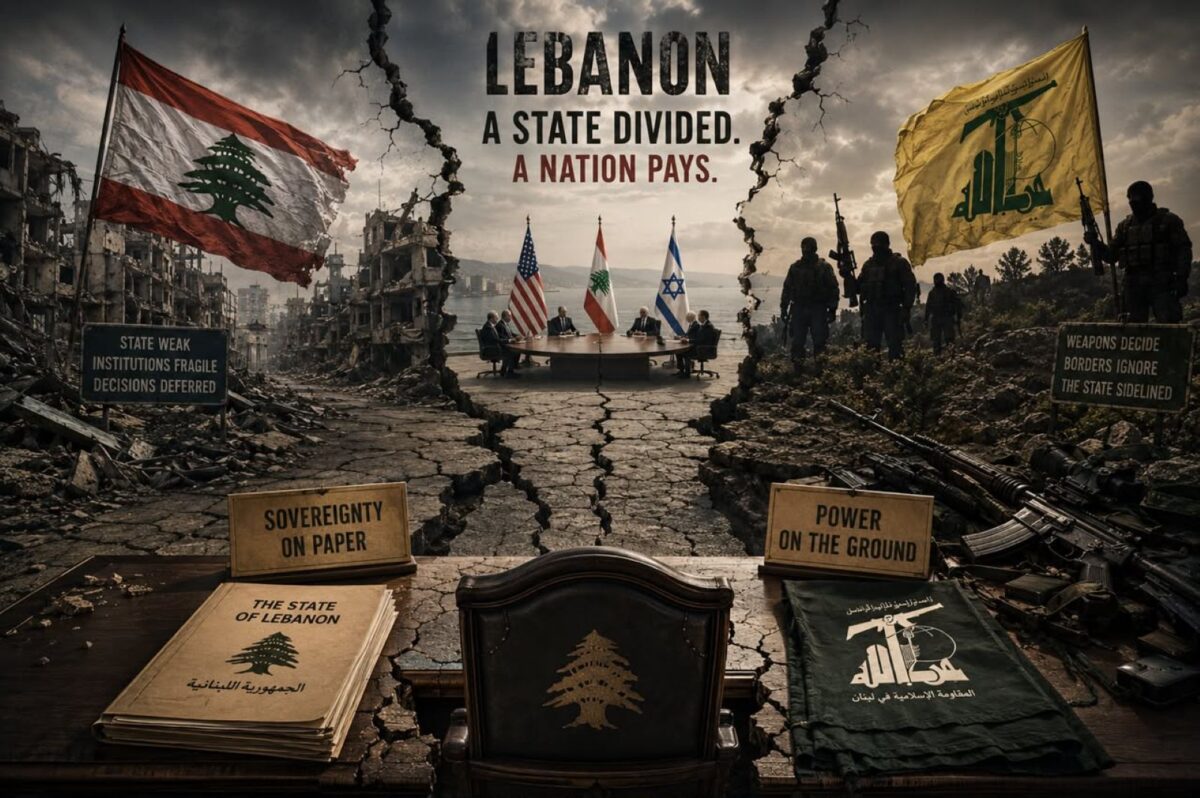
When the United States sits down to negotiate with Lebanon and Israel simultaneously, it is doing something it cannot officially admit: it is managing a three-party conflict in which one of the parties is an organization it has designated a foreign terrorist group. The architecture of the current Washington talks, a political track with the Lebanese state and a security track that requires Hezbollah’s compliance, is not a diplomatic innovation. It is a confession. A confession that the Lebanese state, as a sovereign interlocutor, does not fully control the territory it is supposed to represent.
This is the parallel state syndrome in its most naked form. Beirut gets the symbolism of sovereignty, the delegations, the communiqués, the language of rights and borders and reconstruction. Hezbollah gets the substance: it is the entity whose behavior determines whether any agreement holds, and everyone in the room knows it. The US maintains that it is negotiating with a state. The state maintains that it speaks for Lebanon. And Hezbollah maintains its weapons, which is, in the end, the only currency that matters in this exchange.
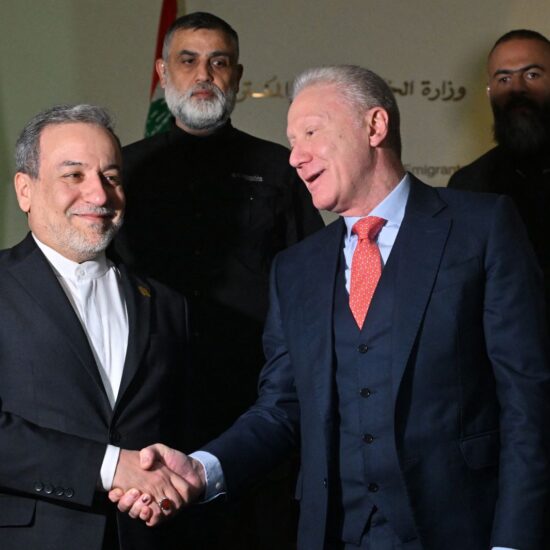
The paradox is structurally elegant and politically ruinous. By engaging Hezbollah as the necessary variable in any durable arrangement, even through Iranian interlocutors, even through Nabih Berri’s convenient translation services, Washington confers functional recognition without formal recognition. It says, in practice: the Lebanese state is the address for politics, but the militia is the address for security. This is precisely the division of labor Hezbollah has spent two decades trying to institutionalize. The US, in attempting to work around it, has instead cemented it.
But here is where the honest reckoning has to begin. Because the parallel state syndrome is not only an external imposition. It is also a product of choices the Lebanese state made – or refused to make – at the moments when it had the most leverage to make them.
After the 2024 war, Hezbollah emerged genuinely weakened. Its military infrastructure was degraded, its senior command decimated, its regional environment transformed by the fall of Assad and Iran’s strategic retrenchment. The weapons that were supposed to protect Lebanon had instead brought it another devastating war, this one without the ambiguous dignity of 2006. That was a window, narrow, time-limited, but real. A Lebanese state with strategic clarity would have used it: not to force disarmament at gunpoint, which was never possible, but to make the political cost of Hezbollah’s autonomous military posture visible to Lebanese society. To build a domestic coalition around a simple, honest argument, that October 8 was a decision taken without the state, imposed on the Lebanese people, and that the country cannot afford another such decision.
That argument was never made with the sharpness the moment required. Instead, the state chose its familiar instrument: ambiguity. Hezbollah was neither brought inside the tent nor placed formally outside it. The new government, which arrived with genuine international goodwill, a credible prime minister, and the momentary attention of a world willing to invest in Lebanese recovery, converted very little of that capital into political action. Symbolic capital has a shelf life. It depreciates rapidly when it is not exchanged for something real.
The Lebanese state will offer its standard defense: that it cannot force disarmament without triggering civil war, and that coercive action against Hezbollah is not a serious option. This is true. But there is an enormous distance between forced disarmament and the complete abdication of even making the political argument internally. What the state avoided was not a military confrontation it could not win; it avoided a political confrontation it chose not to fight.
The consequence is what we are watching now: Lebanon at the negotiating table in Washington, committed to a process it cannot fully control, representing a sovereignty it cannot fully exercise, opposite an adversary that understands exactly where the gaps are. Israel’s military escalation, the Beaufort capture, the strikes beyond the Zahrani, is not irrational. It is a calculated reading of Lebanese structural weakness, designed to extract maximum concessions from a state that cannot deliver what it promises.
Lebanon is not only a victim of the parallel state syndrome. It is, in part, its co-author. The reckoning the state avoided after the war is now arriving through the negotiations. The only difference is that this time, Lebanon will be paying the price at the table rather than on the ground.
The bill, as always, will go to the Lebanese people.
Ramzi Abou Ismail is a Political Psychologist and Senior Research Fellow at the Institute for Social Justice and Conflict Resolution at the Lebanese American University.
The views in this story reflect those of the author alone and do not necessarily reflect the beliefs of NOW.