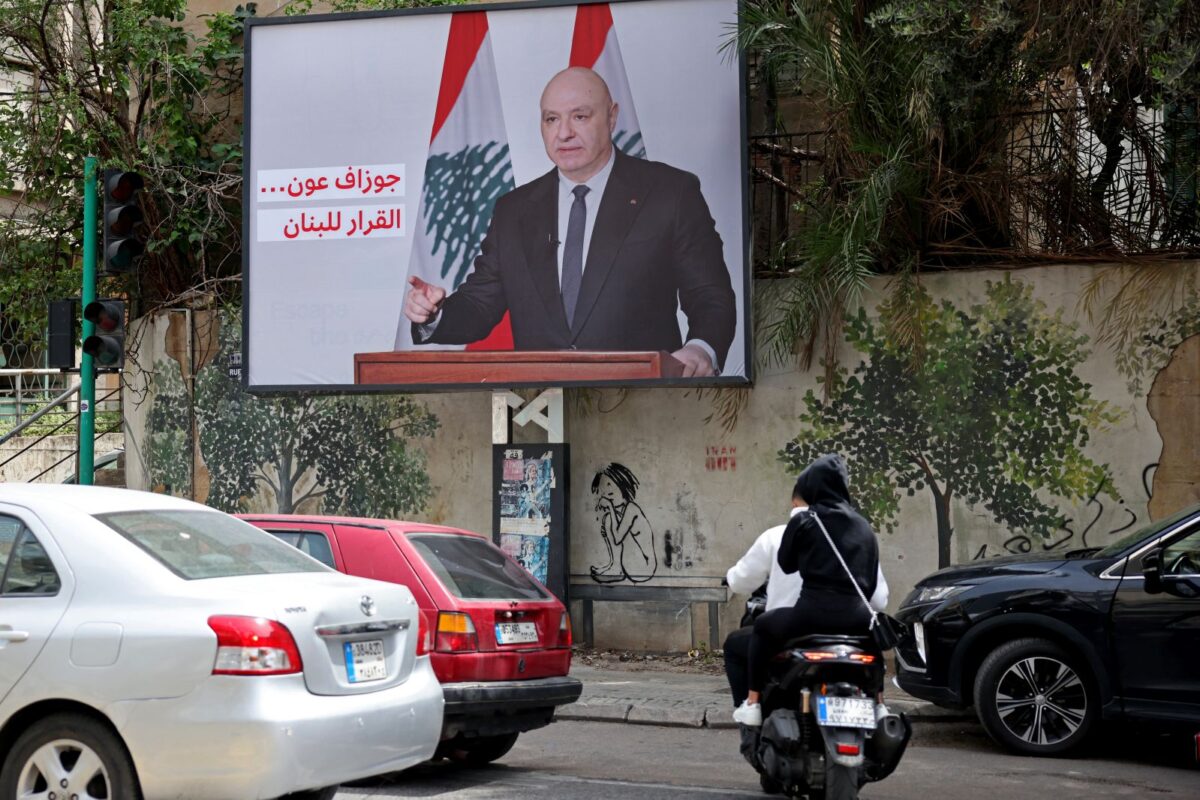
Photo by ANWAR AMRO / AFP. Vehicles drive past a billboard depicting Lebanon's President Joseph Aoun and reading "the choice is for Lebanon" on April 24, 2026 in the capital Beirut.
The current moment in Lebanon is full of contradictions. There is a ceasefire, yet there is no real cessation of violence. There are negotiations, yet one of the central actors refuses to recognize them. There is international urgency, yet domestic paralysis. The instinctive explanation circulating in policy and media circles is that Hezbollah’s rigidity reflects fragmentation within Iran, that a divided patron produces incoherent behavior in its proxy. It is an appealing argument. It is also, largely, the wrong one.
What we are witnessing is not fragmentation leading to flexibility. It is fragmentation producing consolidation, and consolidation producing rigidity.
To understand Hezbollah’s posture today, one must start not in Beirut or the south, but in Tehran.
To understand Hezbollah’s posture today, one must start not in Beirut or the south, but in Tehran. Iran is indeed undergoing a period of internal instability. Leadership transitions, institutional competition, and the pressures of a broader regional confrontation have created the appearance of a system under strain. But strained systems do not necessarily liberalize. In authoritarian contexts, they often do the opposite: they centralize authority in the hands of the most coercive, least compromise-oriented actors.
In Iran’s case, this has meant a relative shift toward the Islamic Revolutionary Guard Corps (IRGC) and away from whatever remained of a more pragmatic political class. This is not fragmentation in the sense of competing visions producing negotiation. It is fragmentation resolved through militarization. And militarization rarely negotiates from a position of concession.
Hezbollah, structurally and strategically, is embedded within this logic. It is not merely an ally of Iran; it is part of an integrated regional architecture designed to project power, deter adversaries, and maintain strategic depth. Its decision-making is not independent of Tehran, but neither is it mechanically controlled. It operates within a shared strategic framework, one that, at present, is defined by confrontation rather than compromise.
This matters because it reframes how we interpret Hezbollah’s refusal to meaningfully engage with the ongoing negotiations. The issue is not confusion. It is clarity.
From Hezbollah’s perspective, the current talks are not neutral diplomatic exercises. They are attempts to reshape the balance of power in southern Lebanon. Proposals around the deployment of the Lebanese army, the stabilization of the border, and the long-term security architecture are not perceived as technical arrangements. They are perceived as political interventions with direct implications for Hezbollah’s role, capabilities, and legitimacy.
In this sense, refusing negotiations is not a failure to adapt. It is a strategy of resistance.
There is also a second layer that is often overlooked. Hezbollah, like many armed non-state actors, does not negotiate primarily at the table. It negotiates through the field. Limited escalation, calibrated violations, and controlled instability are not signs that the ceasefire has failed. They are mechanisms through which bargaining continues by other means. Violence, in this context, is not the breakdown of diplomacy. It is part of it.
This is why the current situation feels so dissonant. Diplomacy and escalation are happening simultaneously, not sequentially. The ceasefire is not an end to conflict; it is a framework within which conflict is managed and instrumentalized.
Yet even this strategic logic is insufficient on its own. There is a deeper, more uncomfortable reality that Lebanon must confront. The negotiations underway assume the existence of a state capable of monopolizing the use of force within its territory. But Lebanon does not meet this condition. It is attempting to negotiate a security arrangement while one of its most powerful military actors operates outside the authority of the state.
This is the core contradiction.
Israel negotiates with the Lebanese state, but calibrates its actions in response to Hezbollah.
Israel negotiates with the Lebanese state, but calibrates its actions in response to Hezbollah. The United States pushes for institutional arrangements that presume state sovereignty, while acknowledging, implicitly, that sovereignty is incomplete. Hezbollah, for its part, engages in a parallel logic of deterrence and resistance that does not map onto the diplomatic framework being constructed.
The result is a three-layered system of interaction: state diplomacy, non-state coercion, and external mediation. These layers do not align. And when they do not align, agreements become fragile by design.
It is within this structure that Hezbollah’s refusal to negotiate must be understood. It is not simply following Iranian orders, nor is it acting irrationally. It is operating within a coherent strategic and ideological framework that sees the current negotiations as a potential pathway to constraint, if not outright disarmament.
And here lies the broader lesson. External pressure, no matter how intense, cannot substitute for internal political resolution. The United States can broker ceasefires and convene talks. Israel can impose costs and demand guarantees. But neither can resolve the fundamental question that sits at the heart of Lebanon’s crisis: who controls the use of force within the state?
Until that question is addressed, every ceasefire will be temporary, every negotiation partial, and every agreement vulnerable to collapse.
The temptation, in moments like this, is to look outward – to Iran, to Israel, to Washington – for explanations and solutions. But the uncomfortable truth is that the limits of this process are not only imposed from outside. They are produced from within.
Hezbollah’s rigidity is not an anomaly. It is a reflection of a system that has yet to decide what it wants to be.
And until that decision is made, Lebanon will continue to negotiate without fully being in the room.
Ramzi Abou Ismail is a Political Psychologist and Senior Research Fellow at the Institute for Social Justice and Conflict Resolution at the Lebanese American University.
The views in this story reflect those of the author alone and do not necessarily reflect the beliefs of NOW.