Three heretical concepts dominate Lebanon’s political and media discourse today, and while they may appear as passing slogans or emotional reflexes shaped by years of war and collapse, they are in fact carefully constructed narratives sustained by distortion and, more often than not, deliberate bad faith. These ideas are not merely rhetorical excesses; they are instruments designed to mislead public opinion and obscure a far more dangerous reality, namely the systematic hollowing out of the Lebanese state and its transformation into a façade for a military–ideological structure tied to Iran’s Revolutionary Guard.
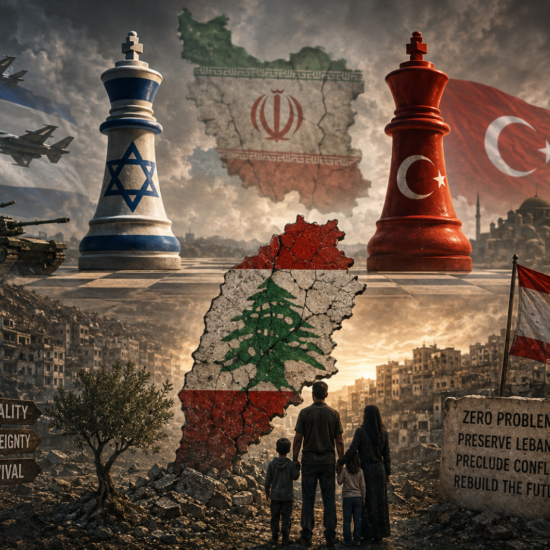
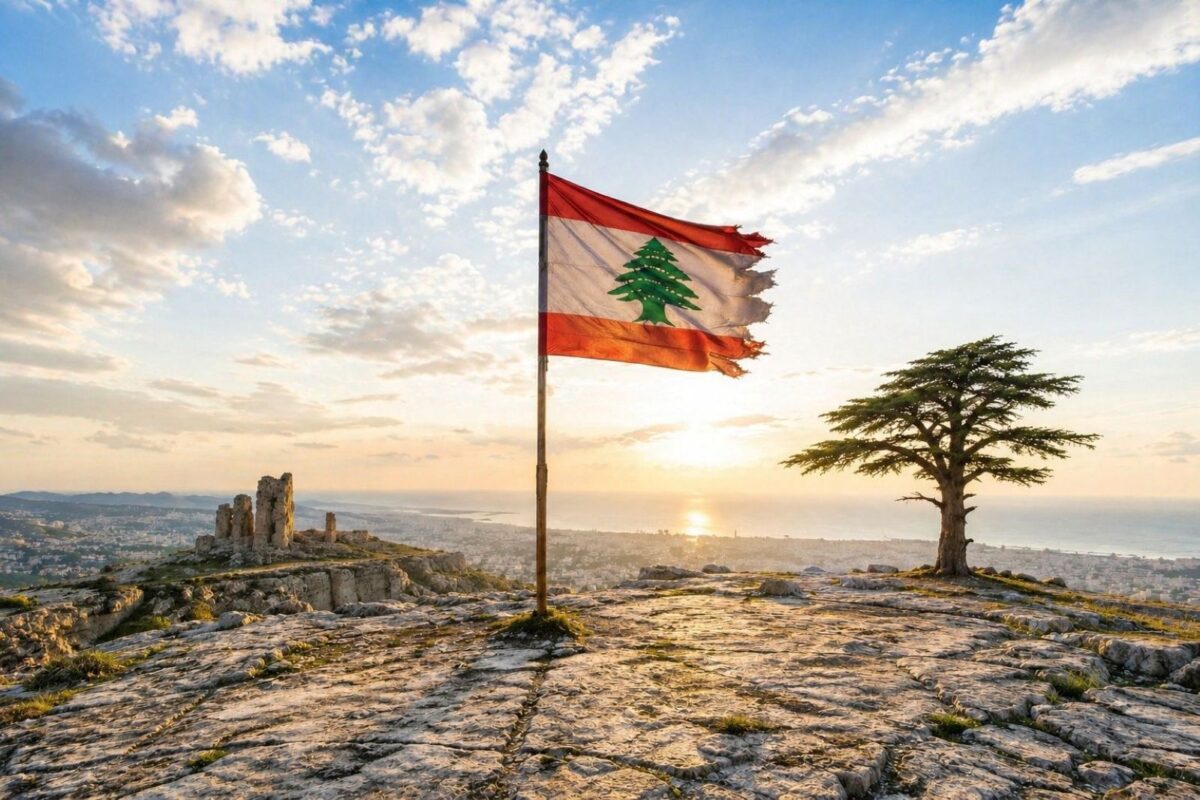
The first of these concepts is the invocation of the slogan “10,452 square kilometers” as proof of Hezbollah’s supposed patriotism and commitment to Lebanon’s territorial integrity, a claim that borders on the surreal. Historically, this phrase was tied to the principle of indivisible sovereignty and was embedded in the political vision of a sovereign, independent Lebanese state. Today, however, it has been stripped of its meaning and repurposed as a symbolic cover for a reality that fundamentally contradicts it. One cannot speak of territorial unity while sovereignty itself is fragmented, nor can one invoke the sanctity of borders while the south of Lebanon has effectively become a theater for regional conflict beyond the control of the Lebanese people.
To raise this slogan without acknowledging that sovereignty is its essential precondition, and that the state must be the sole authority over arms and decisions of war and peace, is not an expression of patriotism but an insult to political reason. A nation is not a map circulated on social media; it is a political contract grounded in the state’s exclusive right to exercise legitimate violence, and any deviation from that principle amounts to the erosion of the very idea of the nation.
To oppose the killing of Lebanese citizens, to reject the dragging of the country into external wars, or to demand accountability for a long series of political assassinations that have targeted politicians, journalists, and activists, is not incitement but the bare minimum of civic responsibility.
The second concept is the weaponization of the accusation of “incitement,” a charge routinely deployed to silence any voice that challenges Hezbollah’s dominance or questions its arsenal. This accusation, applied arbitrarily and often cynically, reflects a dangerous degradation of public discourse because it reverses the roles of victim and perpetrator. To oppose the killing of Lebanese citizens, to reject the dragging of the country into external wars, or to demand accountability for a long series of political assassinations that have targeted politicians, journalists, and activists, is not incitement but the bare minimum of civic responsibility.
From the assassination of former Prime Minister Rafik Hariri to Lokman Slim and to the countless victims of turning Lebanon into an open arena for the conflicts of the Revolutionary Guard, none of this can be dismissed under the pretext of avoiding “provocation.” On the contrary, true incitement lies in framing all dissent within sectarian boundaries, thereby reinforcing the very divisions that sustain the system in place. Naming reality for what it is does not inflame tensions; it is the necessary foundation for any meaningful political conversation. Attempts to suppress such clarity are not efforts to preserve stability but integral components of a broader architecture of coercion.
Yet perhaps the most dangerous development is the gradual slide toward the fabrication of an internal enemy, a process that seeks to justify the continued existence and redirection of weapons toward the domestic sphere. Instead of confronting the external adversary that ostensibly legitimizes its arsenal, Hezbollah’s discourse increasingly pivots toward identifying internal opponents, namely those who advocate for state sovereignty and institutional authority, as threats to be neutralized.
In this inverted logic, the Lebanese citizen who seeks to rescue the state becomes the adversary, while society itself is recast as a battlefield of internal confrontation rather than a collective political project. Nowhere is this distortion more painfully evident than in the treatment of mothers within Hezbollah’s social base, who are no longer seen as individuals with agency, fear, and the right to protect their children, but as components of a mobilization machine in which motherhood is reduced to an endless function of sacrifice. Restoring these women to their full humanity, affirming their right to fear for their sons rather than celebrate their deaths, is neither betrayal nor incitement but an ethical imperative. A healthy society is not built on the glorification of death or the normalization of perpetual loss, but on the protection of life and the preservation of human dignity. Any discourse that seeks to silence this truth or portray it as a threat is not confronting violence but perpetuating it.
The third and perhaps most insidious concept is the promotion of the “truce” as a substitute for peace, as though Lebanon is condemned to exist in a perpetual state of ambiguity, suspended between one war and the next. While no rational actor rejects a ceasefire in principle, it becomes a political crime when it is presented as a permanent solution in a context where arms remain outside the control of the state. A truce, by definition, is a temporary arrangement between sovereign entities; in Lebanon’s case, it becomes a mechanism to normalize a deeply abnormal condition in which the state remains incapacitated while Hezbollah retains independent military authority.
Accepting this equation is tantamount to institutionalizing Lebanon’s failure, reducing it to a marginal actor that survives on the periphery of regional stability without ever being part of it. Peace, however difficult or politically costly, remains the only viable path to redefining the role of the state and restoring its sovereignty, and such a path necessarily requires the disarmament of Hezbollah and the reintegration of all security and military decision-making within state institutions.
“No opinion is valid when it is not obeyed,” transcends rhetorical flourish and becomes an accurate diagnosis of Lebanon’s condition.
In this context, the oft-cited saying attributed to the fourth Muslim Caliph Ali ibn Abi Talib, “No opinion is valid when it is not obeyed,” transcends rhetorical flourish and becomes an accurate diagnosis of Lebanon’s condition. A state whose decisions are not enforced, whose authority over arms is contested, and who’s foreign and security policies are dictated from outside its institutions is a state without a real voice, regardless of how many official statements it issues. Any discussion of reform, recovery, or even survival that does not address this fundamental imbalance remains hollow.
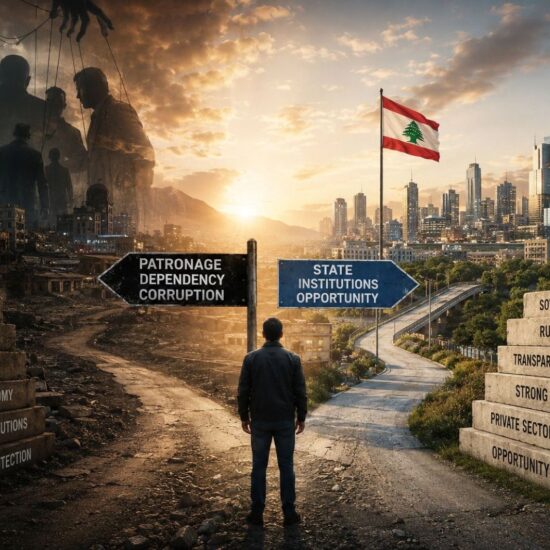
Lebanon today does not suffer from a lack of slogans but from an excess of illusions. What it requires is a deliberate and profound restructuring of the state, beginning with the restoration of full sovereignty and culminating in an exit from the logic of temporary truces toward a horizon of lasting stability.
Lebanon today does not suffer from a lack of slogans but from an excess of illusions. What it requires is a deliberate and profound restructuring of the state, beginning with the restoration of full sovereignty and culminating in an exit from the logic of temporary truces toward a horizon of lasting stability. Everything else is merely the recycling of failed ideas, illusions for which the Lebanese have already paid in blood, ruin, and the slow erosion of their collective future.
Makram Rabah is the managing editor at Now Lebanon and an Assistant Professor at the American University of Beirut, Department of History. His book Conflict on Mount Lebanon: The Druze, the Maronites and Collective Memory (Edinburgh University Press) covers collective identities and the Lebanese Civil War. He tweets at @makramrabah
This article was originally published in Elaph.