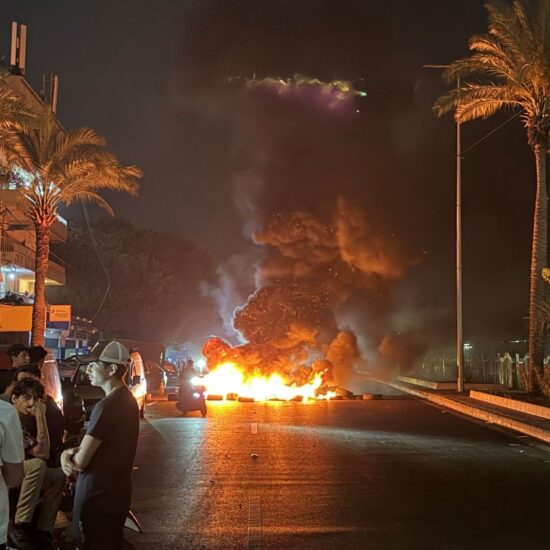
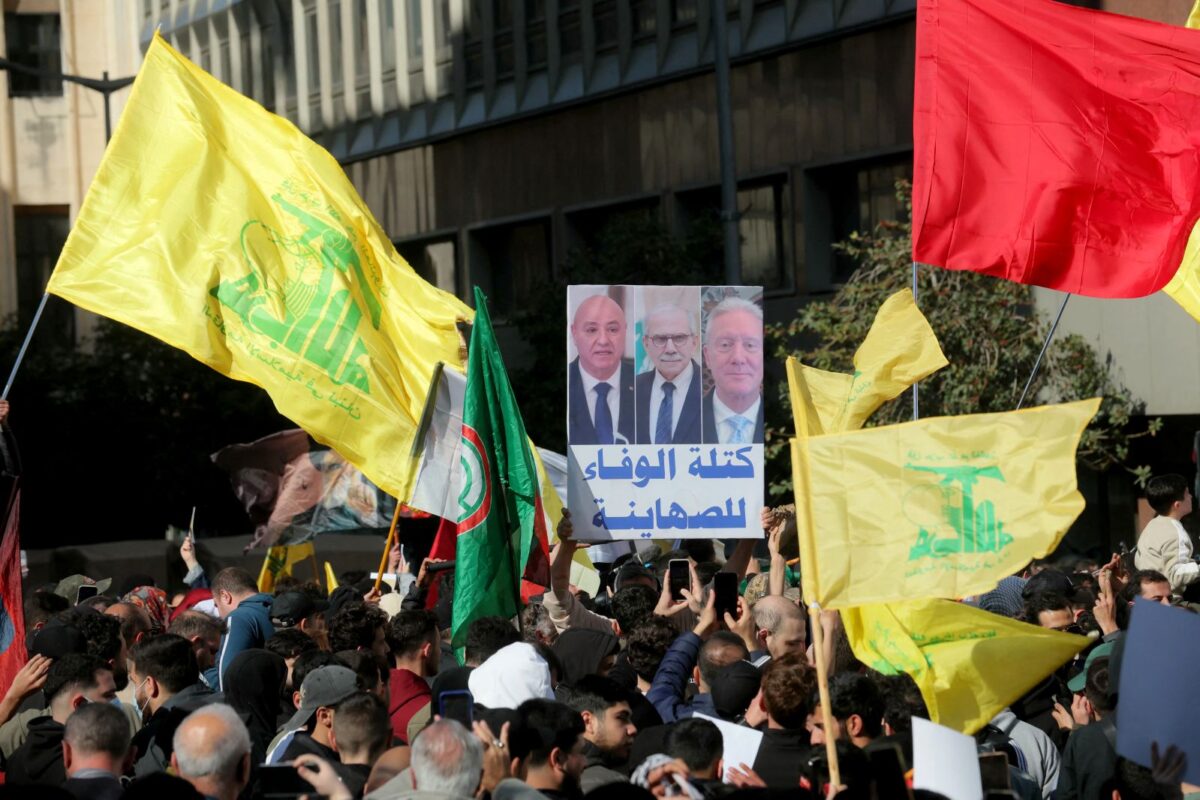
IBRAHIM AMRO / AFP. Hezbollah supporters hold up a placard showing the images of the (from left) Lebanese President Michel Aoun, Prime Minister Nawaf Salam, and US Ambassador to Lebanon Michel Issa, as they demonstrate near the Governmental Palace to protest against the Lebanese authorities’ decision to engage in direct negotiations with Israel, in downtown Beirut on April 11, 2026.
Hezbollah lawmaker reiterated on April 11, his group's rejection of direct negotiations between Israel and Lebanon, where authorities reported 10 people killed in Israeli attacks in the south. The office of the Lebanese president said on April 10, that officials from his country, Israel and the United States would meet next week in Washington "to discuss declaring a ceasefire and the start date for negotiations between Lebanon and Israel under US auspices".
A growing campaign against Joseph Aoun is less about a single speech than about a deeper struggle over who controls Lebanon’s path out of conflict.
As regional and international actors push different peace plans, Aoun’s alignment with a Western-backed approach has made him a main target of criticism, especially from Hezbollah and its supporters, while figures like Nabih Berri face less scrutiny.
The recent wave of criticism reflects more than a reaction to Aoun’s latest speech or his increasingly explicit stance against Hezbollah dragging Lebanon into war.
Lebanon is not navigating a single negotiation process, but rather two competing frameworks for de-escalation and political settlement.
According to Lebanon-based researcher George Haddad, the current moment cannot be understood without recognizing that Lebanon is not navigating a single negotiation process, but rather two competing frameworks for de-escalation and political settlement.
On one side stands a Western-backed track, led primarily by the United States and Israel, which relies on what Haddad describes as Lebanon’s “sovereigntist” leadership, figures such as Aoun and Prime Minister Nawaf Salam. This track seeks to consolidate decision-making within the Lebanese state.
On the other side is a more traditional, “Arab-centered” framework, rooted in the legacy of the Arab Peace Initiative and supported by France and Gulf states, particularly Saudi Arabia. This approach emphasizes regional consensus.
These parallel tracks are not merely diplomatic alternatives but they also represent competing visions of Lebanon’s political identity and strategic alignment.
Why Aoun is the primary target
In the current political landscape, Aoun has become the main focus of criticism not just because he represents a particular political direction, but because he is seen as the most credible figure capable of advancing it.
His recent statements stressing sovereignty, the authority of state institutions, and the rejection of unilateral military decisions place him in direct contrast with Hezbollah’s parallel security structure.
The core problem is the question of weapons, and this is where the real division lies.”
What is increasingly clear is that the campaign against him is not merely reactive. Political messaging and media narratives suggest a coordinated effort to target Baabda, portraying Aoun as aligned with an external agenda aimed at reshaping Lebanon’s strategic orientation.
Here, Sam Menassa, a journalist and political analyst specializing in Middle Eastern affairs offers a deeper reading of the backlash, arguing that it reflects both political division and a more fundamental structural conflict within Lebanon.
“There is certainly political disagreement—Lebanon is deeply divided,” Menassa explains. “But the issue is not only about negotiations with Israel. The core problem is the question of weapons, and this is where the real division lies.”
He also points to growing tensions within the Shiite political sphere itself, suggesting that disagreement over Hezbollah’s role is no longer confined to traditional political opponents.
Menassa further emphasizes that Hezbollah cannot be understood as a conventional political party:
“This is not a typical Lebanese party. It is an organization tied to a foreign power and shaped by a religious doctrine. That makes engagement with it fundamentally different—politically, socially, and ideologically.”
This, he argues, helps explain why the confrontation with Aoun has intensified. As the president pushes a state-centered vision, he is not only challenging Hezbollah politically, but also confronting a structure that does not operate within the framework of a traditional state.
A conflict beyond politics
Menassa’s analysis suggests that the current tensions extend beyond standard political disagreement.
“The issue of weapons today is more important than the issue of negotiations
“The issue of weapons today is more important than the issue of negotiations,” he says. “For Hezbollah, preserving this structure is essential, because its identity is tied to being an armed ‘resistance.’ It cannot easily redefine itself outside that role.”
He adds that decision-making within Hezbollah is shaped by two key factors: its alignment with Iran and its underlying religious doctrine, both of which limit its flexibility.
“Its decisions are not purely internal. There is a connection to Iran, and there is also an ideological dimension that makes compromise more difficult.”
Within this context, Aoun’s rhetoric, linking Lebanon’s collapse to the presence of non-state armed actors touches a particularly sensitive nerve. It challenges not only Hezbollah’s political position, but its foundational narrative.
Why not Berri?
This also helps explain why the campaign focuses more heavily on Aoun than on Berri.
While Berri is part of the same broader political process, he operates within a framework of negotiation and ambiguity that does not directly threaten Hezbollah’s position. Aoun, by contrast, represents a clearer move toward consolidating authority within the state.
“Aoun is at the forefront. He is the president, and he is leading an initiative that prioritizes the restoration of the state, its authority, its territory, and its institutions. That puts him in direct confrontation with Hezbollah’s priorities.”
Menassa reinforces this distinction: “Aoun is at the forefront. He is the president, and he is leading an initiative that prioritizes the restoration of the state, its authority, its territory, and its institutions. That puts him in direct confrontation with Hezbollah’s priorities.”
Berri, on the other hand, continues to play a balancing role, maintaining lines of communication across camps while avoiding a direct challenge to Hezbollah’s core structure.
Aoun’s position and the political divide
In this context, Aoun has doubled down on his call for US-sponsored direct negotiations with Israel, while maintaining key conditions, chiefly an immediate halt to Israeli attacks and adherence to Lebanon’s national constants.
Despite political differences, this position partially intersects with Berri’s approach, though the latter remains opposed to direct negotiations.
Politically, Aoun’s stance appears to enjoy broad backing across much of the Lebanese spectrum. Menassa notes that while disagreements over negotiations persist, they are secondary compared to a broader national consensus emerging around one issue:
“There is disagreement over negotiations, but the majority of Lebanese reject the idea of Hezbollah retaining its weapons as it is. This has become the central issue.”
A system under strain
Ultimately, the intensity of the campaign against Aoun reflects more than a dispute over policy, it signals a deeper crisis within Lebanon’s political system.
“Hezbollah’s position, as it stands, is leading to the collapse of the state. What is needed is a shift outside the existing framework.”
“The current situation cannot continue,” Menassa warns. “Hezbollah’s position, as it stands, is leading to the collapse of the state. What is needed is a shift outside the existing framework.”
For many Lebanese, the immediate priority remains ending the war, securing a ceasefire, and enabling displaced families to return.
But as both Haddad’s structural analysis and Menassa’s political reading suggest, the real battle is not only over how the war ends but over who defines Lebanon’s political order in its aftermath.