Washington, United States
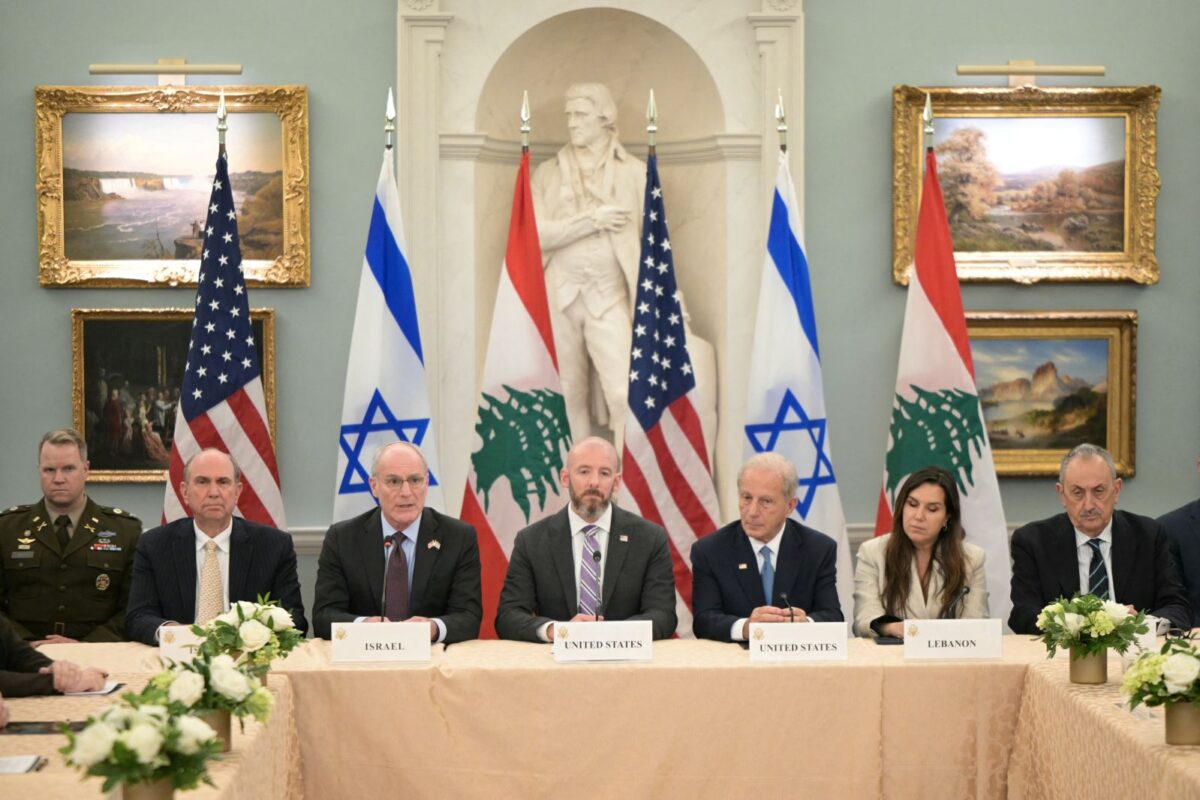
Photo by OLIVER CONTRERAS / AFP. Israel's Ambassador to the US Yechiel Leiter, State Department Chief of Staff Daniel Holler, US Ambassador to Lebanon Michel Issa and Lebanese Ambassador to the US Nada Hamadeh attend a meeting between Israeli and Lebanese delegations hosted by the United States at the State Department in Washington, DC, on June 3, 2026.
Israel and Lebanon agreed Wednesday to implement a ceasefire but said it would require a "complete cessation" of fire by Iran-backed Hezbollah, according to a joint statement after US-led talks in Washington. The two sides, which do not have formal diplomatic relations, also agreed to create "pilot zones" in which the Lebanese armed forces "will take exclusive control of the territory to the exclusion of all non-state actors."
The ceasefire announced after the latest U.S.-led trilateral meeting between Lebanon and Israel is not a peace agreement. It is not a rescue plan. It is not a diplomatic miracle. It is a final opening, perhaps the last one, for the Lebanese state to do what it has avoided for decades: completely disarm Hezbollah and restore sovereignty over its own territory.
The agreement is clear. The ceasefire depends on Hezbollah stopping its fire and evacuating its operatives from the South Litani Sector. It also calls for pilot zones where the Lebanese Armed Forces, and only the Lebanese Armed Forces, control the territory, excluding all non-state actors. The parties are expected to reconvene during the week of June 22 to continue political and security talks.
This is where Lebanon must be honest with itself. A ceasefire that depends on Hezbollah’s restraint is not a ceasefire; it is a countdown. It will not stand if Beirut once again hopes that Iran and its Lebanese proxies will suddenly listen to the sound of reason. Hezbollah does not exist to serve the Lebanese state. It exists to weaken it, blackmail it, and replace it whenever the interests of Tehran require it.
President Trump used American leverage to force Israel into accepting this ceasefire. That matters. But Lebanese officials should not misunderstand what happened. Washington may have created the space for diplomacy, but no foreign capital can build a Lebanese state on behalf of Lebanese leaders who are afraid to govern. The Americans can facilitate talks. They can pressure Israel. They can support the Lebanese Armed Forces. But they cannot disarm Hezbollah while Beirut hides behind statements, formulas, and national dialogue theater.
For years, Lebanon has mastered the language of ambiguity. We speak of sovereignty while tolerating a militia stronger than the state. We praise the army while denying it the monopoly of arms. We condemn war while allowing one faction to decide when Lebanon enters one. We demand international respect while failing to respect the basic definition of a state. That era must end.
For years, Lebanon has mastered the language of ambiguity. We speak of sovereignty while tolerating a militia stronger than the state. We praise the army while denying it the monopoly of arms. We condemn war while allowing one faction to decide when Lebanon enters one. We demand international respect while failing to respect the basic definition of a state. That era must end.
Hezbollah is not merely a problem on the border. It is the central disease inside the Lebanese political body. Its weapons have distorted every institution, corrupted every compromise, and transformed the republic into a hostage camp. Around it, a rotten political class built a system of cowardice and profit. Some feared Hezbollah. Others used it. Many normalized it. Together, they fed the beast and then asked the Lebanese people to live inside its cage.
This is why disarmament cannot be treated as a technical security file alone. It is also a political and constitutional reckoning. Lebanon must reexamine the political system that allowed an armed party to become untouchable, that rewarded corruption with immunity, and that turned national decision-making into a marketplace of sectarian vetoes. A state that cannot decide war and peace is not sovereign. A parliament that negotiates around a militia is not representative. A government that shares power with an armed proxy is not governing; it is performing submission.
The Lebanese Armed Forces must now become the only armed authority in the country, not in speeches, but on the ground. The pilot zones south of the Litani cannot become another symbolic exercise. They must be the beginning of a full national process: one flag, one army, one border authority, one decision over war and peace.
The Lebanese Armed Forces must now become the only armed authority in the country, not in speeches, but on the ground. The pilot zones south of the Litani cannot become another symbolic exercise. They must be the beginning of a full national process: one flag, one army, one border authority, one decision over war and peace.
Israel, too, must understand that Lebanon’s sovereignty requires respect for internationally recognized borders and the end of practices that weaken the very state it claims it wants as a partner. But Lebanon’s first responsibility is internal. No country can ask the world to respect its sovereignty while allowing a foreign-backed militia to operate above its laws.
The next round of talks must therefore be treated as a national test. Lebanon should remain fully engaged in every negotiation that can lead to security, stability, and eventually peace. Direct talks are no longer a taboo; they are a necessity. The real taboo should be allowing Hezbollah to decide Lebanon’s future without the consent of the Lebanese people.
This ceasefire is not a victory. It is a warning wrapped in diplomacy. If Lebanon uses it to delay, Hezbollah will regroup, Iran will interfere, Israel will respond, and the Lebanese people will once again pay the price. But if Lebanon uses it to reclaim the state, then this moment may become the beginning of the end of the Hezbollah era.
This ceasefire is not a victory. It is a warning wrapped in diplomacy. If Lebanon uses it to delay, Hezbollah will regroup, Iran will interfere, Israel will respond, and the Lebanese people will once again pay the price. But if Lebanon uses it to reclaim the state, then this moment may become the beginning of the end of the Hezbollah era.
There is no middle ground left. Either Lebanon becomes a sovereign state, or it remains a battlefield managed by others.
The choice is now before the Lebanese state. And this time, history will not forgive hesitation.
Makram Rabah is the managing editor at Now Lebanon and an Assistant Professor at the American University of Beirut, Department of History. His book Conflict on Mount Lebanon: The Druze, the Maronites and Collective Memory (Edinburgh University Press) covers collective identities and the Lebanese Civil War. He tweets at @makramrabah