Photo by MAHMOUD ZAYYAT / AFP
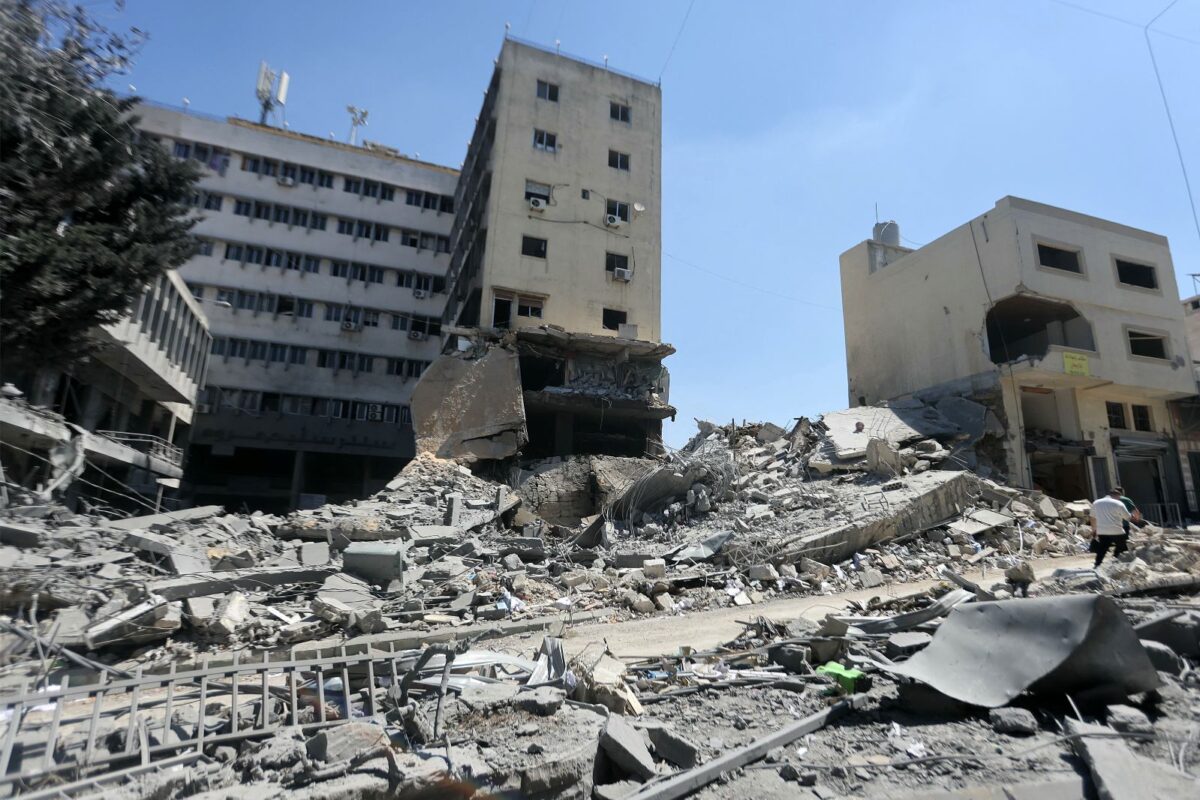
The rubble of a collapsed building is pictured following Israeli bombardment, in Nabatieh in southern Lebanon on June 21, 2026.
Iran warned the US to "be careful" after the US president threatened to strike the Islamic republic over its support for Hezbollah, even as the arch-foes held talks in Switzerland seeking a deal to permanently end the Middle East war. Disagreement over key sticking points and the threat of renewed fighting in Lebanon weighed on the talks, with Washington and Tehran exchanging threats in parallel with the negotiations.
The war in Lebanon was one of the main topics during Sunday’s round of negotiations between the United States and Iran in Switzerland, eventually taking center stage as tensions nearly jeopardized the talks. Both sides later agreed on a “deconfliction cell” for Lebanon.
All actors involved “agreed on the creation of a de-confliction cell between the parties and the Lebanese Republic, facilitated by the mediators,” a joint statement by mediators Qatar and Pakistan, published on Monday morning, says. The goal is “to ensure adherence to the termination of military operations in Lebanon.” Technical talks on the details of the de-confliction cell will take place this week.
Prior to that, the situation in Lebanon had escalated again. Tehran threatened to keep the Strait of Hormuz closed as long as Israel continued to strike Lebanon. U.S. President Donald Trump sent out a warning to Iran, causing a backlash before and during the talks. “Iran must immediately stop their highly paid PROXIES in Lebanon from causing trouble,” Trump said on Sunday on his platform Truth Social. “If they don’t, we’ll hit Iran very hard again,” he added.
The statement caused anger on the Iranian side of the negotiations. Iranian Parliament Speaker Mohammad Ghalibaf reacted promptly, warning the Americans to be “careful with their statements” as Iran’s “armed forces are ready to respond in another way.” Ghalibaf is one of Iran’s key negotiators in the talks with U.S. Vice President JD Vance.
The exchange heightened tensions between the two warring parties, prompting the Iranian delegation to walk out of the room. In recent days, the Lebanon file has taken on a major role in the discussions between the U.S. and Iran. Following Israeli attacks on Lebanon, Tehran accused Trump of allowing Israel to breach the terms of the agreement with impunity.
Compared to Trump, U.S. Vice President Vance spoke in softer terms ahead of the meeting. He called the negotiations “historic,” saying he expected “further progress.” If Tehran were to curb its regional influence and cease its ambitions of obtaining a nuclear weapon, the U.S. would be ready to normalize ties with Iran, Vance added.
A new but fragile ceasefire was agreed on Friday, but fighting started shortly afterward. Israel resumed bombing Lebanon on Saturday, with Hezbollah attacking Israeli soldiers in southern Lebanon. The fighting calmed down on Sunday — the day of the talks.
In Lebanon
The situation in Lebanon is calming down: the night from Sunday to Monday was relatively calm, marking a shift compared to the previous days. Citizens are slowly returning to their towns, some only temporarily, to look at their houses — hoping they have not been destroyed.
Syria’s Ahmed al-Sharaa on supporting Lebanon: Syria’s president on Sunday clarified his remarks about Lebanon, which triggered fears of a renewed strong Syrian presence in the country. Instead of military links, Syria was hoping to establish economic relations with Lebanon, al-Sharaa said.
Israeli presence in South Lebanon: Israel’s Defense Minister Israel Katz said that Israel is not planning to withdraw from Beaufort Castle, which it has been occupying in recent weeks. According to Katz, the area is “an integral part of the security zone in Lebanon and essential for the defense of the Galilee settlements and IDF forces.”
Hezbollah’s reaction: Hezbollah’s Secretary-General Naim Qassem has ruled out Israel’s claim to further occupy the so-called “security zone” inside southern Lebanon along the border.
In The Region
Iran-U.S. talks to continue: After 18 hours of negotiations between high-level delegations from both countries, talks are planned to continue throughout this week on a technical level. The goal is to finalize an agreement between the two countries. Sunday was the first day of negotiations since the signing of the memorandum of understanding. Alongside the Lebanon file, Iran’s nuclear program remains the biggest point of contention, with the U.S. seeking a complete end to Iran’s nuclear program.
Iran’s take on the talks: Ghalibaf said that the talks “delivered major progress to end the Lebanon war”. According to one of Tehran’s negotiators, Hussein Gurbanzadeh, the talks with Washington on Sunday also focused on frozen assets and oil sanctions.
Trump clashes with Meloni: U.S. President Donald Trump has criticized yet another NATO member country. On Sunday, he said that Meloni was unwilling to join the U.S. efforts in fighting Tehran’s nuclear threat, despite Washington spending money on NATO. Meloni and Trump got into a fight after the American president claimed that his Italian counterpart begged him for a photo at the G7 summit.
What We’re Reading
Cold Analysis: “U.S.-Iran Deal Outcome(s)”. Samuel Carter-Smith analyses the different possible results of negotiations on Iran’s nuclear program during the Iran-U.S. talks. The author sees three possible outcomes. Iran could either fully comply, partially comply while secretly rebuilding some capabilities, or fully violate the deal. According to him, it is most likely that Iran will, to some degree, comply while also rebuilding its capacities. In this way, Tehran could foster its economic gains while also sticking to its long-term strategic options. Carter-Smith therefore argues that what matters more than the deal itself is the ability to verify and enforce the details of the agreement.
Reading Lebanon and the Iran Deal Through Rubio’s Face. Now’s managing editor Makram Rabah analyses the memorandum of understanding between the United States and Iran based on the facial expressions of Marco Rubio, who reacted uneasily during Donald Trump’s presentation. Rabah writes that the deal might calm regional tensions, but that the core issues in Lebanon remain untouched. Hezbollah and Iran are still making the decisions about war and peace, rather than the Lebanese state itself. The agreement between Washington and Tehran treats Lebanon as a secondary issue and does not weaken Hezbollah, Rabah argues. Instead, a lasting peace for Lebanon can only be achieved through the state’s full control over its borders, territories, and all weapons in the country.
Lebanon First Before It Gets Trampled by Bigger Players. Elissa El Hachem argues that decisions about the future of Lebanon are often taken by large outside powers, such as the United States, Iran, and Israel, rather than by the government in Beirut. For Lebanon to regain its power at the negotiation table, El Hachem argues that the country needs to prioritize national interests by strengthening state institutions and sovereignty. Tehran’s influence in Lebanon, especially through Hezbollah, has weakened the country, the author argues. For a better future, Beirut should take a “Lebanon first” approach by strengthening the country’s institutions rather than relying on foreign influence, El Hachem argues.
Rouge ou Noir? Lebanon’s Oldest Bet, Placed Again. Cathryn Papadopoulo argues that Lebanon’s future is again at risk of being decided by outside actors. The United States has recently given Lebanon a choice. Either the country has to disarm Hezbollah, or the Syrians will get involved. To Papadopoulo, this dynamic resembles the past, when other actors such as Israel or Syria played a major role in Lebanon. Hezbollah’s strength, however, is also a reason for Lebanon’s weakness. According to the author, the state did not take the necessary steps to assert its authority after the militia was weakened following the war with Israel that started in 2023. Papadopoulo writes that Lebanon must assert state authority, including establishing a monopoly on weapons, to prevent external actors from taking control of decision-making regarding the country’s future.
Lebanon Was Included. The Question Is: By Whom? Ramzi Abou Ismail analyses how Lebanon is part of the broader U.S.-Iran deal and what it means for the country. He argues that the most important point is not that Lebanon was included in the agreement, but rather who included the country. All major actors — Iran, Washington, Hezbollah, and Israel — offer different explanations. On the one hand, Iran and its proxy Hezbollah say that Lebanon’s inclusion in the deal is evidence of the bloc’s regional influence. On the other hand, the U.S. sees developments in Lebanon as part of a bigger picture that includes Lebanese-Israeli rapprochement. Washington’s view shows that the U.S. administration does not see Lebanon merely as a proxy arena. The author argues that the most important aspect of being included in a deal is whether Lebanon can show that its inclusion is the result of its own state structures rather than being defined by other actors.