In politics, there are moments when a single photograph captures a reality that official statements spend years trying to obscure.
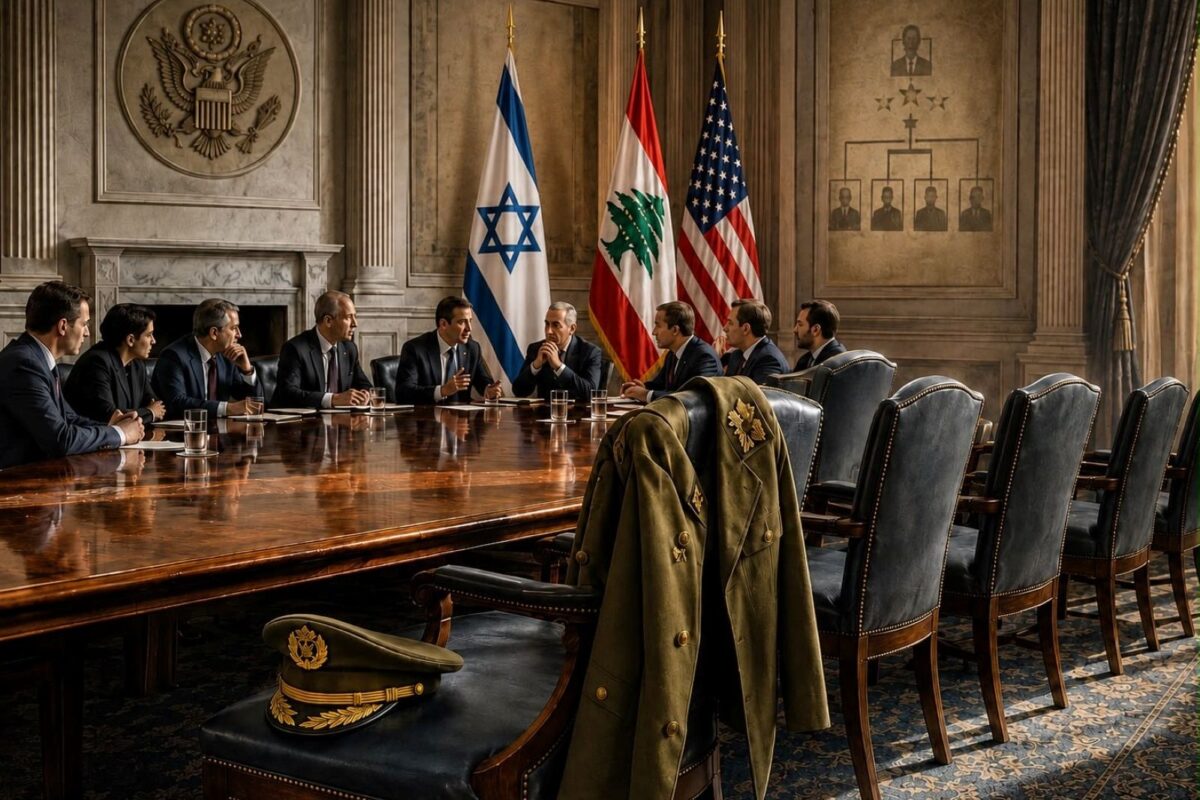
The recent image from Washington, showing Lebanon’s diplomatic delegation engaged in discussions while military representatives were notably absent from the room, may prove to be one of those moments. The significance of that image lies not in who appeared in the photograph but rather in who did not, and the circumstances that led to that absence. Behind that image lies a question that has been quietly growing since the election of President Joseph Aoun and the beginning of a new phase in Lebanon’s attempt to reclaim state sovereignty: who commands Lebanon’s Army?
This is neither a personal nor a partisan question. It is a constitutional and strategic one that goes to the very heart of the Lebanese state.
The Lebanese Constitution leaves little room for ambiguity. The President of the Republic serves as Commander-in-Chief of the Armed Forces, while the Council of Ministers establishes state policy and national priorities. The military establishment is therefore entrusted with implementing those policies rather than formulating them. In any functioning state, an army does not define national strategy or negotiate political doctrine; it executes decisions taken by the constitutional authorities under whose authority it operates.
The growing gap between declared state policy and actual implementation on the ground, raise legitimate questions about accountability. When government resolutions remain unimplemented, when commitments adopted by the state are not executed, and when international obligations appear to be applied selectively, the question is no longer merely operational. It becomes necessary to ask where responsibility resides and how the constitutional chain of command functions in practice.
The issue is particularly relevant at a moment when Lebanon is attempting to convince both its citizens and its international partners that the state is capable of exercising authority over all of its territory and institutions. A state cannot simultaneously claim sovereignty while remaining unable to demonstrate that its own policies are being implemented by all of its agencies and institutions.
The government has adopted resolutions intended to reinforce state authority and restore exclusive sovereignty over Lebanese territory, yet many remain only partially implemented while others remain entirely dormant. The examples are numerous: resolution 1701, 2024 November Agreement, 5th & 7th August resolutions, the Raouché incident, 2nd March resolution, a weapons-free Beirut, pilot implementation zones, etc.
That authority should be visible and measurable. Lebanon’s international partners are justified in examining whether official reporting accurately reflects realities on the ground. This is ultimately not a political question but one of governance and institutional credibility. The growing gap between declared policy and actual implementation has become a credibility issue not only domestically but internationally.
The deeper issue concerns doctrine. States possess doctrines, armies possess doctrines, and stable nations ensure that the two remain aligned. In Lebanon, however, that alignment is no longer self-evident.
President Joseph Aoun has repeatedly spoken of sovereignty, state authority, and the dangers posed by foreign interference in Lebanese affairs, describing external intervention as destructive to national institutions and harmful to Lebanon’s sovereignty. Yet official military statements continue to reflect a security narrative that often appears disconnected from the broader evolution of state policy.
The result is a legitimate question as to whether the strategic doctrine of the Lebanese Armed Forces fully reflects the doctrine articulated by the Lebanese state, or whether an institutional gap has emerged between the state’s political objectives and the military establishment’s operational worldview. The issue extends beyond any individual commander and concerns the coherence of the state itself.
In democratic systems, armies defend state policy; they do not shape political narratives and define national priorities independently.
Who Is the Enemy? No issue better illustrates Lebanon’s strategic confusion than the definition of the enemy itself.
For decades, official military statements have consistently referred to Israel as an occupying enemy. That position reflects a historical reality and remains embedded in Lebanon’s political and military discourse. Yet Lebanon’s sovereignty challenges today extend far beyond a conventional military confrontation across an international border.
The debate that Lebanon has avoided for years is whether the concept of an enemy should be confined to a foreign state or whether it should encompass any actor, foreign or domestic, whose actions undermine Lebanese sovereignty, weaken state institutions, or challenge the state’s exclusive authority over decisions of war, peace and national security.
Viewed through that lens, Lebanon appears confronted by three distinct challenges.
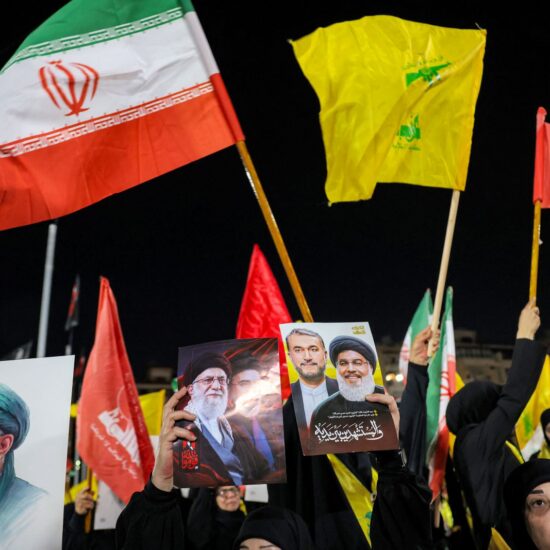
The first is Israel, with whom Lebanon remains in a state of war. The second is Iranian interference in Lebanese affairs and military sponsorship of its proxy Hezbollah. The third challenge may be the most uncomfortable of all: Lebanon’s own institutional paralysis. A state that cannot implement its own decisions, enforce its own laws, establish a monopoly over arms, or ensure that all of its institutions operate according to a unified national doctrine ultimately becomes an obstacle to itself.
In that sense, Lebanon’s sovereignty crisis is no longer simply about external adversaries. It is also about whether the state possesses the capacity and the will to act as a state.
What Does Sovereignty Mean?
Sovereignty is among the most frequently invoked concepts in Lebanese political discourse, yet it is rarely defined with precision. At its core, sovereignty means that the state alone controls weapons, determines foreign policy, and possesses legitimate coercive authority. It also means that no foreign actor, military structure, organization, or government exercises authority on Lebanese territory beyond the state’s consent and control.
Once that definition is accepted, a series of unavoidable questions follow. Can sovereignty coexist with parallel military structures and with foreign command networks operating beyond state authority? Can sovereignty coexist when national decisions are influenced by actors who answer to authorities beyond Lebanon’s borders?
Sovereignty either applies universally or it becomes merely a political talking point. The issue is no longer what Lebanese officials say but what Lebanese institutions actually do.
This is particularly true in Washington, where congressional scrutiny of assistance programs has intensified and questions regarding effectiveness, accountability, and implementation have become more frequent. International donors increasingly seek evidence that their support strengthens state authority rather than perpetuating institutional ambiguity. The concern is not merely financial but fundamentally political, as Lebanon’s partners seek reassurance that the state speaks with a unified voice and operates according to a coherent strategy.
The Lebanese Armed Forces therefore find themselves under unprecedented scrutiny. They are no longer being evaluated solely on their operational performance but also on their ability to demonstrate that they are advancing the sovereign authority of the Lebanese state and helping create the conditions necessary for the restoration of full state control over Lebanese territory.
The Washington Photograph: This brings us back to the image that attracted so much attention.
At a moment when American officials repeatedly stress that only the Lebanese state can determine and negotiate Lebanon’s future, any appearance of divergence between diplomatic and military tracks inevitably raises questions. If both institutions represent the same state and pursue the same national objectives, observers are entitled to ask why they appeared to operate separately, why one remained present while the other withdrew, who made that decision, and under what authority it was taken?
These questions matter because perceptions matter, and in Washington such perceptions often shape policy. At a time when Lebanon is seeking support, investment, and political backing, images that suggest institutional fragmentation undermine confidence in the state’s ability to act cohesively. What mattered was not who stayed in the room. What mattered was who did not, and why.
Lebanon’s future will not be determined solely by how it confronts Israel, nor solely by how it manages Iranian influence. It will be determined by whether the Lebanese state can overcome the third challenge, its own inability to act with unity, clarity, and constitutional purpose. The crisis is no longer confined to the existence of weapons outside the state’s control. Increasingly, it concerns uncertainty over whether all state institutions continue recognize the same chain of command, and pursue the same national objectives.
The unanswered question at the center of Lebanon’s political future therefore remains the same: Who commands?
Elissa E Hachem is a journalist and political writer specializing in regional affairs and governance. Former Regional Media Advisor at the U.S. State Department’s Arabic Regional Media Hub, with broad experience in strategic communication across government and private sectors.
The views in this story reflect those of the author alone and do not necessarily reflect the beliefs of NOW.