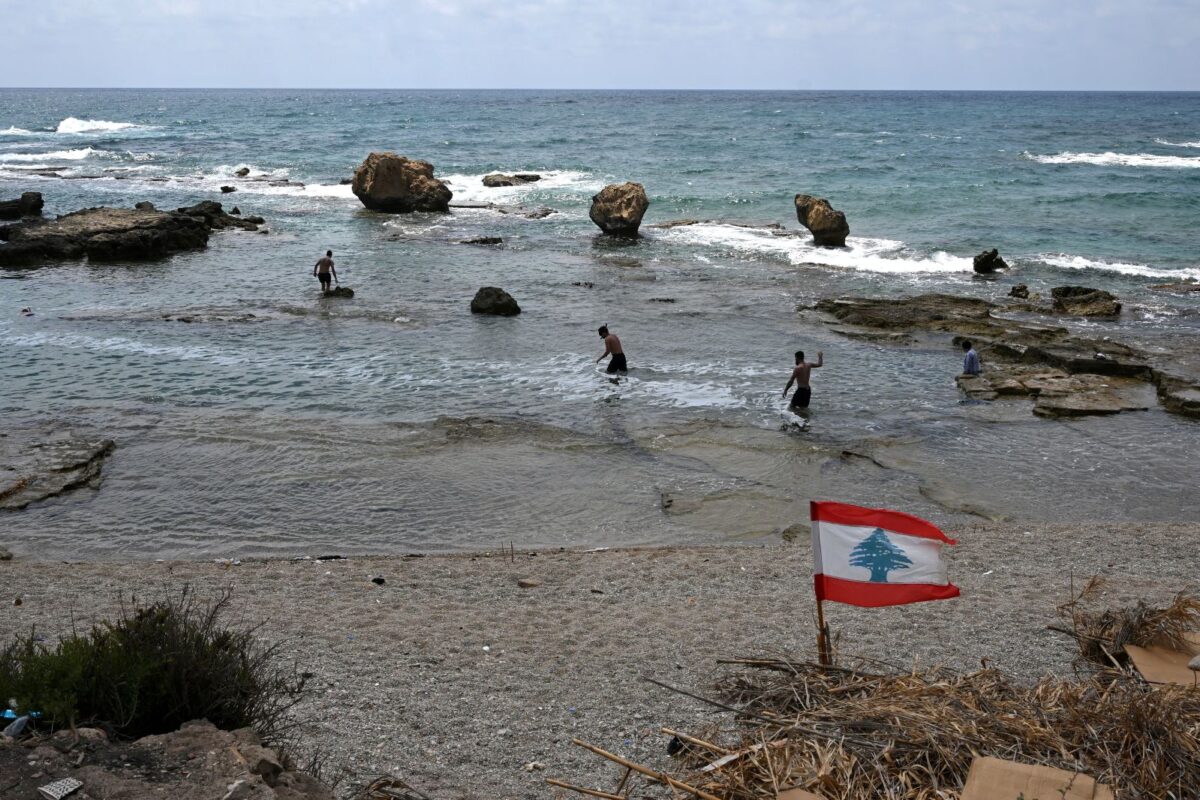
Tyre, Lebanon. Photo by JOSEPH EID / AFP The Lebanese flag flutters as residents cool off in the Mediterranean Sea in the southern Lebanese coastal city of Tyre on June 23, 2026, days after the city saw numerous Israeli military strikes.
On June 22, 2026, mediators Pakistan and Qatar said that Tehran and Washington had agreed to set up a "de-confliction cell" to limit flare-ups in Lebanon following talks in Switzerland on ending the wider Middle East war, which Tehran has linked to halting the parallel conflict in Lebanon.
The Lebanese debate is moving toward the question of foreign enforcement in the south, but it is doing so without confronting the deeper political trap such an arrangement may create. After the failure of previous attempts to rely on the Lebanese Army, UNIFIL, and diplomatic pressure alone, it is no longer unreasonable to imagine that external actors may push for a stronger international mechanism to enforce security south of the Litani. The problem is that such a mechanism may succeed at stabilizing the border while leaving Lebanon’s central crisis untouched.
This is the distinction that matters most. Lebanon does not only suffer from a security problem on its southern frontier. It suffers from a sovereignty problem inside the republic itself. Hezbollah’s weapons are not merely a military challenge located in a specific geography. They represent a parallel authority embedded within the political system, capable of shaping war and peace while the state carries the cost of decisions it did not fully make. Any arrangement that treats the issue as a southern security file alone risks reducing Lebanon’s problem to Israel’s problem.
From an Israeli perspective, a foreign enforcement mechanism may be attractive because it answers a practical concern. If Hezbollah can be prevented from returning to sensitive border areas, if its visible military infrastructure can be pushed back, and if violations can be monitored by a force with a stronger mandate, Israel may conclude that its immediate security needs have been met. From the perspective of many international actors, this would also look like success: fewer strikes, fewer rockets, fewer civilians displaced, and a lower probability of regional escalation.
For Lebanon, however, this is where the success may become dangerous. A calmer border does not necessarily mean a stronger state. A stabilized south does not automatically produce a sovereign republic. It may simply create a situation in which Hezbollah is contained geographically but preserved politically and militarily elsewhere. The international community may then declare the Lebanese file manageable, while Lebanon is left with the same unresolved question that has haunted it for decades: who has the legitimate right to use force in the name of the country?
This is why the Lebanese Army’s role has to be understood with realism rather than slogans. The army can deploy, monitor, and inherit positions when political conditions allow it to do so. It can become the legal face of state authority in areas where Hezbollah has been pushed back. But it cannot be expected to wage an internal war against Hezbollah without risking the collapse of the very state it is meant to defend. Asking the army to do alone what the political system has refused to do collectively is not a strategy. It is an evasion.
Foreign forces may therefore become part of an enforcement architecture in the south, but they cannot become a substitute for a Lebanese political settlement. They can secure geography, but they cannot build sovereignty. They can reduce Israeli fears, but they cannot resolve Lebanese power-sharing, communal anxiety, or the question of armed legitimacy. If their mandate is limited to preventing escalation at the border, then they may help Israel more than they help Lebanon. They would manage the symptom while leaving the disease inside the body of the state.
The danger is that this arrangement could even strengthen Hezbollah’s domestic narrative. The party may lose some operational space in the south while presenting itself internally as the force that resisted foreign pressure and preserved its weapons. It could tell its constituency that international forces came to protect Israel, not to build Lebanon. In that scenario, Hezbollah would be weakened as a border actor but preserved as a domestic veto power. Lebanon would get external containment without internal sovereignty.
This is why any serious international plan must link southern enforcement to a national roadmap. Such a roadmap would have to include a clear timetable for expanding Lebanese state authority, a real national security strategy, political guarantees for the Shia community, and a process through which the weapons question is addressed beyond the south. Without this, foreign enforcement becomes a border-management tool rather than a state-building project.
The real question, then, is not whether foreign forces can help secure southern Lebanon. They probably can, under the right mandate and political conditions. The real question is whether the emerging arrangement is designed to protect Israel from Hezbollah, or to help Lebanon finally recover sovereignty from Hezbollah’s parallel authority. These are not the same objective. Confusing them may become the next great mistake in the long history of the Lebanese state.
Ramzi Abou Ismail is a Political Psychologist, Researcher and Analyst.
The views in this story reflect those of the author alone and do not necessarily reflect the beliefs of NOW.