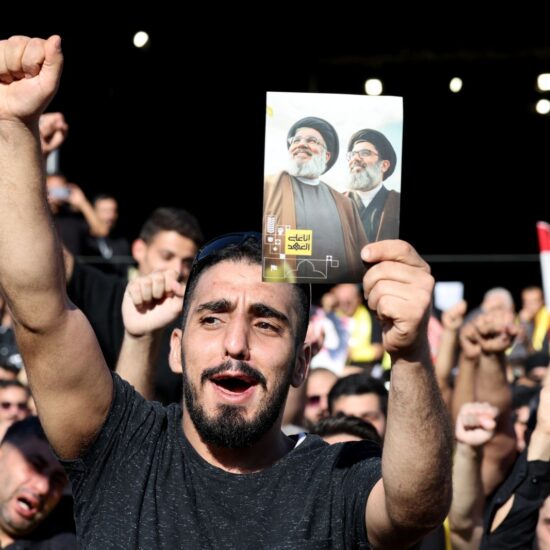
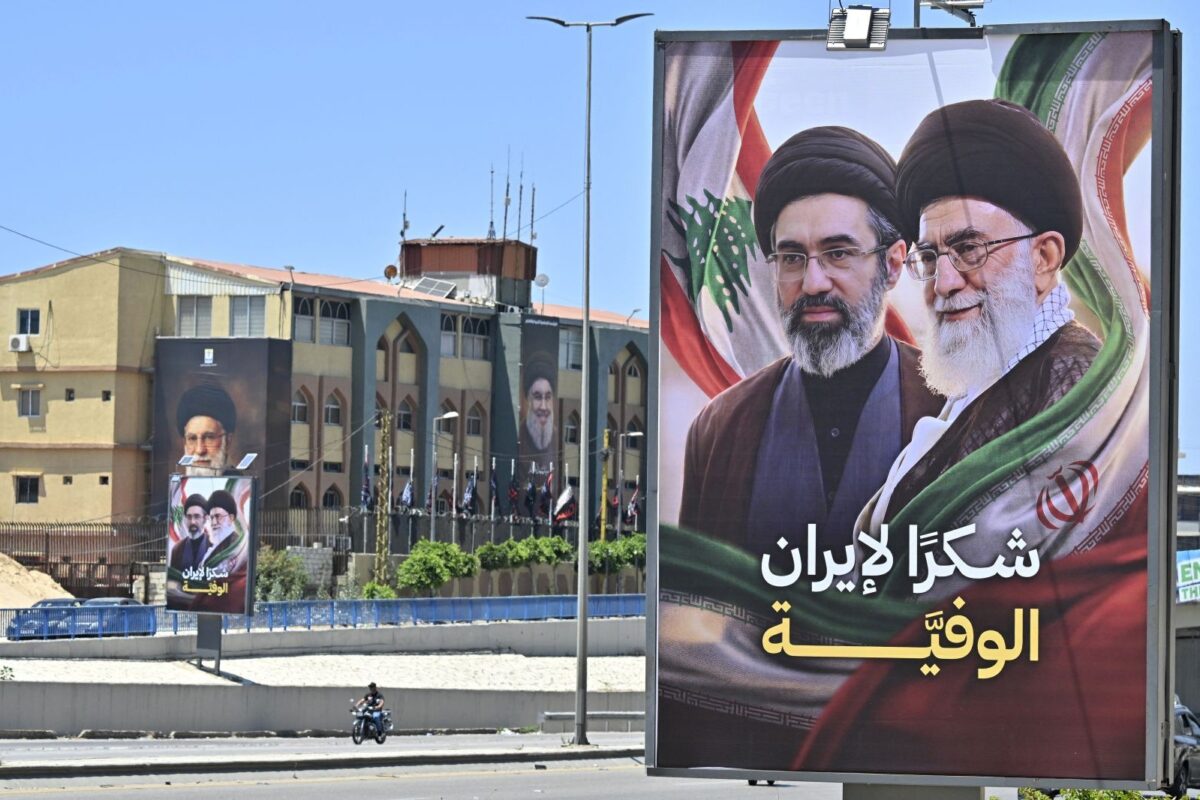
BEIRUT, LEBANON - JUNE 21: Billboards featuring the late former Iranian leader Ali Khamenei and his son Mojtaba Khamenei, who were killed in U.S. and Israeli attacks against Iran on February 28, are displayed on the Rafic Hariri International Airport highway with the text reading 'Thank you, loyal Iran' in Beirut, Lebanon on June 21, 2026. Houssam Shbaro / Anadolu (Photo by Houssam Shbaro / ANADOLU / Anadolu via AFP)
As the country’s primary gateway, the airport road has long served as a stage for competing political narratives, often displaying portraits of Hezbollah leaders, Iranian officials, Palestinian figures, and resistance slogans.
While Hezbollah supporters viewed the campaign as an expression of gratitude toward their longstanding ally, critics argued that the billboards symbolized the primacy of Iranian influence over Lebanese state institutions at a particularly sensitive moment following a devastating war. This has raised questions not only about legality but also about who controls Lebanon’s public sphere and the political messages displayed within it.
Journalist and media writer Aline Hage, who specializes in political discourse and digital narratives, believes the slogan was designed to send a political message rather than simply express gratitude.
“For me, the ‘Thank you Iran’ slogan was a provocative political message from Hezbollah,” she told NOW.
“After a war in which Lebanese people paid with their lives, homes, displacement, and immense economic losses, the slogan appeared to disregard the suffering endured by so many Lebanese.”
Aline argues that the campaign also challenged the state’s authority.
“I see it as a direct challenge to Lebanon’s sovereignty and state institutions, and as an attempt to normalize the idea that allegiance to a foreign power can take precedence over loyalty to the Lebanese state.”
“Thank You” for what?
Across social media, many Lebanese questioned the timing and symbolism of thanking Iran after a conflict that left entire villages destroyed, displaced thousands of families, and further deepened Lebanon’s already severe economic crisis.
Posts repeatedly asked the same question: “Thank you for what?”
Critics argued that Iran’s longstanding backing of Hezbollah had contributed directly to the war and its consequences, making public expressions of gratitude deeply offensive to those who had lost homes, livelihoods, or loved ones.
Social media reactions to the billboards also highlighted moments of stark irony. One widely circulated photograph taken on Beirut Airport Road by Lebanese photojournalist Nabil Ismail showed a displaced Shiite man riding a motorcycle, carrying his mattress and shroud as he moved through the capital’s entrance road, passing beneath a billboard reading “Thank you, loyal Iran.” The image quickly spread across social media platforms, where many users pointed to the contrast between the slogan’s message and the lived reality of displacement and loss following the war.
Others questioned why one of Lebanon’s most prominent public roads should be dominated by messages honoring foreign leaders rather than celebrating Lebanese institutions, including the army, emergency responders, healthcare workers, and communities that carried much of the burden of the war.
For Aline, the location itself amplified the political message.
“Its placement on one of Beirut’s main gateways and most visible public thoroughfares cannot be separated from Hezbollah’s display of influence in Lebanon,” she said.
“I see it as conveying the message that effective power in the country still lies with Iran’s regional axis rather than with the Lebanese state.”
Her assessment reflects a broader concern among critics that public space has increasingly become a platform through which non-state actors project political authority and shape competing narratives about Lebanon’s identity and alliances.
Beyond Politics: The Legal Dimension
The controversy also prompted renewed debate over the legal framework governing political displays in public space.
While billboard installations remain subject to licensing requirements and municipal oversight, legal discussions also revived references to the 1945 law governing foreign flags and symbols, as well as advertising regulations introduced in 2015.
Although Lebanese law does not explicitly prohibit every political billboard featuring foreign leaders, legal experts note that installations on public property generally require authorization from the relevant authorities.
Some observers maintain that municipalities possess the authority to remove unauthorized displays. Others argue that enforcement has historically depended less on legal provisions than on political calculations, given that similar displays have appeared in previous years without state intervention.
The Removal: Reasserting state authority?
The authorities’ decision to remove the billboards marked a significant development in the controversy.
For Aline, the move represented more than a routine administrative decision.
“The decision reflects an official move by the state to regulate the use of public space and prevent it from being turned into a platform for political messaging by internal or external actors, while reaffirming the state’s role in managing the public sphere, especially in sensitive areas and at the entrances to the capital,” she told NOW.
She believes the removal also carried an implicit political message.
“It can also be understood as an indirect message to Hezbollah and Iran that public space falls under state authority, and that political expression within it should not reflect influence operating outside the framework of official institutions.”
“Disconnected from reality”
For many Lebanese returning from abroad, the controversy was more than just another political dispute it shaped their first impression of the country. For some, the billboards reflected what they saw as a disconnect between the political messages displayed in public spaces and the devastating consequences of the recent war.
Sahar Fakhouri, a Lebanese Australian visiting Lebanon on holiday, said she was shocked to see the giant portraits of Iran’s leader lining Beirut Airport Road.
“It made me feel as though Lebanon was thanking a country whose influence has, in my opinion, contributed to so much of the instability and suffering we’ve experienced,” she told NOW. “Many Lebanese lost their homes, their businesses, and their loved ones during the war. Many of those most heavily affected were from the very communities Hezbollah claims to defend. Seeing those billboards felt completely disconnected from that reality.”
Sahar said the images left her disappointed at a moment when she had hoped to see a country focused on rebuilding and reaffirming its own national identity.
“As someone who lives abroad, I wanted to come back and see Lebanon presenting itself through its own people, its resilience, and its institutions,” she said. “Instead, one of the first things visitors encountered was a message thanking Iran. I want people arriving in Lebanon to be welcomed by symbols that represent our country. Lebanon deserves to be known for its own identity, not as a place where foreign influence dominates the public landscape.”