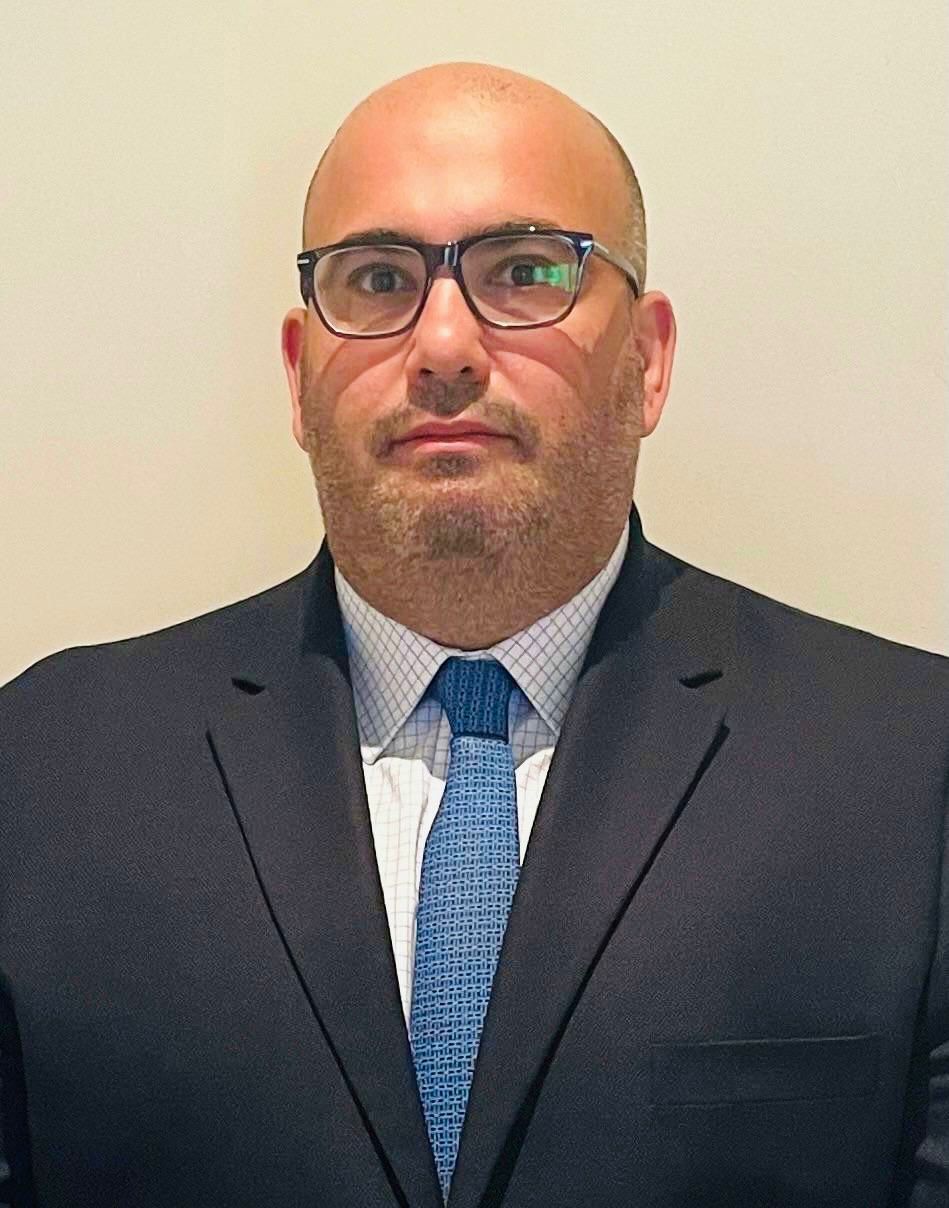
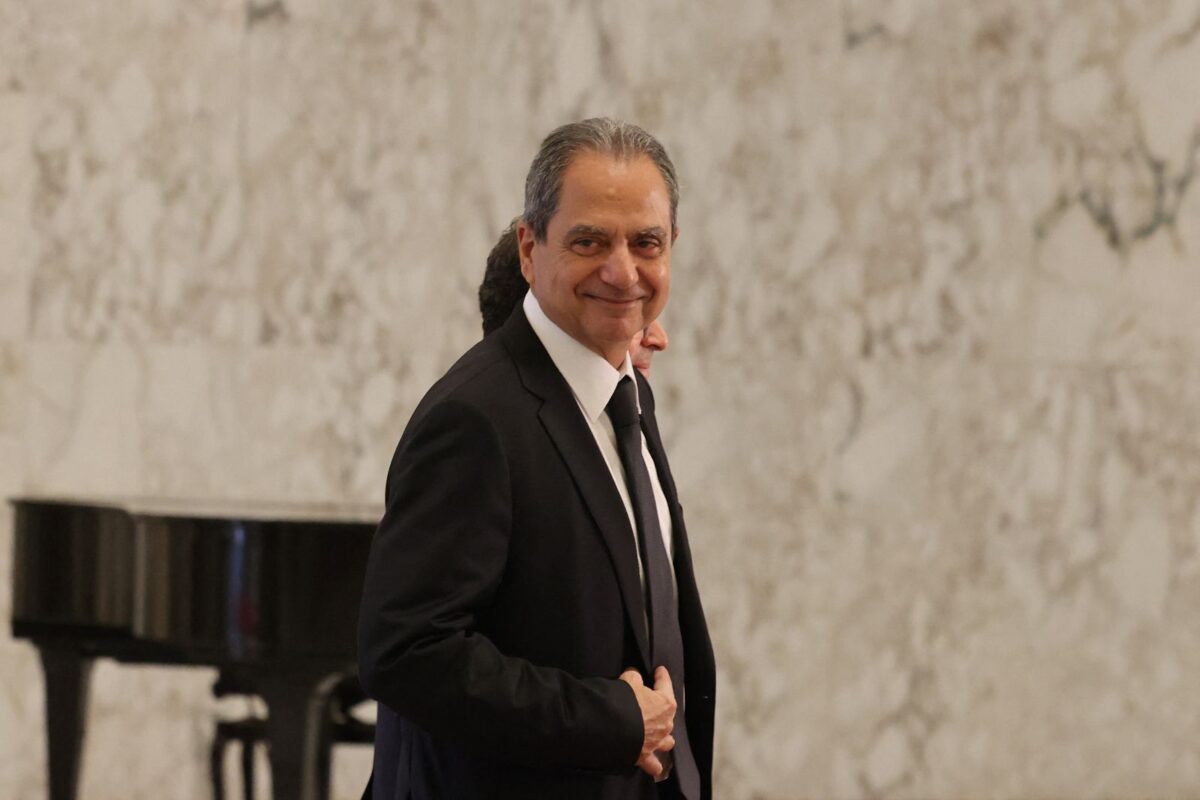
Minister of Energy and Water Joseph Saddi arrives at the first meeting of Lebanon's new government at the presidential palace in Baabda on February 11, 2025. (Photo by Anwar AMRO / AFP)
Energy Minister Joe Saddi announced on October 6 that he would stop attending cabinet sessions until the government assumed its responsibilities toward the energy sector. His complaint is specific. Ministries and public institutions have accumulated unpaid electricity bills. He estimates the state’s arrears to Électricité du Liban at around $300 million and also demands reimbursement for electricity-bill exemptions granted to parts of the south affected by the war. According to Saddi, EDL’s fuel costs have roughly doubled since the war began in March. Supply remains limited to a few hours a day. Nontechnical losses stand at around 30%, which he calls theft. His question is simple: how can the state ask citizens to pay their full bills when its own institutions do not pay theirs?
We may have the best-explained darkness in the world.
It is a fair question. It is also the kind of question Lebanese officials have been very good at asking for thirty years. Every minister who held this portfolio could explain, with charts, why there was no electricity. Very few could tell us concretely what they had achieved to improve the supply. We may have the best-explained darkness in the world.
The boycott
Al I’tikaf is an old Lebanese practice. The late Prime Minister Rashid Karami invoked it in 1969 during a political crisis that ended after the Cairo Agreement. Hardly a proud precedent. More recently, ministers affiliated with Hezbollah and the Amal Movement boycotted the PM Najib Mikati cabinet from October 2021 to January 2022. Ministers aligned with the Free Patriotic Movement boycotted caretaker cabinet sessions in 2022 and 2023. Four Shiite ministers walked out of a cabinet meeting in August 2025.
None of these protests produced a kilowatt. Boycotting is a populist tool. It lets a minister stand outside the room he belongs in and blame the people still inside. Saddi’s version adds a twist. The minister in charge of electricity is protesting the government’s failure to address the electricity crisis. A minister who cannot get his government to act on his own portfolio can resign. In Lebanon, he can keep the portfolio and stop attending the meetings. None of this makes him wrong. He is right. But being right in a press conference has never lit a single house in Lebanon.
Why there is no electricity
There is no technical mystery here, and it is certainly not rocket science. What we have is a toxic mix of interests, greed, incompetence, and negligence, with plenty of people benefiting from the darkness.
What we have is a toxic mix of interests, greed, incompetence, and negligence, with plenty of people benefiting from the darkness.
First, the private generators. They are a black box. No comprehensive official account exists of how many operate, who owns them, or how much they earn. We know they fill the gap the state leaves. We also know that tariff violations persist and that parts of the sector have political connections and protection from local patrons. Every hour EDL adds to the grid is an hour taken from their revenue.
Second, the fuel importers. A small group dominates the private fuel-importing market, including diesel for the generators. Alongside fuel procured for EDL, this dependence keeps electricity tied to petroleum imports, whether the grid works poorly or not at all. A shift toward natural gas and renewables would threaten the revenues built on that dependence. The problem is not simply fuel prices. It is the interests attached to continuing to buy it.
Third, bad policies and plain negligence. Promised plants remained unbuilt. Gas projects stalled. Incompetent ministers were tolerated because of their sectarian backing. The law establishing an electricity regulatory authority was passed in 2002, but its members were not appointed until September 2025, twenty-three years later. That is not a delay. That is a decision. But today, the real question is whether appointing an authority without the resources and tools to implement its mandate is useful.
A balanced budget built on unpaid electricity bills is not fiscal discipline.
Fourth, the Ministry of Finance. Its pursuit of a zero budget deficit becomes a mirage when the state leaves its electricity bills unpaid. Withholding payment reduces cash spending today but leaves the obligation outstanding and leaves EDL short on funds. A balanced budget built on unpaid electricity bills is not fiscal discipline. It is like using the remaining credit on one card to cover the minimum payment on another. The debt has not disappeared, and citizens pay the consequences in generator invoices.
Fifth, the central bank. Its priorities are to protect the fixed exchange rate, limit the money supply, and make dollars available for public-sector salaries. Those dollars do not buy fuel. They help maintain the clientelist networks that keep the political class in place. Between dollars for loyalty and dollars for power plants, the choice is made each month.
The political class has built networks whose survival depends on unreliable electricity.
Put these together, and the conclusion is uncomfortable. The political class has built networks whose survival depends on unreliable electricity. Electricity around the clock would threaten generator rents, reduce dependence on diesel, expose the cost of balancing budgets through unpaid bills, and remove one of the daily services through which politicians remind people that they need them. Darkness is not the system failing. It is the system working as designed.
Darkness is not the system failing. It is the system working as designed.
What is left for us
What can we realistically hope for? At best, an announcement from the Ministry of Economy that it caught a generator violating the rules. On September 30 of last year, inspectors visited six generators across Beirut, and security agencies issued eight legal notices for tariff and meter violations. Six generators in a city dependent on private electricity. One wonders whether this qualifies as real enforcement or merely enforcement as theater.
When citizens find a way out on their own, the state’s first response is to put another obstacle in their path.
Meanwhile, the families who escaped by installing solar panels and paying for their own energy transition out of pocket received their reward last September, when a joint ministerial decision required a list of approvals. A few days later, the PM directed that this decision be shelved. However, the reflex it revealed remains familiar. When citizens find a way out on their own, the state’s first response is to put another obstacle in their path.
This is why the word punishment is not an exaggeration. The failure is not only that the state does not provide reliable electricity. It is that it demands payment from citizens while failing to settle its own bills, tolerates the interests that profit from the shortage, and burdens those who try to escape it. A boycott of cabinet sessions does not change any of this. It only adds one more official to the long list of those who have explained the problem very well.
Khalil Gebara is an academic and researcher.
The views in this story reflect those of the author alone and do not necessarily reflect the beliefs of NOW.