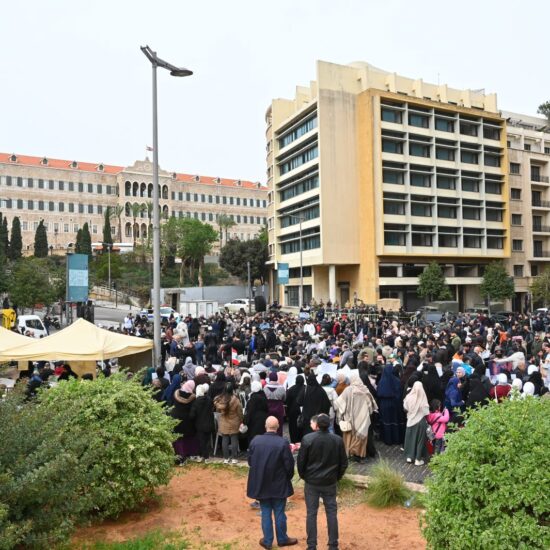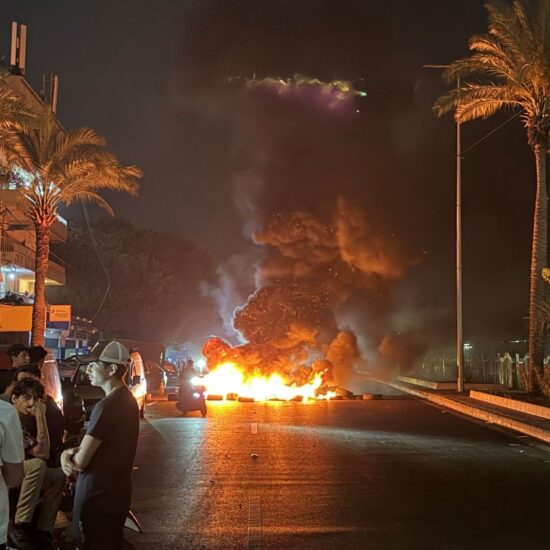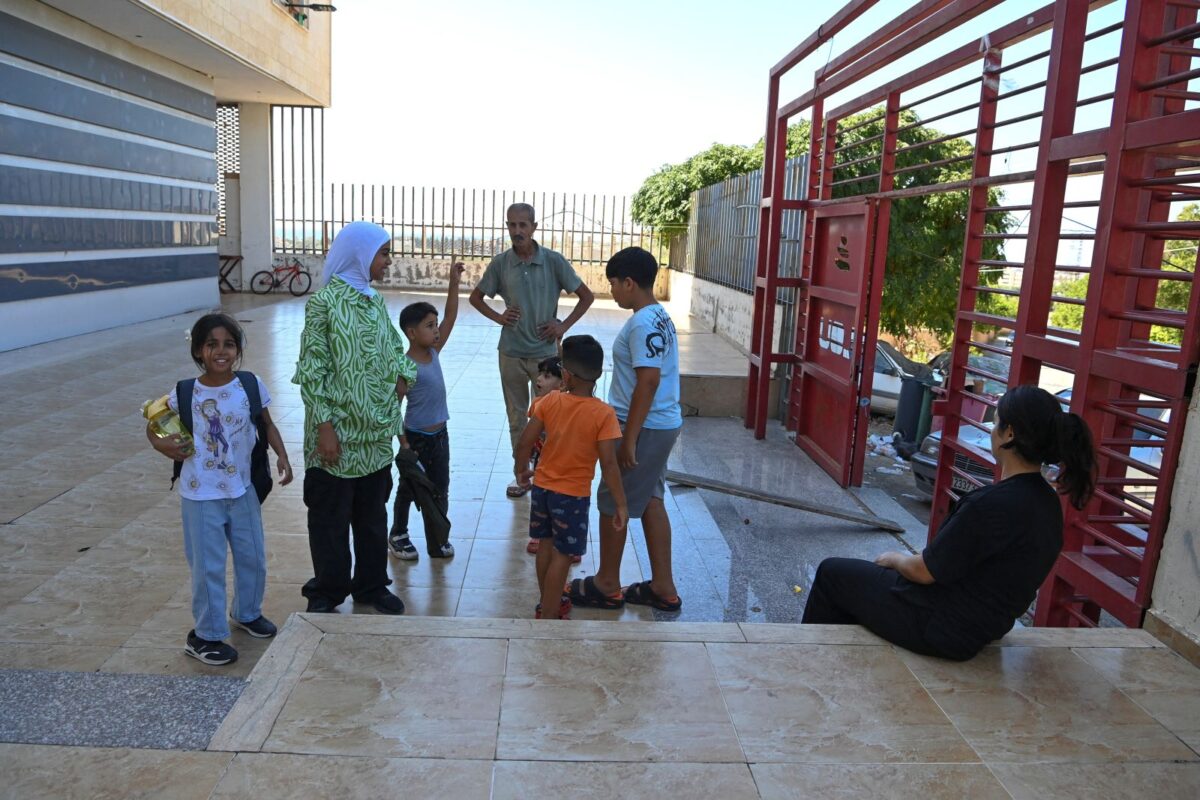
Displaced people stand near an entrance gate at a makeshift refugee center at the Lebanese-German University in Tyre, Lebanon, on September 23, 2026. The facility houses people who lost their homes in Deira as a result of Israeli airstrikes. (Photo by Nadezda Tavodova Tezgor / Middle East Images / Middle East Images via AFP)
A couple of weeks ago, the OECD released the PISA 2025 results. PISA assesses whether fifteen-year-olds can apply what they have learned in reading, mathematics, and science to solve problems. It offers a rare opportunity to ask a question Lebanon usually avoids: after years of schooling, what can students actually do?
The countries Lebanon is compared with are getting weaker, and Lebanon is still falling further behind them.
Lebanon scored 331 points in reading, 377 in mathematics, and 372 in science. The OECD averages were 461, 463, and 482. In reading alone, Lebanon is 130 points behind. This is worse than it appears. This year’s OECD averages are the lowest ever recorded across all three subjects. In other words, the countries Lebanon is compared with are getting weaker, and Lebanon is still falling further behind them.
The regional comparison is equally uncomfortable. Lebanon’s reading score was below Jordan’s 363, Saudi Arabia’s 387, Qatar’s 418, and the UAE’s 433, and only slightly above Morocco’s 321. These countries have different education systems and circumstances, yet Lebanon now trails most of them. Whatever challenges the region shares, Lebanon’s problems go beyond them.
The averages also mask a more serious finding. In science, 66.2% of Lebanese students scored below the minimum level the OECD deems necessary, compared with 25.7% across the OECD. Only 0.6% reached the top levels, compared with 7.2%. The question in Lebanon is no longer how many students excel. It is how many have basic skills.
A country that has long treated education as its strongest asset needs to closely examine what these numbers indicate about its economic future.
COVID, the financial collapse, the port explosion, and the wars have all disrupted schooling. But Lebanon’s problem did not start a few years ago. Its results today are lower than when it first joined PISA in 2015, and the OECD estimates that its science performance has been falling by 15 points per decade. A country that has long treated education as its strongest asset needs to closely examine what these numbers indicate about its economic future.
The sector that survived the war
Lebanon had schools and universities before it had a state. Ain Warqa opened in 1789; Butrus al Bustani’s National School in 1863; the Collège de la Sagesse in 1875; the Makassed schools in 1878; and Choueifat in 1886. Churches, Muslim associations, individual visionaries, and missionaries founded them all. The Syrian Protestant College, later the American University of Beirut, and Université Saint-Joseph were also founded decades before independence. As I argued in an earlier piece on Lebanon’s economic model, the country inherited much of this educational capacity from religious and private institutions. It became one of the few advantages Lebanon could carry into the world.
The country inherited much of this educational capacity from religious and private institutions. It became one of the few advantages Lebanon could carry into the world.
The civil war damaged that legacy. It divided the Lebanese University and repeatedly interrupted instruction. Yet the official examinations retained their place in national life. Their importance went beyond the certificate. Students educated in different schools, often on opposite sides of the war, could still be judged by a common standard.
Exams were canceled only in 1976 and replaced with certificates in 1985, 1987, and 1989. Those years were remembered as exceptions during the worst phases of the Lebanese civil war.
That is why this year’s decisions deserve more attention than they received. In May, the brevet examinations were canceled. In June, the cabinet exempted regular candidates from the baccalaureate examinations and awarded certificates based on school marks recorded by March 1, with a minimum average of 9.5 out of 20. The stated reason was serious security concerns. The government said it could not guarantee safe and fair examinations nationwide. But whenever the state replaces a common examination with marks awarded by individual schools, it weakens one of the few standards those schools still share.
An economy that produces people
Lebanon’s education system has always done more than prepare children for work at home. Families paid for schooling, often at great cost, hoping their children would find opportunities abroad. Those who left supported the families who stayed behind. This was how a country with too few productive jobs kept household incomes afloat.
The success of Lebanese graduates abroad has long masked a failure at home.
It also allowed Lebanon to postpone a difficult question: why did so many educated people have to leave to make a living? Remittances help families pay rent, medical bills,and school fees. They do not, by themselves, create jobs for the next graduating class. In that sense, the success of Lebanese graduates abroad has long masked a failure at home.
In 2026, the Ministry of Education and Higher Education received 13.2% of total spending, about $792 million, most of it for teachers and staff. The 2027 draft increases education spending by $97.1 million, but $81.9 million goes to personnel and only $8.2 million to direct support for schools and students. A larger education budget does not necessarily mean better education. It depends on where the money goes, and in Lebanon, most of it never reaches the classroom.
A larger education budget does not necessarily mean better education. It depends on where the money goes, and in Lebanon, most of it never reaches the classroom.
PISA raises a more fundamental question than how much is spent on education or where. What are students learning? Across public and private schools, Lebanon’s national result is poor. The country cannot protect its reputation for education by pointing to a handful of excellent schools and graduates while most of its fifteen-year-olds struggle to reach basic proficiency.
What happens when the jobs change?
For decades, the Gulf offered Lebanese graduates a path the domestic economy could not. Language skills, professional training, and the ability to work across cultures secured them jobs in hospitals, banks, engineering firms, and businesses across the region. That path still matters, but it can no longer be taken for granted. This year’s regional war has put pressure on Gulf employers and their clients, while Lebanese families remain as dependent as ever on remittances from abroad.
Technology adds another layer of uncertainty, especially for young people entering office professions. The first tasks graduates used to perform to learn a job are increasingly beingdone with AI. Lebanon’s PISA results do not tell us how many future jobs will disappear. They do show why the country should worry about whether its graduates will have the skills to use these tools well. Lebanese students scored 358 in computational problem solving, compared with an OECD average of 500. At the same time, only 13% said they did not use AI for preliminary research on a new topic. Using AI is not the problem. The problem is relying on it without the reading and reasoning skills needed to judge what it produces.
Students are learning less, and the jobs they are preparing for are changing.
Lebanon could once assume that an education, even one that ended in emigration, would eventually bring something back. That assumption supported families and, indirectly, the economy. PISA suggests the bargain is weakening at both ends. Students are learning less, and the jobs they are preparing for are changing. If Lebanon waits for remittances to fall before noticing, it will have waited too long.
The paper economy
The decline does not stop at the school gate. Lebanon has one public university and about50 private higher education institutions, 36 of which are universities. The Lebanese University’s share of enrollment fell from 59% in 2001 to 34% in 2022. Part of that change reflects the growth of private education. It also raises the question of what happened to the university that was supposed to make higher education accessible to everyone.
A degree depends on trust. An employer cannot attend every lecture or examine every graduate.
A degree depends on trust. An employer cannot attend every lecture or examine every graduate. The certificate is meant to stand for work completed and a standard met. Lebanon has given employers reasons to doubt both. In 2019, the Lebanese Army announced arrests in an investigation into forged university degrees. In 2021, Iraq suspended recognition of degrees from three Lebanese universities, citing nonadherenceto its academic standards.
In October 2025, the Lebanese University itself opened an investigation into suspected tampering with examination papers and grades at its law faculty. These cases do not describe every institution or every graduate. They show what happens when the institutions responsible for protecting a degree cannot always do so.
The state has allowed its public university to weaken while expecting Lebanese families to continue paying for the education on which the country’s reputation rests.
The Lebanese University should have been a safeguard against this erosion. Instead, disputes over appointments and its dependence on political clientelism have made self-governance more difficult for the university. Its teachers and students have paid the price. The state has allowed its public university to weaken while expecting Lebanese families to continue paying for the education on which the country’s reputation rests.
That reputation was built not only by the state but also by families who made enormous sacrifices to educate their children. Churches, religious foundations, and private institutions founded and sustained schools and universities. Beginning in the middle of the Civil War, the late Prime Minister Rafik Hariri also invested heavily in students. His foundation supported the higher education of some 36,000 Lebanese between 1984 and 2012, both in Lebanon and abroad. This history matters because it reminds us that Lebanon’s educational strength was sustained by people and institutions willing to pay for it, even as the country around them was falling apart.
But private commitment cannot replace public goods forever. Families can pay tuition. A foundation can fund a scholarship. Neither can guarantee that every school teaches well, that every exam is credible, or that every degree is what it claims to be. Those are responsibilities Lebanon has allowed to slip over time.
Lebanon’s last dependable export was never the certificate. It was what the person holding it could do.
For years, the country accepted that many of its best-educated people left. Their work abroad supported the families they left behind. But what happens when the next generation leaves with weaker skills or qualifications employers have learned to distrust? That is the economic question behind PISA 2025. Lebanon’s last dependable export was never the certificate. It was what the person holding it could do.
Khalil Gebara is an academic and researcher.
The views in this story reflect those of the author alone and do not necessarily reflect the beliefs of NOW.