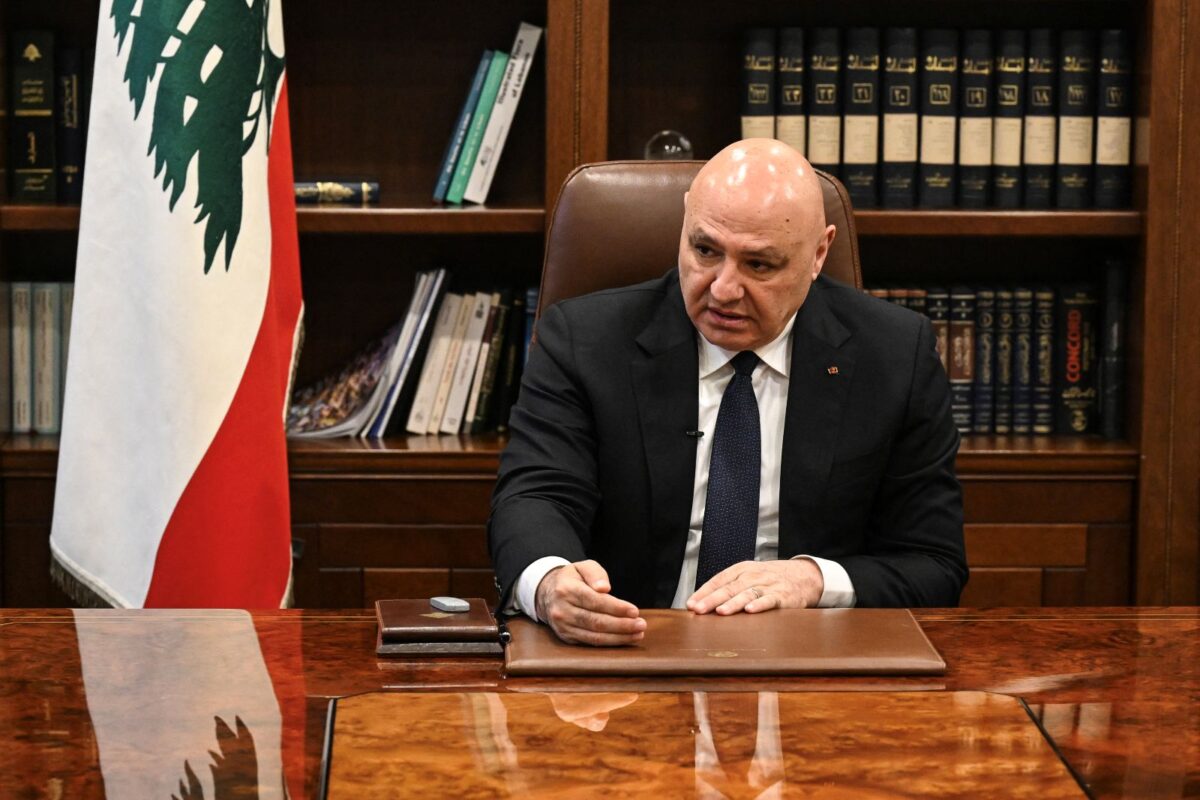
JOSEPH EID / AFP. Lebanese President Joseph Aoun speaks during an interview with AFP at the Presidential Palace in Baabda on September 15, 2026.
The Lebanese government has chosen to shield Hezbollah from accountability, postponing the referral of the Dahr al-Baidar explosives case to the Court of Justice even after the group publicly claimed ownership of the shipment. What the cabinet presented as a compromise amounts to another retreat before Hezbollah’s armed power.
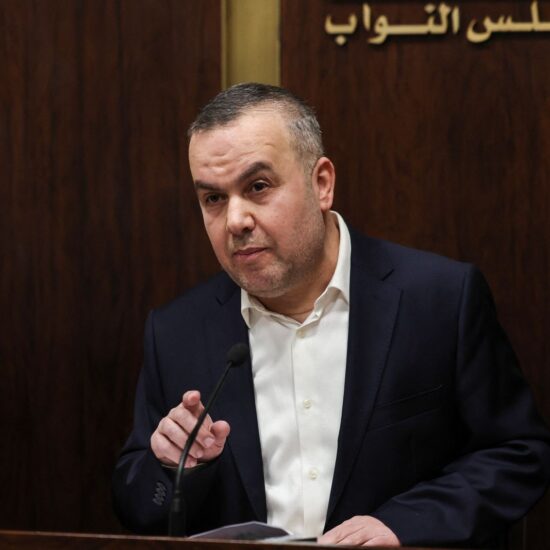
Authorities discovered 780 kilograms of explosives at the Dahr al-Baidar checkpoint in early October. There is no ambiguity about the group’s claim: Hezbollah MP Hassan Fadlallah acknowledged that the “vehicle and its cargo belong to the resistance.” Yet even this admission failed to produce a firm cabinet decision. A government that claims to uphold the state’s exclusive authority over weapons could not agree to refer a shipment of this magnitude to the court responsible for crimes against Lebanon’s internal and external security.
Justice Minister Adel Nassar pressed for referral to the Court of Justice. Hezbollah-aligned Labour Minister Mohammad Haidar reportedly opposed the proposal. The cabinet’s response was to accommodate the objection: the case would first proceed before the military judiciary, while referral to the Court of Justice would remain an unspecified future possibility.
That formula gives the government a convenient excuse to postpone a decision it lacks the political courage to take. Lebanese Forces ministers walked out in protest and subsequently renewed their demand for referral. The cabinet nevertheless adopted the arrangement, leaving Hezbollah with another demonstration that its objections carry more weight than the government’s declarations of sovereignty.
The government cannot credibly promise to disarm Hezbollah while retreating over how to prosecute a shipment the group openly admits owning. Keeping referral “on the table” is no substitute for taking responsibility. Every such postponement reinforces the same destructive message: Hezbollah can impose the terms, and the cabinet will find the language to accommodate them.
In Lebanon
Nawaf Salam denies accusations of releasing Mossad agents: In a press release, the Prime Minister claimed that he had not given orders to deport Mossad agents. Instead, the rumors were spread to hurt him, he argued.
Druze leader warns Israel might stay in south of Lebanon: The Druze leader Walid Joumblatt argued that Israel “will never leave” the south of the country and that Israel’s goal was to “expand to Syria and Lebanon.”
Aoun visited Tripoli: The Lebanese President Joseph Aoun visited Lebanon’s northern city of Tripoli on Saturday — the first presidential trip to the city in 15 years. He said he wanted to show the residents of the city that “the state is present and always stands by your side.”
In the Region
Israel heads to the polls: On Tuesday, Israel will vote on the fate of the current Israeli Prime Minister Benjamin Netanyahu. The main opposition is led by Gadi Eisenkot, a center-right politician and leader of the Yashar party.
Trump renews endorsement of Netanyahu: U.S. President Donald Trump has supported Netanyahu on Sunday in a social media post on his platform Truth Social. He called him “an outstanding Warrior” and said that both “have had a great relationship in winning together.” He also said that they had to “finish the job” in Iran.
Makkah defense pact visits Tehran: Delegates for the new alliance between Saudi Arabia, Turkey and Pakistan are in Tehran on Monday. Saudi Arabia will be represented by Defense Minister Khalid bin Salman, Turkey by the Director of National Intelligence and Pakistan by Field Marshal Asim Munir, according to a social media post by Saudi Deputy Minister for Public Diplomacy Rayed Krimly. The delegation will meet with Iranian President Masoud Pezeshkian and Mohsen Rezaei, the secretary of Iran’s Supreme National Security Council. The visit is “part of the continued effort by the Makkah Joint Defense Agreement countries for de-escalation between parties involved,” Krimly said.
Trump called off strike on Iran on Sunday: Amid speculations about a renewed attack on Iran ahead of the Israeli elections, Trump ruled out on Sunday that he would hit Iran that day. “There will be no strike today,” he said. He also added that he was facing two choices — either attack Iran again and “finish it off,” or make a deal with the country.
What We’re Reading
The Envoy Who Confuses Ankara’s Talking Points with American Values. Now’s Managing Editor Makram Rabah criticises Tom Barrack, the US special envoy to Turkey and Syria, for being too closely aligned to Turkey rather than truly supporting an American standpoint. Rabah argues that Barrack downplays violence against minorities like the Druze in Sweida, while not being harsh enough on Hezbollah.
Open letter to Prime Minister Nawaf Salam. Ronnie Chatah calls on Lebanese Prime Minister Nawaf Salam to be stricter against Hezbollah and Iran’s influence in Lebanon. Salam should be more pushy, and challenge other government representatives like Lebanese President Joseph Aoun, Chatah argues.
Who Was the Lady of Byblos? Charles H. Al-Hayek examines the history of Baalat Gubal, the ancient Phoenician goddess, who allegedly protected the city of Byblos — but has been long forgotten and neglected in Lebanese history.
Paris Seen From Beirut. Mohammad El Sahily looks at how Lebanon has reacted to the protests in France — arguing that they have been met with a lot of racism, xenophobia and political polarization. He argues that some Lebanese are engaging in far-right anti-immigration rhetoric, which reveals that part of the country has its own problem with racism.
780 Kilograms of Death: Lebanon at the Mercy of Hezbollah. Now’s Managing Editor Makram Rabah argues that the investigation into the explosives found at Dahr al-Baydar must go deeper than only imprisoning those who drove the trucks. Rabah calls for real investigations and calls on the government to monopolize the weapons under state control.