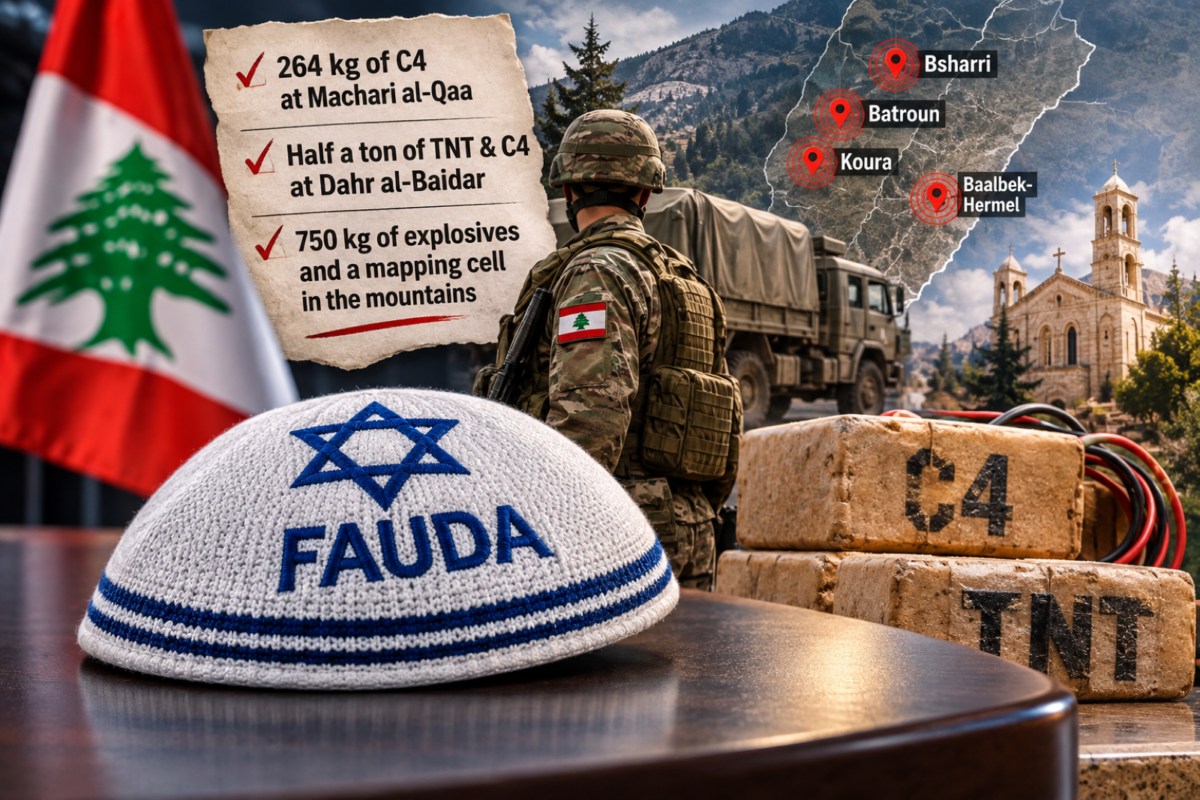
Last Thursday, on a prime-time talk show, a host placed a skullcap bearing a Star of David and the word “Fauda” on a guest’s head. Within hours, Lebanon had a national emergency: treason accusations, calls for prosecution, a whole country discovering its patriotism in a piece of cloth.
Two days later, the army stopped 264 kilograms of explosives, mostly C4, smuggled from Syria at Machari al-Qaa and bound for Baalbek-Hermel. Seven weeks earlier, at Dahr al-Baidar, security forces seized half a ton of TNT and C4 with two Hezbollah members on board; the party asked for its explosives back.
Last week, five suspected Hezbollah members were arrested in the highlands between Batroun and Bsharri, carrying maps, lists of sites across Koura, Batroun and Bsharri and references to sniper rifles. Three quarters of a ton of explosives and a cell mapping Christian districts, in under two months. How much was missed?
Yet the country spent its weekend on a kippah. That is not an accident; it is how the system survives. This week, one of its own admitted the system is failing.
The system rests on a cultivated confusion: in our vocabulary, Jewish, Zionist and Israeli all mean the enemy. They do not. Jewish is a faith, and Lebanon’s Israelite community, older than Israel itself, remains one of our 18 recognized sects. Zionist is a political ideology, championed by millions of evangelical Christians and rejected by some Orthodox Jews. Israeli is a citizenship held by some two million Arabs. The stunt, to be fair, blurred faith and state as crudely as the outrage did.
If every Jew is the enemy, every conversation about peace is betrayal, and anyone asking where the trucks were heading is “serving the enemy.” The label replaces the argument.
If every Jew is the enemy, every conversation about peace is betrayal, and anyone asking where the trucks were heading is “serving the enemy.” The label replaces the argument.
Hezbollah MP Hussein Hajj Hassan just demonstrated it. The Bsharri detainees, he said, were due out on Monday morning until “the US High Commissioner” pushed judges to charge them. The March 2 cabinet decision was “rejected, condemned and unconstitutional.” Lebanon, he lectured, cannot be taken “à la carte,” and the party’s “patience has limits.”
Strip away the anger and it is a confession. For decades, files touching Hezbollah died quietly: investigations stalled, judges were branded “politicized,” detainees went home. Now a party MP complains that it no longer works. Times have changed, and he said so himself.
His “High Commissioner” tells us what changed. From 1990 until the 2024 war, Washington handled Lebanon from a distance or through brokers: Damascus in the 1990s, Riyadh and Paris after 2005, Doha in 2008. Brokers could be bargained with, and Hezbollah mastered the bargaining.
Since the November 2024 ceasefire, Washington has been in the room, micromanaging file by file: the army’s deployment, the border crossings, the cabinet’s decisions, now the courtroom. A party built on intermediaries and a state that looked away cannot digest a superpower that reads every line itself and has decided disarmament is not optional.
The irony: a party that has always taken the state à la carte now demands the full menu of “consensus,” and offers civil peace as a favor, not an obligation.
The irony: a party that has always taken the state à la carte now demands the full menu of “consensus,” and offers civil peace as a favor, not an obligation.
A society trained to react to symbols will chase a skullcap across every screen while C4 crosses the Bekaa and cells map the mountains. We, of all people, should know better: on August 4, 2020, we buried more than 200 people because nobody asked what was stored in Hangar 12.
So who was waiting in Baalbek-Hermel, and for what target? Why was a cell mapping Bsharri? And since when is charging them foreign interference? Since the state started doing its job.
Lebanon needs schools that teach the difference, the repeal of the 1955 boycott law, judges left alone, and the courage to say peace out loud.
A kippah has never blown up a Lebanese neighborhood. Explosives have. Washington is finally watching the roads; Hezbollah’s anger proves it. Until we learn to tell a faith from a flag, and a flag from a bomb, those moving the explosives will keep counting on us to look at the wrong head.
A kippah has never blown up a Lebanese neighborhood. Explosives have. Washington is finally watching the roads; Hezbollah’s anger proves it. Until we learn to tell a faith from a flag, and a flag from a bomb, those moving the explosives will keep counting on us to look at the wrong head.
Elissa E Hachem is a journalist and political writer specializing in regional affairs and governance. Former Regional Media Advisor at the U.S. State Department’s Arabic Regional Media Hub, with broad experience in strategic communication across government and private sectors.
The views in this story reflect those of the author alone and do not necessarily reflect the beliefs of NOW.