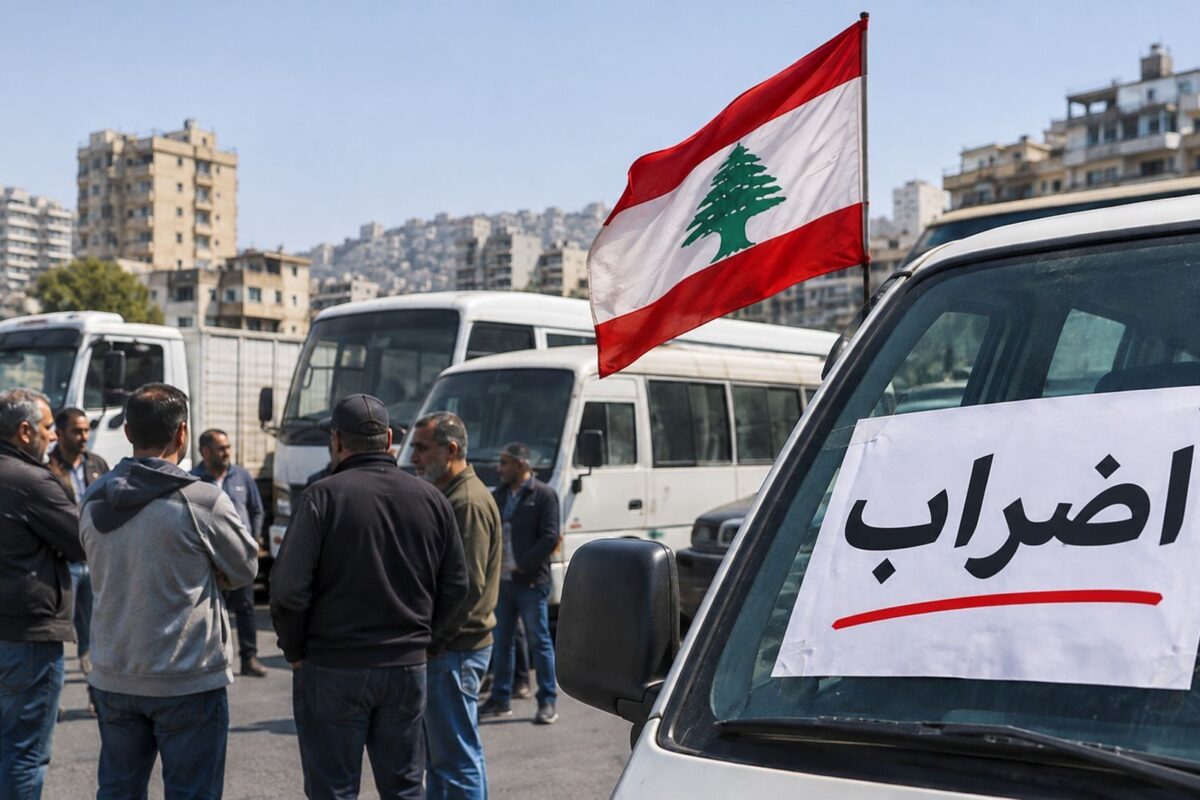
Lebanon’s land transport sector took to the streets on Wednesday as drivers, truck owners and public transport workers staged strikes across several regions, demanding that the government honour previous commitments, implement legislation protecting the sector and address what union representatives describe as increasingly difficult working conditions.
The nationwide movement brought together transport workers from different parts of the country, with demonstrations and gatherings reported in Beirut, Tripoli and the North, and the Beqaa.
Their grievances range from the government’s failure to implement an agreed legal framework and provide promised financial assistance to restrictions on vehicle registration, licensing problems and competition from unregulated transport services.
Speaking to NOW, Bassam Tlais, head of the Land Transport Unions and Syndicates, said the main objective of the movement was to pressure the government into passing legislation that would protect and organise the sector.
“The main demand is to pass a law,” Tlais said, arguing that the absence of an effective legal framework has left different branches of the transport sector exposed to violations and unfair competition.
He stressed that the demands extend beyond individual drivers, encompassing public transport workers, truck drivers and those involved in transporting goods and passengers.
Tlais also criticised restrictions affecting vehicle registration and the transfer of ownership, questioning how drivers and vehicle owners could continue operating when they face obstacles to registering their vehicles or transferring them to family members following a death.
He said the unions had previously reached agreements with the authorities, but these commitments had not been followed through.
Asked whether the government or the Ministry of Public Works and Transport had contacted the unions ahead of Wednesday’s action, Tlais said no one had reached out to him.
He added that further telephone discussions would serve little purpose without concrete implementation of previous agreements.
“This is not a matter of phone calls,” he said, explaining that the unions had already held discussions and reached understandings with officials, only to see decisions reversed or left unimplemented.
Tlais warned that Wednesday’s movement would not necessarily be the last, announcing that a larger mobilisation could take place within four weeks if the authorities failed to address the sector’s demands.
A sector struggling to survive
The grievances were also evident in the North, where Shadi El-Sayed, head of the Land Transport Union in the North, described the strike as an expression of the financial and professional pressures facing drivers.
Speaking to NOW, El-Sayed said the government had previously promised to provide financial alternatives and support for the sector within three months, but had failed to fulfil that commitment.
He also referred to a promised monthly allocation of 12.5 million Lebanese Lira, which he said had not materialised.
Beyond financial assistance, El-Sayed highlighted difficulties with obtaining and renewing professional driving licences, explaining that drivers were struggling to complete the necessary procedures because of administrative delays and the absence of committees responsible for conducting examinations.
He said the situation was leaving drivers unable to renew their documents and continue working, despite depending on their vehicles as their primary source of income.
El-Sayed said drivers continued to shoulder rising costs, including insurance, vehicle maintenance and other operating expenses, while facing additional taxes and charges.
“How will this citizen, or this driver, live?” he asked, describing the financial burden on workers who are already struggling to make ends meet.
In Tripoli and the wider North, the strike involved trucks, buses and other public transport vehicles. El-Sayed said the movement began at around 5:30 a.m. and continued until midday, with gatherings and road closures affecting several locations.
He warned that the mobilisation could intensify in the coming days, saying drivers could organise further demonstrations across Lebanon if their demands remained unanswered.
Addressing the authorities, El-Sayed said the sector had placed considerable trust in President Joseph Aoun, but criticised the government’s approach to taxation and its failure to provide adequate support for workers.
He argued that drivers were being asked to absorb higher costs without receiving corresponding improvements in wages, services or working conditions.
Registration disputes and unregulated competition
In the Beqaa, Mohammad Farhat, head of the Syndicate of Public Drivers in the governorate, pointed to what he described as a combination of regulatory failures, administrative restrictions and broken government commitments.
Speaking to NOW, Farhat said the failure to implement existing decisions and legislation was among the main reasons behind Wednesday’s strike.
He referred to previous government commitments involving financial allocations for the transport sector, claiming that agreements reached with the prime minister, deputy prime minister and several ministers had not translated into tangible results.
Farhat also raised concerns about the difficulties facing owners of minibuses, buses and trucks when attempting to register or renew their vehicles.
He said Lebanon has approximately 4,350 minibuses whose owners have invested in their vehicles, paid registration fees, obtained insurance and covered mechanical inspection costs, only to find themselves facing restrictions that could prevent them from continuing to operate.
He questioned how these families were expected to absorb the financial consequences of regulations that could render their vehicles unusable.
Similar concerns, he said, affect long-distance buses and trucks, particularly when vehicle modifications or registration requirements make it difficult for owners to obtain the necessary documentation.
Farhat also criticised the spread of unregulated transport services, including three-wheeled vehicles being used to carry passengers despite concerns over passenger safety.
He argued that the absence of effective oversight was creating unfair competition for licensed drivers while exposing passengers to potential risks.
“We are not against public transport, but it needs to be organised,” he said, stressing that the unions were not opposing efforts to develop public transportation but wanted a system that took existing operators into account.
Farhat argued that any public transport strategy should complement the existing sector rather than undermine the livelihoods of drivers who have invested in their vehicles and depend on them to support their families.
Despite the different concerns raised across the country, the three union representatives shared a common message: Wednesday’s strike was intended to pressure the government into honouring its commitments before the situation deteriorates further.
“Drivers wanted their demands addressed through dialogue and concrete government action rather than repeated demonstrations,” said Tlais,
Farhat also defended the unions’ right to protest, saying that drivers needed a way to make their grievances heard when previous discussions and commitments had failed to produce results.
The dispute reflects growing frustration with regulatory uncertainty, the government’s failure to honour previous commitments and the mounting difficulties facing drivers trying to sustain their livelihoods.