There is something profoundly fitting about Lebanon’s future being debated in Rome.
The city that gave the world one of history’s most enduring legal traditions reminds us that republics are built not by the power of armed men but by the supremacy of law. More than two millennia ago, Cicero wrote, “We are all servants of the laws so that we may be free.” The wisdom of that observation extends far beyond the Roman Republic. It speaks directly to Lebanon’s predicament today.
Whether intentionally or not, the negotiators meeting in Rome find themselves in a city that symbolizes the triumph of institutions over arbitrary force. Rome’s greatest legacy was not military conquest but the idea that law—not private armies, militias, or political violence—should govern public life. Every republic ultimately faces the same choice: whether it will be ruled by laws or by those who claim exemption from them.
That choice now confronts Lebanon.
The ongoing discussions in Rome have been portrayed by some as negotiations over Israeli withdrawal, ceasefire mechanisms, or technical security arrangements. They are all of these things. But they are also something much larger. They represent a confrontation between two competing visions of Lebanon itself: one in which the state alone possesses the legitimate authority to wield force, and another in which an armed political movement reserves that authority for itself while simultaneously participating in government.
For this reason, the debate surrounding Hezbollah’s disarmament has been deliberately distorted. We are repeatedly told that disarming Hezbollah is an Israeli demand imposed upon Lebanon. It is not.
Long before it became an Israeli demand—or an American demand—it was a Lebanese one.
It is the demand of citizens who have watched an armed organization repeatedly override the authority of their state, violate their privacy and freedoms, cripple their economy, and drag the country into wars that neither Parliament nor the Lebanese people chose. It is the demand of families who have seen political violence silence dissent and of those who continue to seek justice for former Prime Minister Rafik Hariri and for countless journalists, intellectuals, security officials, activists, and ordinary Lebanese whose only crime was believing in a sovereign, pluralistic republic governed by institutions rather than intimidation.
The issue, therefore, is not simply the physical surrender of weapons. It is the restoration of political sovereignty.
Nor should the verification of Hezbollah’s disarmament be caricatured as an Israeli intrusion into Lebanese sovereignty. Verification is, first and foremost, a Lebanese necessity.
For decades, Lebanese governments have repeatedly discovered that parallel military structures, hidden arsenals, tunnels, and independent chains of command existed beyond the reach of state institutions. A credible process requires credible verification. Such mechanisms do not diminish Lebanese sovereignty; they restore confidence that the state’s authority is genuine rather than symbolic. If anything, verification protects Lebanon from once again becoming hostage to a military structure operating beyond public accountability.
Yet the loudest critics of the Rome framework are often the very same political actors who spent decades defending Hezbollah’s exceptional status. They normalized the existence of an armed party outside the state’s authority while lamenting the weakness of state institutions. They spoke of reform while ensuring that no meaningful reform could threaten the political order sustained by Hezbollah’s coercive power.
Yet the loudest critics of the Rome framework are often the very same political actors who spent decades defending Hezbollah’s exceptional status. They normalized the existence of an armed party outside the state’s authority while lamenting the weakness of state institutions. They spoke of reform while ensuring that no meaningful reform could threaten the political order sustained by Hezbollah’s coercive power.
This is the central contradiction of modern Lebanon.
One cannot advocate judicial independence while accepting armed intimidation of judges. One cannot demand economic recovery while defending the very security architecture that has isolated Lebanon from investment and reconstruction. One cannot speak of sovereignty while insisting that one political faction remain permanently above the law.
What is unfolding today is therefore not merely a negotiation with Israel. It is an internal struggle between what remains of the Lebanese state and the deep state that has gradually captured it.
The Lebanese deep state is more than a collection of corrupt politicians. It is a mutually beneficial system. Traditional political elites provide Hezbollah with institutional legitimacy, political cover, and access to state resources. Hezbollah, in return, provides the coercive power that shields those elites from accountability and preserves a patronage system that has survived financial collapse, institutional paralysis, and overwhelming public rejection.
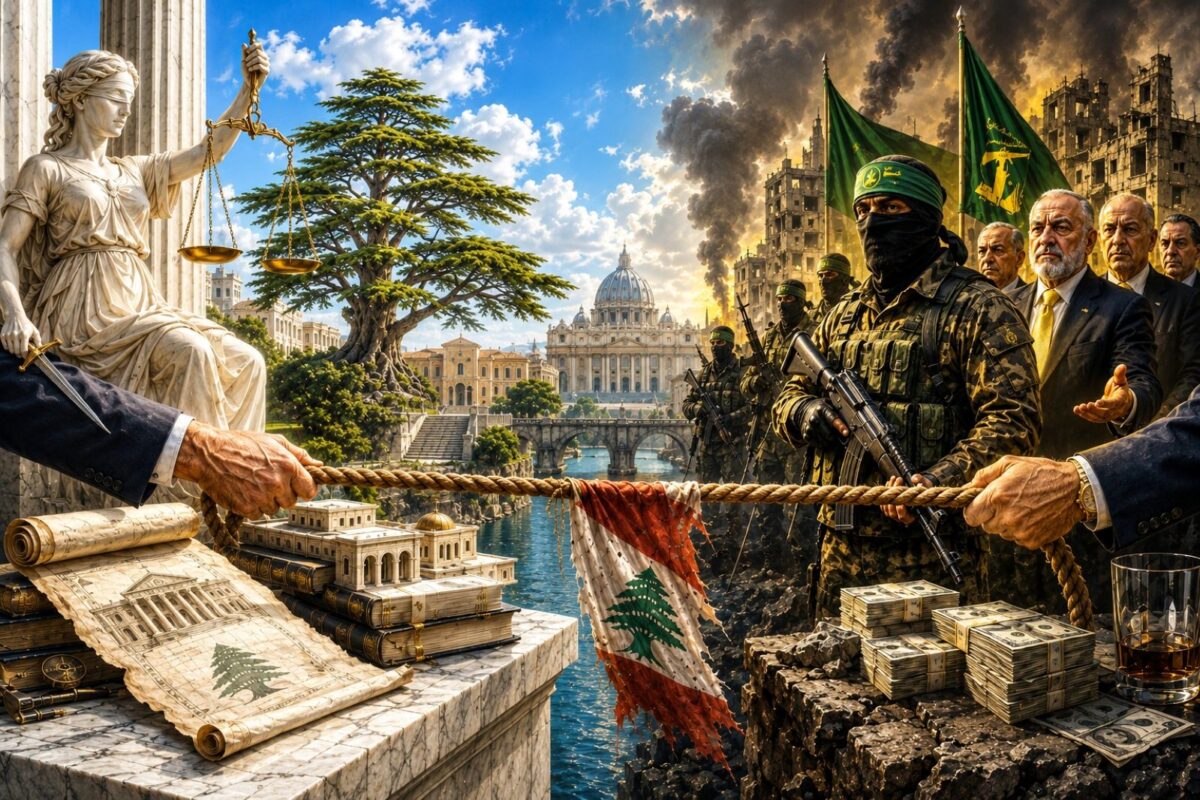
The relationship resembles less a political alliance than an organized protection racket. The politicians wear the suits; Hezbollah carries the guns.
The relationship resembles less a political alliance than an organized protection racket. The politicians wear the suits; Hezbollah carries the guns.
This explains why resistance to disarmament extends far beyond Hezbollah’s own leadership. Many who have little ideological affinity for Iran nevertheless understand that once Hezbollah loses its monopoly on coercion, the entire machinery that has obstructed accountability, blocked reform, and intimidated political opponents begins to unravel.
President Joseph Aoun and the Lebanese government undoubtedly face an extraordinarily difficult challenge. Israel’s continued military presence in parts of southern Lebanon remains unacceptable, and securing its withdrawal is a legitimate national objective. But that withdrawal cannot be separated from addressing the very condition that made repeated wars and occupations possible: the existence of an autonomous military force operating independently of the Lebanese state.
The Romans understood that the legitimacy of a republic rested upon the supremacy of law. Cicero also reminded us that Salus populi suprema lex esto—the welfare of the people shall be the supreme law. If the welfare of the Lebanese people is indeed the highest law, then no political movement, no ideology of resistance, and no armed organization can claim exemption from the authority of the state.
Republics survive not because they tolerate competing armies, but because they insist that all power ultimately answers to the law.
The negotiations in Rome should therefore be remembered for more than the agreements they may eventually produce. They should remind Lebanon of a far older lesson: republics survive not because they tolerate competing armies, but because they insist that all power ultimately answers to the law.
The choice before Lebanon is no longer between resistance and normalization, nor even between war and peace. It is between the law of the republic and the law of the gun.
History, and Rome itself, has already shown which of the two ultimately endures.
Makram Rabah is a lecturer at the American University of Beirut, Department of History. His forthcoming book Conflict on Mount Lebanon: The Druze, the Maronites and Collective Memory (Edinburgh University Press) covers collective identities and the Lebanese Civil War.