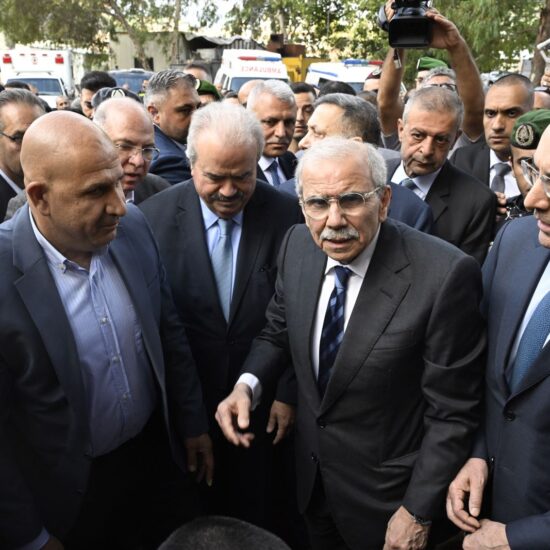

Journalists wait for the arrival of delegations for a new round of talks between the Lebanese and Israeli delegations at the US Embassy in Rome on August 4, 2026. (Photo by Tiziana FABI / AFP)
The seventh round of US-mediated Lebanon-Israel negotiations ended in Rome on August 6 after three days of talks, with the two sides failing to reach an agreement on expanding the pilot-zone mechanism in southern Lebanon. The negotiations were based on the framework agreement reached in Washington in June, which provides for a gradual Israeli withdrawal from designated areas as the Lebanese Army assumes control. Lebanese President Joseph Aoun said the talks made “positive progress” on border issues and the return of prisoners, while the remaining questions over the ceasefire and pilot zones were left for further US mediation.
The central disagreement remains the sequencing of Israel’s withdrawal and Hezbollah’s disarmament. Israel and Washington have continued to push for the Lebanese state to dismantle Hezbollah’s military infrastructure, while Beirut has insisted on a complete Israeli withdrawal from Lebanese territory.
During the Rome discussions, the Israeli side reportedly moved away, at least temporarily, from demanding that Hezbollah’s disarmament be resolved before the border file, although major differences remained. The talks also examined the possibility of a third-party mechanism to verify withdrawals and oversee the Lebanese Army’s deployment.
The lack of progress comes as tensions continue to rise on the ground. Israeli strikes and military activity in southern Lebanon have continued during and after the negotiations, including an incident in Zawtar al-Gharbiyeh, one of the designated pilot zones, where Lebanese authorities said Israeli forces entered the area and erected an earthen barrier. The incident was described by a Lebanese military source as a violation of the framework agreement.
For Lebanon, the challenge now is to prevent the diplomatic process from becoming disconnected from the reality on the ground. The government faces pressure to advance the state’s control over weapons while simultaneously demanding a full Israeli withdrawal.
In Lebanon
US Congress proposes $1.2 billion in aid linked to Hezbollah disarmament:
Two US senators have introduced the “Lebanon Sanctions, Stabilization, and Support Act,” which would provide up to $1.2 billion in security assistance to Lebanon over five years. The legislation aims to strengthen the Lebanese Armed Forces and Internal Security Forces, while tying part of the assistance to measures supporting the state’s monopoly over weapons and the disarmament of Hezbollah. The initiative comes as Washington continues to link support for Lebanon’s institutions with progress on state authority and Hezbollah’s military capabilities.
Israel’s military activity continues in southern Lebanon:
Israeli forces reportedly entered Zawtar al-Gharbiyeh, a village where the Lebanese Army had deployed under the pilot-zone framework, and constructed an earthen barrier near the town square. The Lebanese military described the move as a violation of the June agreement, highlighting the difficulty of implementing an arrangement that requires Israeli withdrawal and Lebanese deployment to proceed in parallel.
Lebanese soldier wounded in Israeli attack in al-Mansouri:
Israeli military activity also targeted Lebanese Army operations in al-Mansouri, where a soldier was lightly wounded as the army attempted to deploy and clear roads for residents returning to the area. The incident came amid wider Israeli strikes in the south and evacuation orders for residents, underscoring the continuing security pressures surrounding the negotiations.
Lebanon detains former Syrian officer wanted by Damascus:
Lebanese authorities detained a former Syrian officer from the Assad era who is reportedly wanted by Syrian authorities. The case highlights the changing judicial and security relationship between Beirut and Damascus, as Lebanon increasingly coordinates with the new Syrian authorities on individuals and cross-border security matters.
Pressure on Hezbollah’s financial networks:
Reports have pointed to increasing pressure on Hezbollah’s financial infrastructure, including activity surrounding institutions and financial channels associated with the group. The issue forms part of a wider effort to restrict Hezbollah’s access to funding as Lebanon moves toward greater state control over financial and security structures.
Six years on, Lebanon remembers Beirut Port blast victims: Lebanon marked the sixth anniversary of the August 4, 2020 Beirut port explosion, with families of the victims gathering near the port to commemorate those killed and demand accountability. The blast killed more than 220 people, injured more than 6,500 and devastated large parts of Beirut after hundreds of tones of ammonium nitrate stored at the port ignited.
In the Region
Hormuz agreement fails to resolve US-Iran tensions:
A new understanding involving Iran and Oman over the Strait of Hormuz has not resolved the broader confrontation between Tehran and Washington. The dispute continues to carry regional and economic consequences, particularly given the strategic importance of the waterway to global energy supplies. For Lebanon, any renewed escalation between Iran and the United States could further complicate the already fragile diplomatic track with Israel.
Iran threatened Gulf infrastructure amid escalation:
Iran reportedly warned that it could target power plants and desalination facilities in Gulf states if the United States attacked Iranian power infrastructure. The warning reflects the wider regional risks surrounding the US-Iran confrontation, with previous attacks already affecting energy sites, ports and airports across the Gulf.
Syria reaches deal with a Russia over future or military bases: Syria and Russia have reached an agreement on the future of Moscow’s two strategic military facilities on Syria’s Mediterranean coast, Hmeimim air base and the Tartus naval base, following 18 months of negotiations. Under the agreement, Syria will take control of the civilian facilities at Hmeimim and parts of the Tartus port, while the remaining military facilities will be converted into joint training and qualification centers for Syrian and Russian forces.
What We’re Reading
“World Lebanese Cultural Union (WLCU) at a Crossroads” Pierre A. Maroun examines the future of the World Lebanese Cultural Union and the implications of its partnership with the Civic Influence Hub. The piece focuses on whether the WLCU can preserve the institutional mission for which it was established while adapting to a changing Lebanese political and diaspora landscape. At the heart of the article is the question of whether principles such as sovereignty, constitutional legitimacy, citizenship, peace and positive neutrality can translate into an effective institutional role for the Lebanese diaspora.
“Berytus the Lamented Lies Low on the Ground” Charles H. al-Hayek looks beyond the August 4 Beirut port blast to examine the city’s much older history of destruction. Using historical and literary sources, the article draws a parallel between the 2020 catastrophe and the earthquake that devastated Roman Beirut, or Berytus, in 551 AD. It explores how earlier generations documented catastrophe and how those accounts can help historians understand Beirut’s long history of destruction, survival and reconstruction.
“Riad Salameh’s Health Raises New Questions in Lebanon’s Biggest Financial Trial” In this piece, Rodayna Raydan examines the latest developments surrounding former Banque du Liban governor Riad Salameh’s health and the implications for the judicial proceedings against him. The article looks at whether medical concerns could lead to further delays in one of Lebanon’s most consequential financial cases, while examining the legal safeguards available to ensure that proceedings can continue when a defendant is medically unable to appear in person. It also places the case within the wider context of Lebanon’s financial collapse, alleged illicit enrichment and the need to examine the broader networks that contributed to the country’s economic crisis.
“When Western Experts Make Iran’s Case” In this piece, Nadim Koteich examines how different strands of Western intellectual and foreign-policy thinking can converge around arguments that ultimately benefit Iran’s strategic position. The article argues that perspectives ranging from anti-imperialist criticism and isolationism to realism and conflict-resolution theory can produce a shared conclusion: that Iran cannot be defeated or removed as a regional power and therefore must be accommodated.
“Israel-Lebanon Talks End Without Progress in Expanding Pilot Zones” Laura Hülsemann assesses the outcome of the Rome talks and the failure to expand the pilot-zone mechanism in southern Lebanon. The article highlights the gap between Lebanon’s demand for successive Israeli withdrawals leading to a full withdrawal and Israel’s insistence on security arrangements linked to Hezbollah’s disarmament. It also examines how the escalation in southern Lebanon during the talks complicated the diplomatic process and why the pilot zones have become central to the implementation of the June framework agreement. The next round of negotiations is expected in September, leaving both sides under pressure to translate the framework into concrete steps.