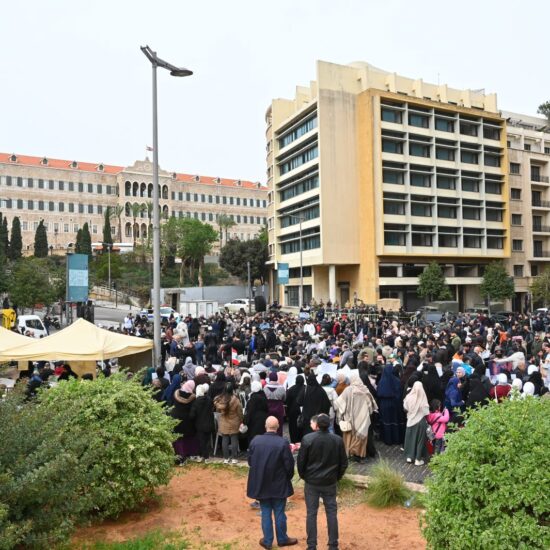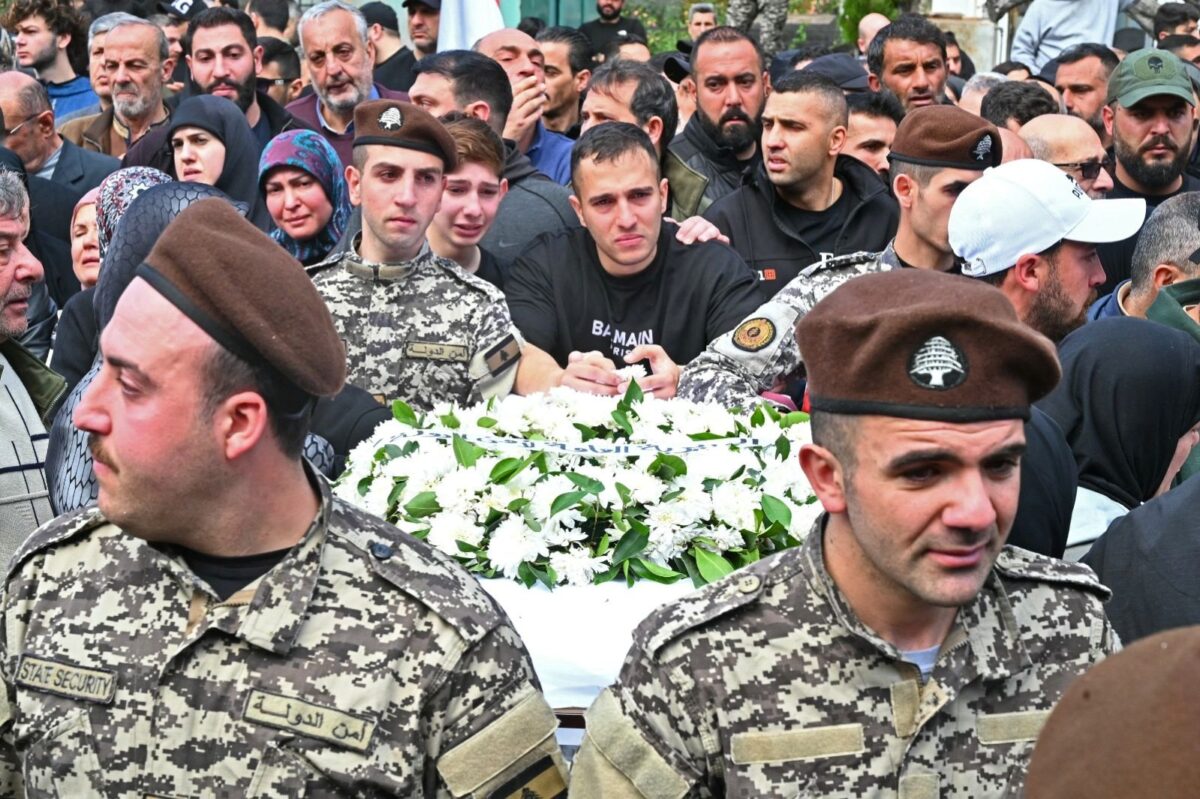
FADEL ITANI / AFP. Relatives and comrades gather around the coffin of a member of Lebanon's State Security agency, who was killed by an Israeli strike, during his funeral in Sidon on April 11, 2026.
The agency said that one Israeli strike in the southern city of Nabatiyeh had killed 13 of its personnel. Lebanon's presidency said on April 10 that a meeting would be held with Israel in Washington next week to discuss a ceasefire in the Israel-Hezbollah war and the start of negotiations between the neighbours.
Why it matters:
What unfolded in Beirut’s Saqiet el-Janzir is not a routine security overreach. It bears the hallmarks of a rogue faction operating within State Security — one aligned with Hezbollah — acting not to enforce the law, but to inflame sectarian tensions at a moment of extreme national fragility.
What happened:
A State Security unit intervened to force a private generator owner to lower electricity tariffs, exclusively for Shiites displaced by the war.
The demand was imposed without legal procedure.
The owner, Sunni, belonging to one of the biggest Beirut families, refused, citing fuel costs.
The confrontation escalated: gunfire in the air, minor injuries, and widespread panic.
Officers reportedly operated in civilian vehicles and outside formal enforcement protocols.
The key point:
This was not enforcement gone wrong.
It was enforcement used as a tool of provocation.
What’s really going on:
The operation fits a familiar pattern:
Selective targeting of individuals rather than systemic regulation.
Absence of legal process or documented violations.
Deployment of intimidation tactics in densely populated, mixed areas.
Such behavior is consistent with a rogue security subset leveraging state cover to pursue political objectives — not public order.
The Hezbollah connection:
State Security, long viewed as penetrated by networks close to Hezbollah, provides the ideal institutional façade for such actions.
It allows coercion to appear as state authority.
It blurs the line between official enforcement and partisan pressure.
In this case, the method — coercion, escalation, and public spectacle — suggests intent beyond pricing disputes.
The bigger picture:
The timing is critical.
Hezbollah has recently escalated rhetoric warning of internal confrontation if its position is challenged.
Lebanon remains economically shattered and socially combustible.
Against this backdrop, triggering localized tension is not incidental — it is strategic.
The sectarian trigger:
Witness accounts indicate that:
The pressure was directed at a specific group.
The confrontation quickly took on communal undertones.
This is how sectarian strife is engineered:
not through large-scale mobilization, but through targeted incidents designed to provoke reaction, fear, and retaliation.
Between the lines:
This was not about electricity.
It was about testing how far coercion can go under the cover of the state.
And more importantly, whether Lebanon can still distinguish between a state institution and a faction using that institution as a weapon.
A revealing contradiction:
This is the same State Security apparatus that was recently targeted by Israeli strikes in southern Lebanon, reportedly losing 13 of its personnel.
An agency that presents itself as part of the national security architecture under external threat
Yet internally deploys coercive, irregular tactics against civilians
That duality is telling. It raises fundamental questions about whether parts of the institution are serving a national mandate — or something far more fragmented.
The risk:
If rogue elements within security agencies are allowed to operate unchecked:
The Lebanese state continues to lose what remains of its monopoly over legitimate force.
Sectarian narratives gain traction.
Every local dispute risks becoming a national fault line.
That is the architecture of civil conflict — built incident by incident.
What to watch:
Will there be accountability within State Security, or institutional silence?
Will the army’s intervention mark a boundary — or merely contain fallout?
Will similar “incidents” begin appearing elsewhere?
Because if this pattern holds, Lebanon is not drifting toward instability.
It is being pushed there — deliberately.