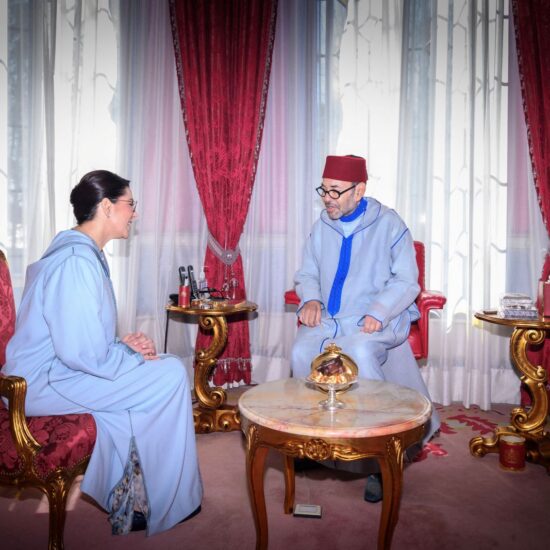
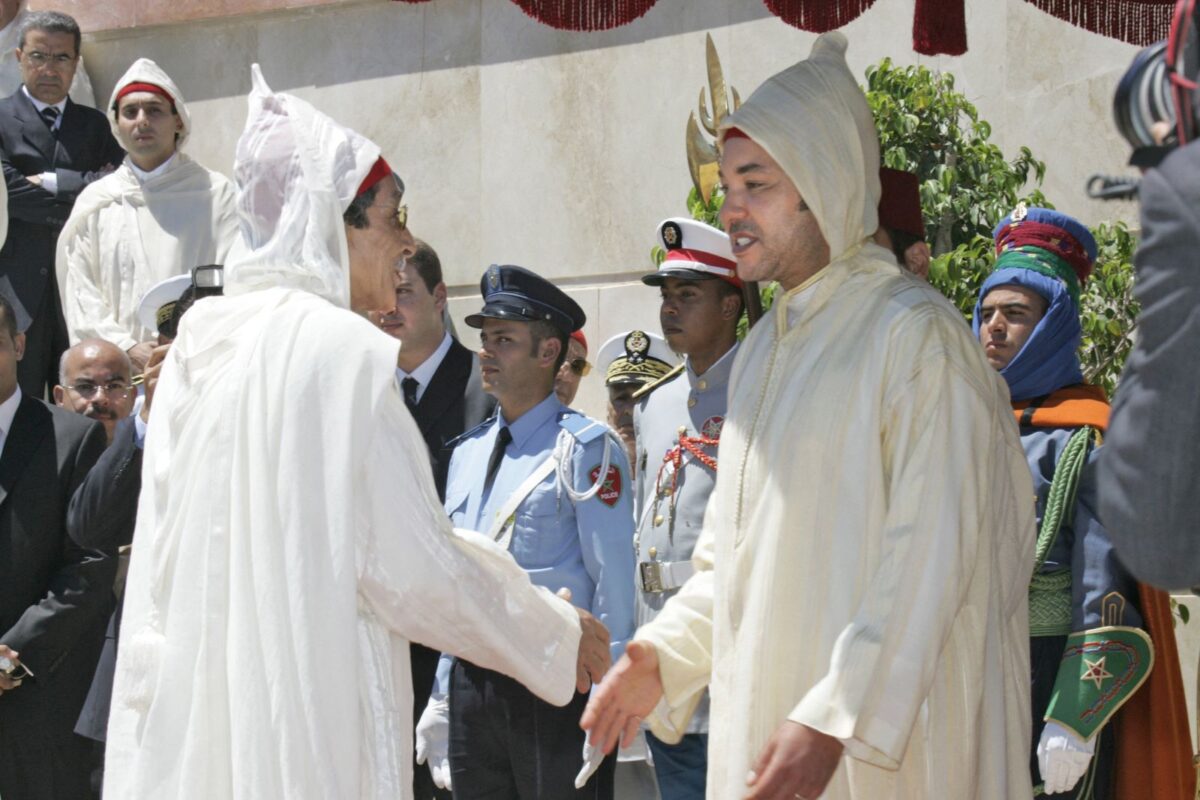
File picture taken 29 July 2005 in Tangiers shows Driss Benzakri (L) president of the justice and reconciliation (IER) committee presenting his good wishes to Moroccan King Mohammed VI on the occasion of the day of the Throne. (Photo by ABDELHAK SENNA / AFP)
The power of states is not measured solely by the size of their armies, the volume of their leaders’ speeches, or their ability to produce ever more ambitious slogans on international platforms. Real power begins elsewhere: with a state’s ability to identify its priorities, exploit its geography, maintain political stability, and build an economy capable of generating influence that does not depend on noise, but on credibility, reliability, and the capacity to turn national interests into coherent foreign policy.
It is from this perspective that Morocco’s growing regional and international standing is worth examining.
Rabat does not appear interested in presenting Morocco as the carrier of a transnational ideological project, nor does it pretend that it can determine the fate of others. Instead, it operates from a relatively clear understanding of its own interests and from the recognition that international politics is not a competition in rhetoric. It is a continuous process of negotiation, partnership-building, and accumulating the instruments of national power.
Nowhere is this approach clearer than in Morocco’s handling of the Sahara question, which Rabat considers an integral part of its national territory. Rather than treating the issue simply as an opportunity for slogans or displays of outrage, Morocco has approached it as a long-term national file requiring the combined deployment of political, economic, and diplomatic resources. To a considerable extent, it has sought to situate the issue within the broader project of strengthening the Moroccan state and expanding its international relationships, rather than turning it into a permanent instrument of domestic mobilization or an excuse for postponing reform.
Perhaps the most important element of this strategy is that Morocco has not relied simply on persuading the world to accept its argument. It has worked to change the interests through which other countries view Morocco.
States rarely rewrite their foreign policies because another government has repeated the same argument more eloquently or more loudly. They do so when they encounter a stable partner, a growing economy, cumulative investment opportunities, and relationships that offer strategic value. The gradual evolution of international positions on Western Sahara can therefore be understood not merely as the product of diplomatic lobbying, but as the result of a much longer process of building influence.
This is where the Moroccan experience becomes particularly interesting for the wider Arab world.
Too many states in our region have treated their national causes as permanent excuses for postponing reform. Morocco, at least in its broader approach, has attempted to reverse that equation: the stronger the state becomes economically and institutionally, the greater its ability to defend its interests abroad
Too many states in our region have treated their national causes as permanent excuses for postponing reform. Morocco, at least in its broader approach, has attempted to reverse that equation: the stronger the state becomes economically and institutionally, the greater its ability to defend its interests abroad. Influence is not produced at the podium. It is built at home and subsequently converted into diplomatic leverage.
This logic was evident in King Mohammed VI’s latest Throne Day address, which once again emphasized diversified partnerships while linking Morocco’s international standing to its capacity for growth, production, and investment. Beyond the ceremonial language that inevitably accompanies such occasions, the more consequential message was that economic development and political stability are themselves instruments of foreign policy.
A state that does not produce, invest in infrastructure, or maintain functioning and credible institutions will struggle to become a serious partner, regardless of how many embassies it opens or how loudly it speaks.
A state that does not produce, invest in infrastructure, or maintain functioning and credible institutions will struggle to become a serious partner, regardless of how many embassies it opens or how loudly it speaks.
Morocco, by contrast, has been trying to turn industry, tourism, infrastructure, renewable energy, and its geographical position between Europe and Africa into sources of diplomatic influence every bit as important as conventional political agreements. Geography may be destiny, but only competent states know how to turn geography into leverage.
Yet the ultimate test of this strategy lies beyond diplomacy itself.
Foreign policy, however successful, has limited meaning if its gains do not eventually reach the citizen. The Moroccan citizen should be the primary beneficiary of diversified partnerships, foreign investment, infrastructure development, and the country’s enhanced international standing. When these policies produce jobs, better education, more efficient public services, and greater opportunities for social mobility, foreign policy becomes an extension of development rather than merely a successful exercise in international relations.
Morocco’s growing international position therefore does not derive from an ability to impose itself through force. It comes from an effort to make itself increasingly difficult to bypass.
Morocco’s growing international position therefore does not derive from an ability to impose itself through force. It comes from an effort to make itself increasingly difficult to bypass.
States do not always need to be the strongest to matter. Sometimes it is enough to become a country that others need, rather than merely one they are obliged to deal with. In an international system increasingly shaped by shifting alliances, protectionism, competition over supply chains, energy security, migration, and access to African markets, that position can become a significant source of power in its own right.
This also explains Morocco’s effort to diversify its partnerships rather than mortgage its foreign policy to a single axis. Diversification is not diplomatic luxury; it is a form of sovereignty. The broader a state’s network of economic and political relationships becomes, the greater its ability to negotiate, resist pressure, and protect its interests.
Moroccan pragmatism should therefore be understood less as an abandonment of principles than as the management of options. Foreign policy is made to serve the state, rather than turning the state into an instrument for ideological adventures abroad.
That distinction is particularly important in a region where states have repeatedly exhausted their resources in conflicts that bring little benefit to their citizens, or subordinated national interests to ideological projects that ultimately weaken the very institutions they claim to defend.
Morocco offers a different proposition: security creates the conditions for investment; investment generates growth; growth strengthens sovereignty; and stronger sovereignty expands the state’s room for political maneuver.
None of this means that Morocco should be presented as a completed success story.
Economic diplomacy cannot remain sustainable if its benefits fail to reach society. Stability cannot simply be a slogan marketed to international investors; it must translate into employment, credible education, better public services, reduced regional inequality, and a greater ability for ordinary Moroccans to participate in the wealth their country is creating.
Nor is becoming a desirable international partner sufficient in itself. The more difficult question is whether foreign investment is producing local knowledge, technological capacity, skilled employment, and Moroccan companies capable of competing internationally.
These questions do not diminish Morocco’s achievements. On the contrary, asking them is necessary if the Moroccan experience is to be treated seriously rather than reduced to official propaganda. The ultimate measure of successful foreign policy is not the number of diplomatic victories announced by the government, but the extent to which those victories strengthen the state and improve the lives of its citizens.
Morocco does not claim that it intends to change the world, nor should it be presented as a flawless model. What it does offer is an example of a state attempting to construct its foreign policy around strengthening the sources of power at home rather than compensating for their absence abroad.
Morocco does not claim that it intends to change the world, nor should it be presented as a flawless model. What it does offer is an example of a state attempting to construct its foreign policy around strengthening the sources of power at home rather than compensating for their absence abroad.
Foreign policy, after all, is not the art of raising one’s voice. It is the art of expanding the state’s room to maneuver.
And perhaps that is the most important lesson of the Moroccan experience: real influence is not manufactured through slogans. It emerges when a state builds itself first—and then makes what it has built matter to the rest of the world
This article originally appeared in Elaph.
Makram Rabah is the managing editor at Now Lebanon and an Assistant Professor at the American University of Beirut, Department of History. His book Conflict on Mount Lebanon: The Druze, the Maronites and Collective Memory (Edinburgh University Press) covers collective identities and the Lebanese Civil War. He tweets at @makramrabah