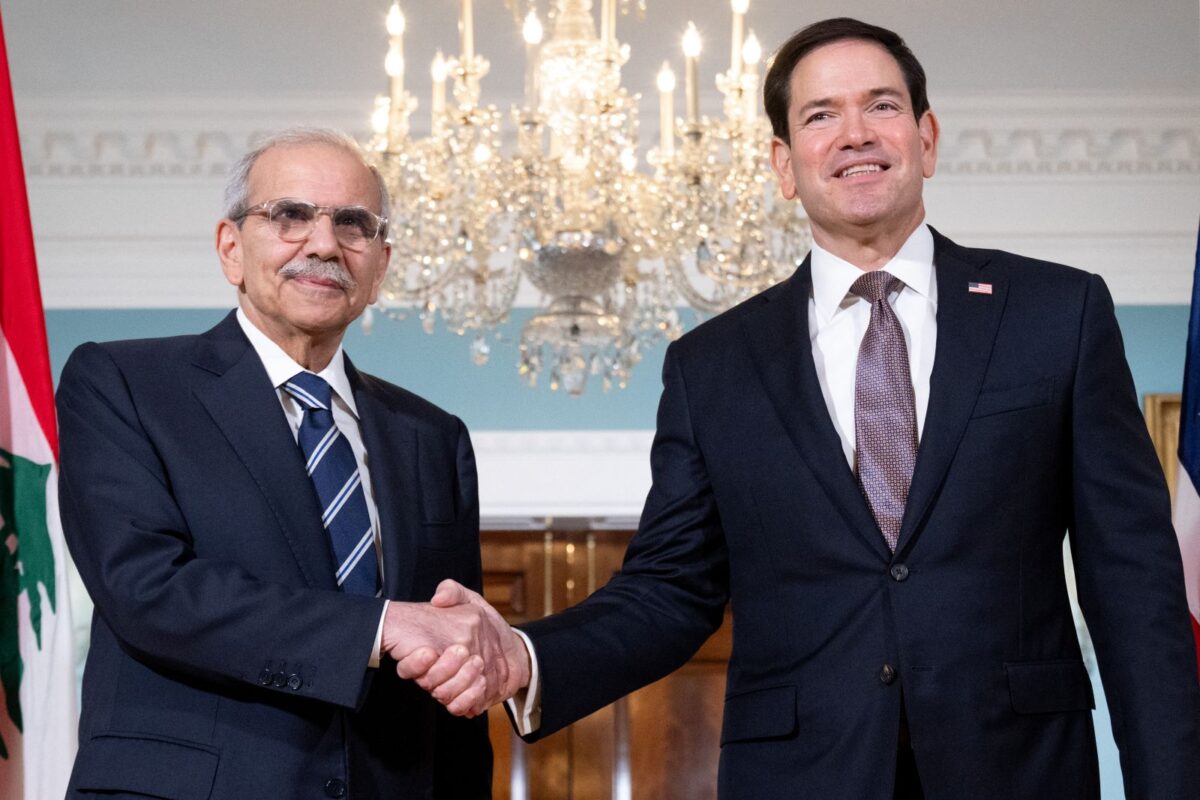
US Secretary of State Marco Rubio shakes hands with Lebanese Prime Minister Nawaf Salam (L) at the State Department in Washington, DC on September 28, 2026. (Photo by SAUL LOEB / AFP)
To understand why Rubio’s personal involvement in the Lebanon-Israel track is not incidental, start with who he actually is right now. Marco Rubio is not just America’s top diplomat. Since September, he has permanently held the job of National Security Advisor too, becoming only the second person in US history, after Henry Kissinger, the diplomat most responsible for reshaping American strategy across the Middle East in the 1970s, to run the State Department and the National Security Council at once. Every file on his desk, Lebanon included, is studied through two lenses at once: the political calculus any Secretary of State applies, and, more importantly, the lens of national security and strategic interest only a National Security Advisor carries.
That is precisely why his words on Lebanon deserve to be read more carefully, not less.
That matters for how Lebanon should read his statements. This is a man dubbed the “viceroy of Venezuela” for engineering Maduro’s ouster, who sits at the center of Washington’s Iran strategy, and manages the Gulf relationship as those states reposition at record speed. Lebanon is one file on that desk, not the only one, and not, most days, the most urgent. That is precisely why his words on Lebanon deserve to be read more carefully, not less.
Rubio did not have to attend the Lebanon-Israel talks personally, nor did Treasury Secretary Scott Bessent have to sit with Lebanon’s finance minister in the same 48-hour window. Two of the most powerful men in the administration cleared their schedules for Lebanon twice in one week. That is not a coincidence. It is a signal.
The signal has already been spelled out plainly. Rubio told Salam directly that deploying the army in the south is not enough on its own, and that disarming Hezbollah is a precondition for any further Israeli withdrawal, not a parallel track
The signal has already been spelled out plainly. Rubio told Salam directly that deploying the army in the south is not enough on its own, and that disarming Hezbollah is a precondition for any further Israeli withdrawal, not a parallel track. He has also called the Trilateral Framework, in his words, “the only path to durable peace” between Lebanon and Israel. Both statements close the door Lebanon’s negotiators keep trying to leave open: no sequence where withdrawal comes first and disarmament follows at Beirut’s convenience, and no lesser arrangement, a truce, a temporary deal, that Washington will broker instead.
Compliance is not an option Lebanon can weigh at its own pace. It is the price of remaining inside the only framework on offer.
There is a harder truth underneath: American assistance is conditional by every measure that matters, financial, military, diplomatic, and there will be no protection for a Lebanese state that does not comply. Washington has made this explicit through Bessent on finance, through conditions on army support, and now through Rubio on sovereignty itself. Compliance is not an option Lebanon can weigh at its own pace. It is the price of remaining inside the only framework on offer.
Rubio treats the Lebanon file not as a standalone drama, but as one piece of a single strategy to roll back Iranian influence region-wide, the same strategy that treats Hezbollah, the Houthis, Iraqi militias, and Tehran’s proxies everywhere as one problem with one solution. When he says Hezbollah is Iran, he is not using rhetorical shorthand; he applies the same framework to Caracas and to every capital where Washington believes a local actor executes someone else’s agenda. Lebanon is not an exception. It is a case study.
Rubio has built his reputation on one consistent position: Washington backs allies willing to fight for themselves, and does not waste resources on those who will not.
Officials who read Rubio’s firmness as negotiable, or assume Washington’s patience is bottomless because Lebanon is small and sympathetic, are misreading him entirely. Rubio has built his reputation on one consistent position: Washington backs allies willing to fight for themselves, and does not waste resources on those who will not. He proved this in Venezuela by moving fast once Maduro’s opposition showed it could govern. He is now watching whether Lebanon will do the same, or keep asking for patience it has shown it does not extend elsewhere. And Rubio is widely seen as one of the Republican Party’s strongest future presidential contenders, a man whose current portfolio is effectively a four-year audition for the country’s highest office. Whatever he commits to today on Lebanon, he will likely remain a dominant voice in Washington for years, in this role or a larger one.
Whatever he commits to today on Lebanon, he will likely remain a dominant voice in Washington for years, in this role or a larger one.
Lebanon’s leadership keeps treating Rubio’s statements as a diplomatic data point to manage. They would do better to recognize him for what he is: the clearest window into how the most powerful man in Washington, after the president, thinks the region’s unfinished business should end.
Elissa E Hachem is a journalist and political writer specializing in regional affairs and governance. Former Regional Media Advisor at the U.S. State Department’s Arabic Regional Media Hub, with broad experience in strategic communication across government and private sectors.
The views in this story reflect those of the author alone and do not necessarily reflect the beliefs of NOW.