Between 1821 and 1860, the commoners of Mount Lebanon, the ahali or ‘amma, rose three times, in 1821, in 1840 and in 1858–1860. These revolts, known as the ‘ammiyyat, challenged the hereditary lords who controlled the tax districts of the mountain and brought down its old order, a process that ended in the civil war and massacres of 1860.
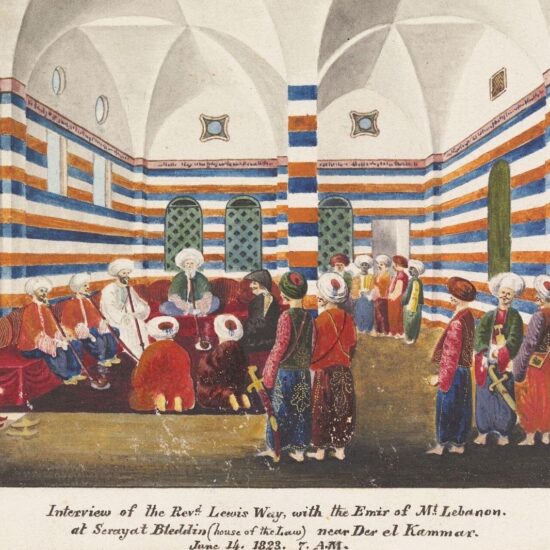
For the Ottoman state and the local notables, the commoners were obedient tax-paying subjects, expected to stay silent and work. On 15 September 1821, Abdullah Pasha, the Ottoman governor of the province of Saida ruling from Acre, issued a stern decree to the Christian and Shi’a peasants who had risen against Emir Bashir II Shihab and refused to pay more than one miri tax. He reminded them that they were “weak people”, easier to crush than a spider’s web, and asked: “How, then, did you try to rebel?”
The pasha’s question reflects the way rural society had been organized in Mount Lebanon since the Ottoman conquest of 1516. The districts of this semi-autonomous territory were integrated into the empire while keeping their internal social structure, which rested on two social orders. At the top stood the district lords, the muqata’jis (Those who control a district), also known as manasib, people of rank, or a’yan, notables. They held titles ranging from emir to muqaddam and shaykh, and some of their families had held power in the mountain since the late Mamluk period. Each dynasty held its muqata’a as a quasi-hereditary domain, where it farmed the taxes, ran the administration, delivered justice of first instance and kept small armed retinues. From 1697 to 1841, the paramount lord, the governing emir, came from the Shihab family, while the great Druze lords kept a strong hand over the affairs of the mountain. As tax farmer-in-chief, the emir remitted the taxes of the mountain to the Ottoman governor of Saida. Below them stood the ‘amma or ahali, the commoners, whose name gave the revolts their name of ‘ammiyya. They were bound to the manasib by ties of loyalty, the ‘uhda, sharecropping, owed labor services, taxes and gifts on feast days, and had no form of political representation.
The gap between the two orders showed in daily life. The lords lived in palaces with ornate gates of ablaq masonry, mandaloun arched windows and painted wooden kiosks, and they dressed in silk and embroidered textiles. Their ladies, who bore the title al-Sitt, wore the iconic tantour, a tall headdress draped with a long silk veil, the mandil. The ahali lived in small farmhouses with flat earthen roofs.
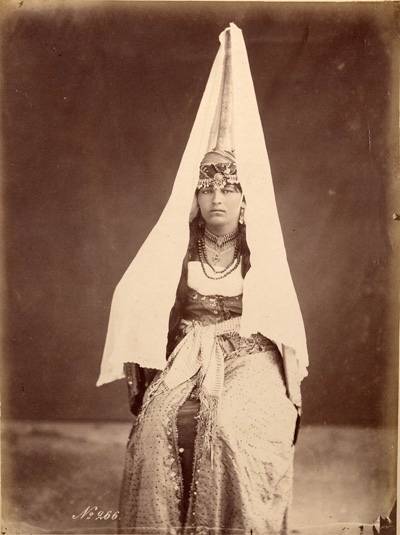
Druze lady wearing the tantour, Felix Bonfils picture, circa 1870.
This elite formed a single, cross-confessional group, and rank, far more than religion, was the decisive social marker of the age. The chroniclers of the period, such as Tannus al-Shidyaq in Akhbar al-A’yan fi Jabal Lubnan, wrote the history of the mountain as the genealogy of its notable families, their feuds and their deeds. The peasants appeared in these texts only as subjects.
Over the 18th and early 19th centuries, this hierarchy of lords and commoners came under growing strain. The Maronite community grew in numbers and influence. Following the Council of Luwayza in 1736, the Maronite Church institutionalized and expanded its network of monasteries and schools, and educated Maronites, long employed as mudabbirs, the managers of the lords’ estates, gained a firmer hold on the running of the mountain. The long reign of Emir Bashir II Shihab (1788–1840) sped up these shifts. The emir broke the power of the Druze lords: he had his former ally, Shaykh Bashir Jumblat, executed in 1825 and sent others into exile. He seized their lands to the benefit of the Maronites and built a more centralized version of the old system, while raising the mountain’s tribute to satisfy both the pasha and his own treasury. Meanwhile, Christian market towns such as Zuq Mikayel, Deir al-Qamar, Beit Shabab and Zahleh flourished through the silk trade and crafts. They gave rise to a new class of merchants and moneylenders wealthy enough to lend to the emirs and shaykhs, a class that still had no share in political power.
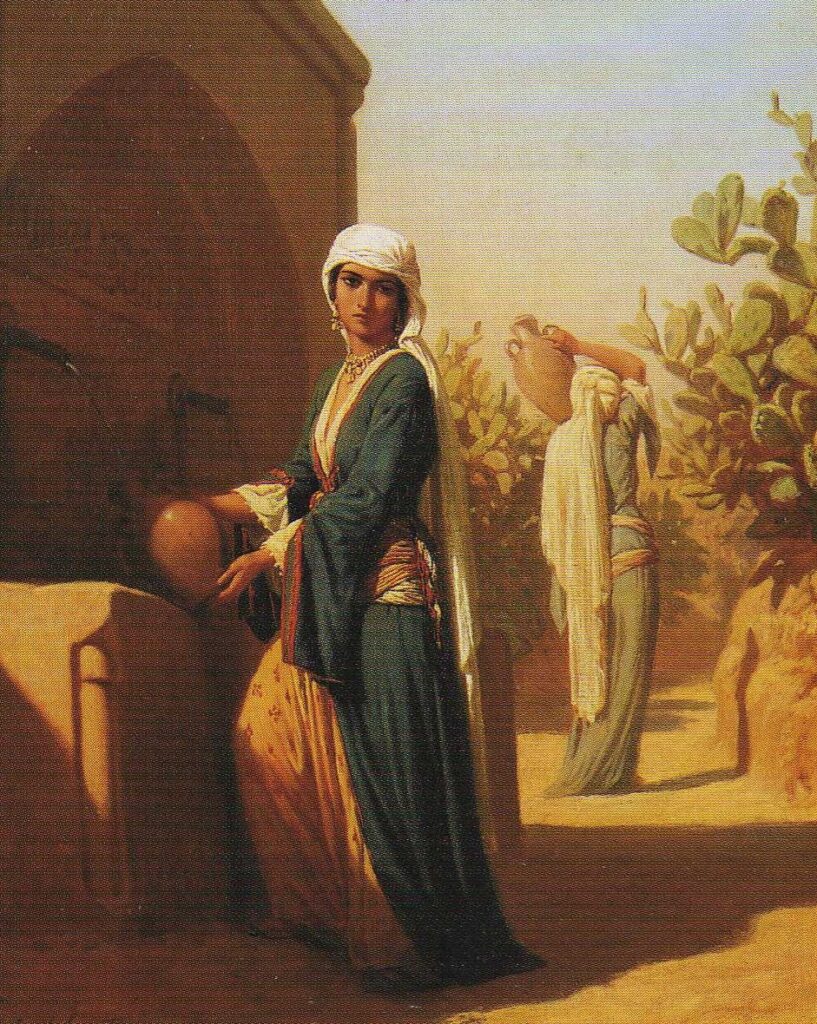
Maronite ladies at the fountain, Vernet-Lecomte, 1863, Philip Jabr Collection.
In January 1821, the Ottoman governor of the province of Sidon, Abdullah Pasha demanded an advance on the annual tax. Emir Bashir passed the burden on to the Christian peasants of the northern districts and spared the Druze south, for fear of alienating its lords. Resistance came in two waves. In the spring, the Maronite archbishop Yusuf Istfan gathered more than 6,000 commoners, joined by some Druze and Shi’a, in the church of Antelias. There they swore to resist the new taxes and vowed never to betray one another. They also elected village deputies, “wukala”, and declared that they acted for the public welfare: “al-salih al-‘umumi”. Emir Bashir withdrew to the Hawran, then returned with the backing of the governor and the notables and reimposed his taxes. That summer, the commoners of Jbeil, Batrun and Akkar rose again at Lihfid and demanded equal treatment with the Druze. The emir crushed them there. Rebels who refused to surrender jumped to their deaths from the cliff that still bears their name, Shir al-‘Ammiyya. One of their leaders, the historian Antonius Abu Khattar al-‘Aynturini, died after being tortured, and Archbishop Istfan died of poisoning in 1823. The revolt left the peasants’ condition unchanged. Yet it was the first collective voice of the mountain’s majority community, and it weakened the bonds that tied the commoners to their lords.
The emir crushed them there. Rebels who refused to surrender jumped to their deaths from the cliff that still bears their name, Shir al-‘Ammiyya. One of their leaders, the historian Antonius Abu Khattar al-‘Aynturini, died after being tortured, and Archbishop Istfan died of poisoning in 1823.
The second wave came under Egyptian rule. In 1831, the forces of Muhammad Ali, ruler of Egypt, occupied Ottoman Syria under the command of his son Ibrahim Pasha, with the support of Emir Bashir. The new administration brought modernizing policies and representative councils, the majalis, with equal numbers of Christian and Muslim members in cities. Its harsh taxation alienated much of the population, along with state control over the Metn iron mines and the silk trade, forced labor, conscription and disarmament.
In 1840, when Muhammad Ali ordered the disarmament of the Christians ahead of general conscription, Druze and Maronites rose together. On 8 June, Maronite, Druze, Sunni and Shi’a representatives met at a church in Antelias and swore to remain “one voice, one mind.” They demanded lower taxes, an end to forced labor, the return of their weapons, and a council at Beiteddine where two elected representatives of each community would advise the emir. The movement brought together peasants, disgruntled muqata’jis, clergy and urban merchants. Ibrahim Pasha put down the revolt, which reignited in August with British and Ottoman support. The London Convention of 15 July 1840 had formalized the decision of the European powers, France excepted, to expel the Egyptians from Syria. The powers supplied weapons and logistics, and promised the Lebanese the restitution of their ancient privileges, along with the new rights proclaimed by the Gülhane edict of 1839, in exchange for allegiance to the Sultan. By September, Britain had assembled twenty-two warships and an allied ground force. The fleet bombarded Beirut, British, Austrian and Ottoman troops landed at Jounieh, and armed peasants fought Ibrahim Pasha’s army in the Metn. By November, the Egyptian army had withdrawn from Syria.
Once the Egyptians were driven out in 1840, Ottoman rule returned with a will to centralize, and the Shihabi emirate was dissolved. The Tanzimat reforms supplied a powerful new vocabulary. The Gülhane edict of 1839 promised to protect the life, honor and property of all subjects regardless of religion, and the Hatt-ı Hümayun of 1856 proclaimed the equality of Muslims and non-Muslims.
The fall of the emirate opened a struggle over the future of the mountain. The Maronite Church wanted a Shihabi restoration, which the Druze rejected. The returning Druze lords saw the Ottoman restoration as the restitution of their lands and privileges. The Maronite commoners, now the most dynamic community of the mountain, invoked the Tanzimat to demand protection and equality. In 1841, violence erupted at Deir al-Qamar in the first sectarian war between Maronites and Druze. In January 1843, the European powers and the Porte divided the mountain into two sub-governorates, the qaimaqamates, on either side of the Beirut–Damascus road. The northern one was placed under a Maronite governor and the southern one under a Druze governor. Both districts, however, included areas of mixed population, and tensions there led to new fighting in 1845. Shekib Effendi’s regulations that year gave the mixed villages their own peasant wakils, who offered them some defense against abuse.
Kisrawan, ruled by the Khazin Shaykhs since the early seventeenth century, received no such representatives. Its population was almost entirely Maronite, so the regulations for mixed villages never applied there. As the historian Malcolm Kerr observed in Lebanon in the last years of feudalism, 1840-1868: “…it had now become a privilege for Maronite peasants to live under a Druze rather than a Maronite feudal overlord” The Khazins themselves were in decline. Indebted to moneylenders in Beirut and Zuq Mikayel, they tightened their grip on peasants who already handed over half of their harvest, along with dues in labor, cash and gifts. The economic depression that followed the Crimean War made these burdens heavier still.
The spark came from a quarrel among the elites. When the Christian qaimaqam Haydar Abi al-Lame’ died in 1854, his succession split the Khazins between supporters of Bashir ‘Assaf and supporters of Bashir Ahmad, both Abi al-Lame’ emirs. Bashir Ahmad was appointed with the backing of the French and British consuls. In the same years, Bulus Mas’ad, a man of commoner origin known for his dislike of the Khazins, became Maronite Patriarch, ending a long line of patriarchs drawn from the notable families. To strengthen their hand, the rival Khazin factions turned to the villagers. At a meeting in Zuq al-Kharab in March 1858, the shaykhs arranged for peasants to elect wakils and gave them seals to stamp petitions against the qaimaqam. Meanwhile, arms poured in: the Belgian consul De Turck reported large shipments passing through Beirut customs between 1856 and 1858.
The rebels’ demands began with taxation and quickly grew. They asked for a fair distribution of taxes, an end to extra levies and to the obligatory gifts on feast days, the right to elect their own representatives, and the exclusion of the shaykhs from the post of sub-district governor. Above all, they demanded that the shaykhs’ station be equal to their own “without exception”.
The movement soon slipped out of the hands of those who had launched it. Clashes between the Khazins and the townsmen of Zuq Mikayel drew in one village after another. Around Christmas 1858, the armed peasants elected delegates for each village and a general representative, the wakil ‘amm: Tanyus Shahin, a muleteer. In January 1859, they drove the Khazins out of Kisrawan and seized their property. The rebels’ demands began with taxation and quickly grew. They asked for a fair distribution of taxes, an end to extra levies and to the obligatory gifts on feast days, the right to elect their own representatives, and the exclusion of the shaykhs from the post of sub-district governor. Above all, they demanded that the shaykhs’ station be equal to their own “without exception”. They based these claims on the Tanzimat edicts, which they called the “benevolent decrees”, and they declared their loyalty to the Ottoman state.
Shahin signed his letters as general representative of the ahali of Kisrawan. He told his correspondents he could accept nothing before consulting every village, since he was bound to “the interest of the general public”, maslahat al-jumhur. The Khazins’ property was confiscated in an orderly way, and for about two years Kisrawan lived as a peasant commonwealth that levied no taxes on its people. The ahali called their uprising a haraka, a movement; the notables dismissed it as hayajan, a tumult.
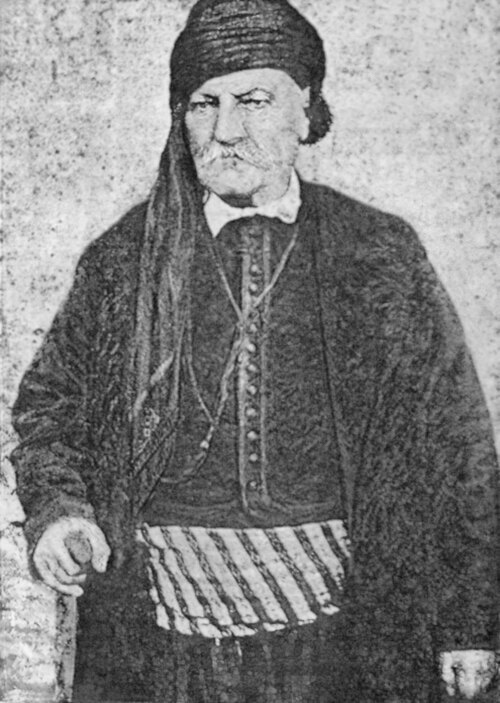
Tanios Shahin in his later life.
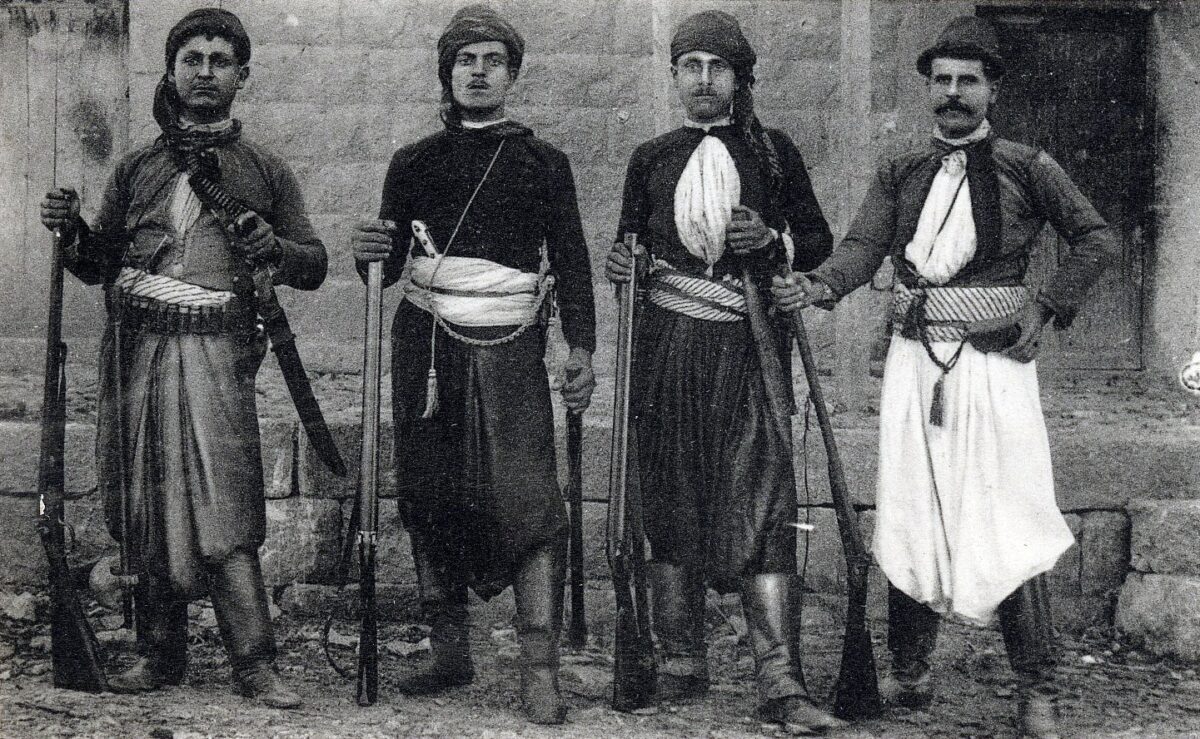
The movement had its limits. The villages of the Ftouh refused Shahin’s leadership. The patriarch and the bishops, heads of a Church that was among the largest landowners of the mountain, grew alarmed at a populism they could no longer contain. In the mixed districts of the south, the conflict took on a confessional character. In Kisrawan, Maronite peasants had risen against Maronite shaykhs, whom they regarded simply as their governors. In the south, Druze peasants saw their shaykhs as the heads of their clans, so a rising of Christian peasants against those lords became a rising against the Druze as a community. Christian youth militias formed under self-proclaimed shuyukh al-shabab, and a Beirut committee led by Bishop Tobia Aoun pressed Kisrawan to come to the aid of the Christians there and gathered munitions and arms that were sent to monasteries in the Shuf. Shahin cast himself as the protector of all the Christians of Mount Lebanon, and his rhetoric of “Christian zeal” merged the language of rights with that of communal solidarity.
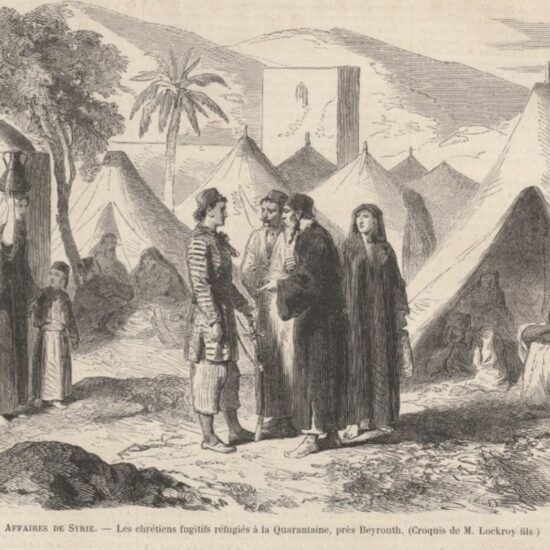
The revolt against the shaykhs began in Kisrawan as a social movement. As it spread into the mixed districts, it turned into a sectarian civil war between Druze and Christians that engulfed the Metn, the Shuf and Wadi al-Taym in 1860. Shahin’s part in the war was brief. His popularity collapsed when he proved unable to prevent the massacres of Christians in the Druze districts and their mass flight to Beirut.
By 12 June 1860, as the fighting in the southern qaimaqamate came to an end, Tanyus Shahin, as general wakil, and the wakils of the villages of Kisrawan had signed a formal declaration setting out the conditions for the return of the Khazin shaykhs. The text blamed the conflict on “certain masters of corruption” and “certain selfishly motivated persons,” and declared the villagers “submissive and obedient to the commands and laws of the gracious Sublime State.” It left any remaining claims to a later meeting with the shaykhs, where both sides would make amends and “exchange forgiveness and absolution.” This was a remarkable statement from a movement that had fought to free itself from the authority of the muqata’jis. Even so, the shaykhs returned to a new order. In 1861, an agreement reached in Istanbul between the Ottoman state and the French Second Empire merged the two qaimaqamates into a single Mutasarrifiyya of Mount Lebanon. Its constitutional charter granted the mountain self-rule, declared all its inhabitants equal before the law and abolished the privileges of the muqata’ji class. Kisrawan’s experiment in peasant self-rule was brief and ended in civil war. Yet the Mutasarrifiyya enshrined its central demands, equality and the end of the muqata’ji system, and opened the way for the commoners to take part in the political life of Mount Lebanon in the last decades of Ottoman rule. Four decades after Abdullah Pasha asked his scornful question, the ahali had given their answer, and with it they entered the history of their country as actors in their own right.
Charles al-Hayek is a public historian and the founder of Heritage and Roots.
The views in this story reflect those of the author alone and do not necessarily reflect the beliefs of NOW.