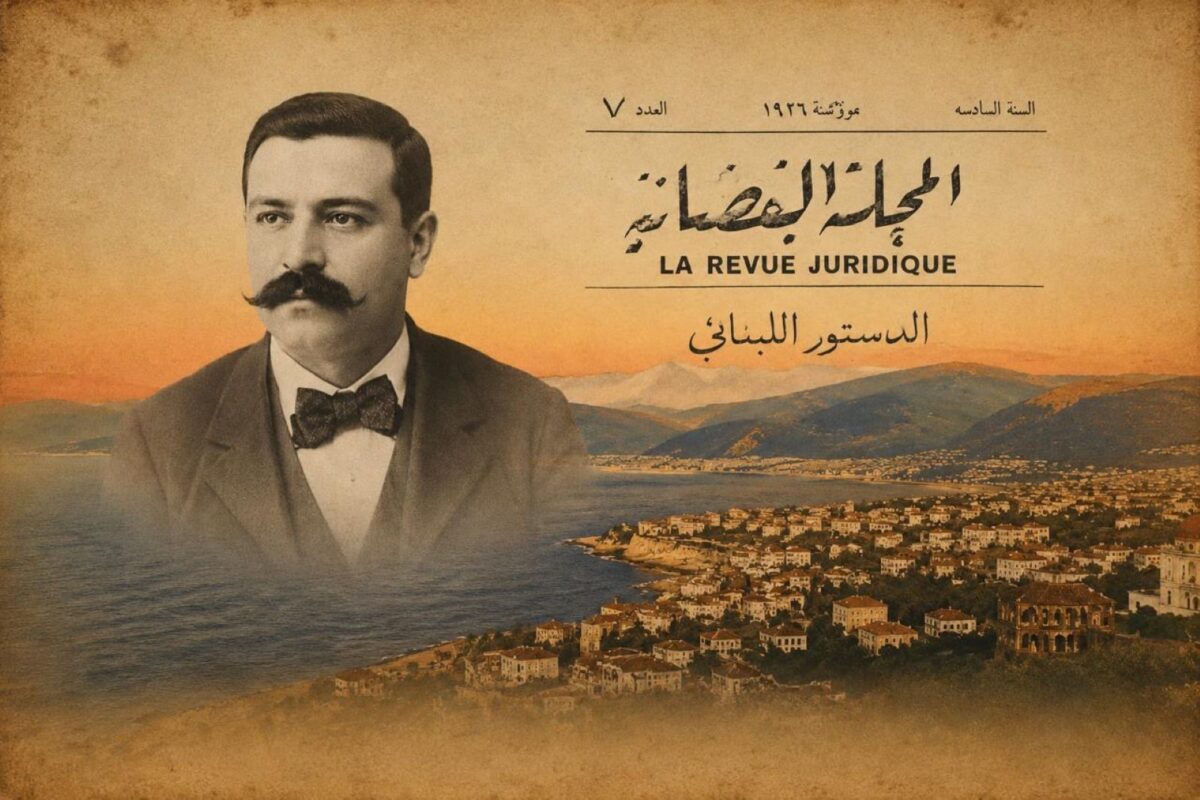
The centennial of the Lebanese Republic and its Constitution falls on 23 May 2026. On that date in 1926, the Constitution was adopted (1), establishing the juridical foundations of the new state, making Lebanon the first constitutional republic in the Arab world, before the French High Commissioner officially proclaimed the Republic from the Petit Sérail (2) in Beirut at four o’clock in the afternoon. Centennials are, above all, an invitation to recover memory, and this one is no exception. A century on, the circumstances of the Constitution’s drafting, adoption, and public dissemination warrant careful re-examination. It is within that last dimension, dissemination, that the contribution of Yusuf Sader demands attention (3). A Beirut-based legal expert and publisher, Sader ensured that the constitutional text reached the general public by publishing it in July 1926 in al-Majalla al-Qadā’iyya (La Revue Juridique), Volume 7, Year 6 (4). That act, and the broader enterprise it belonged to, form the subject of this article.
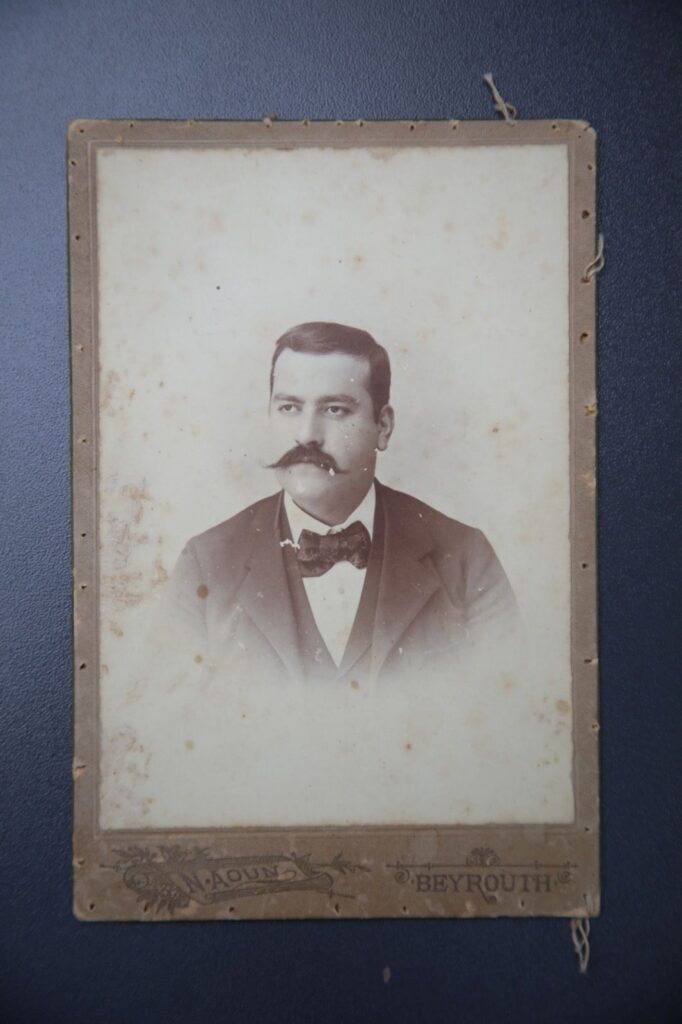
Portrait of Yusuf Ibrahim Sader (1870–1953), legal expert and publisher, Beirut, 1920s. SADER LEGAL ARCHIVES.
Little survives in Beirut today to preserve the memory of this founding moment. The Petit Sérail was demolished in 1950, and no public monument honours the birth of the Lebanese Republic. A single exception endures: Street 54, in the Yesouiyeh sector of Achrafieh, bears the name of Yusuf Sader, the man who made the Lebanese Constitution public.
Sader’s contribution can only be understood against the constitutional process that preceded it. At the origin of the Constitution lay a binding international obligation: the League of Nations required that an organic statute be elaborated within three years of the official proclamation of the Mandate in September 1923. The brief tenure of French High Commissioner General Maurice Sarrail (1924–1925) proved instrumental in the dynamics that would ultimately produce the Constitution. A committed secularist whose convictions led him to reject the confessional system, Sarrail refused any consultation with the local population and proved unable to accommodate local aspirations (5). He failed to prevent the outbreak of the Druze revolt, which became the Great Syrian Revolt of 1925. The spread of that revolt through Syria compelled France to reconquer the territory and to recall him.
His successor, Senator Henri de Jouvenel (6), assembled a commission of French and Lebanese legal and political experts and succeeded in drafting a constitution. He further obtained a positive vote from the members of the Lebanese Representative Council, an embryonic parliament of thirty members (7). Despite the limitations on local participation imposed by France, the Council declared the birth of the Lebanese Republic in 1926 (8), with reservations expressed by Sunni and Shi’ite members who would have preferred the adoption of a constitution for a unified Syria. The Council also elected Charles Debbas as the first President of the Lebanese Republic (9). The drafting of the Constitution was marked by the significant role played by Michel Chiha, who shaped key articles and adapted others to reflect the diverse nature of the local constituency and the power-sharing formula that would come to define Lebanese political life (10). Yet if Chiha shaped the text, it was Yusuf Sader who ensured that the Lebanese public could read it.
In July 1926, Sader published the full text of the Constitution in al-Majalla al-Qadā’iyya, bringing the foundational document of the new republic within reach of the general public. Founded in 1921 and the first legal periodical in the Levant, the journal had been conceived from the outset as an instrument of legal diffusion: its issues were organised with detailed alphabetical indexes and carried texts of direct consequence for the formation of the modern Lebanese state, among them the Lebanese Nationality Law, the Intellectual Property Protection Law, and the Cedar Protection Law.
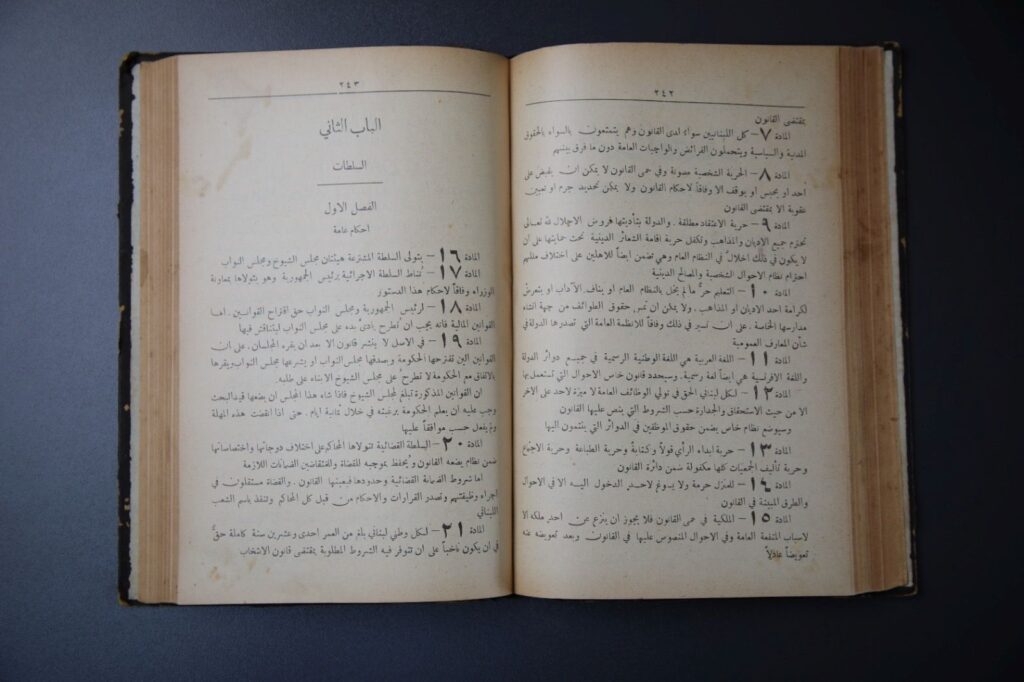
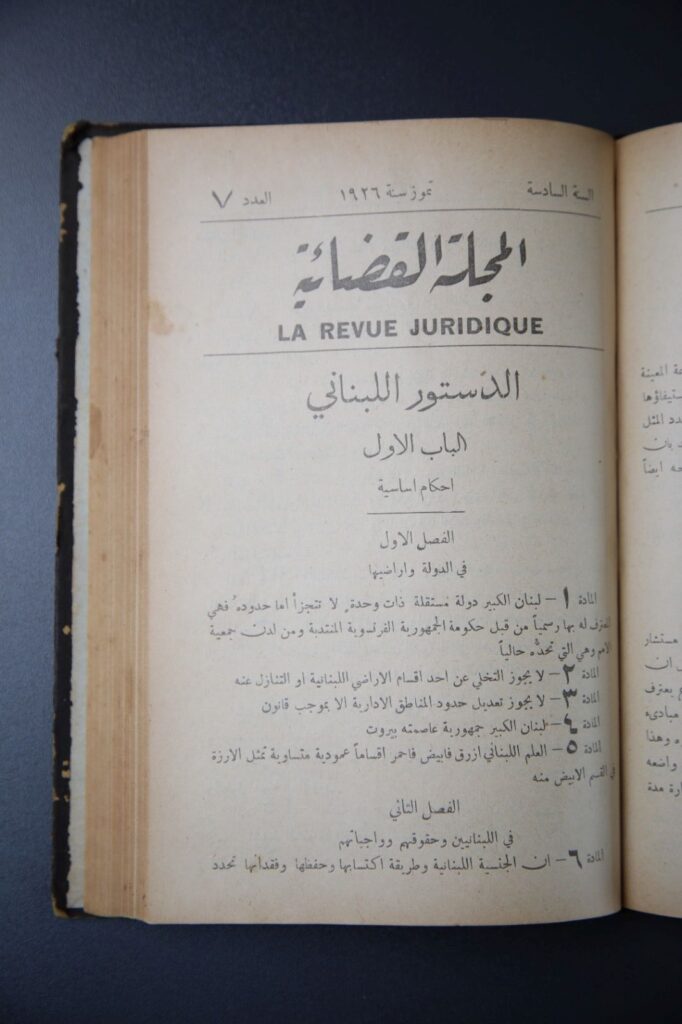
Pages of the Lebanese Constitution as first published for the general public. Al-Majalla al-Qadā’iyya (La Revue Juridique), Vol. 7, Year 6 (July 1926). Beirut. SADER LEGAL ARCHIVES.
The same year saw Sader complete The Collection of Laws in Lebanon, the first systematic legal compilation produced in Lebanon and the Arab world. Issued in nine volumes and furnished with alphabetical indexes designed to serve practitioners and scholars alike, the work was at once a reference instrument and an act of state-building: by assembling, organising, and making available the legislative corpus of the new republic, Sader was participating directly in the consolidation of its legal institutions. The collection’s reach extended beyond the region; the United Nations Library in New York acquired a complete set, followed by several universities. Within Lebanon, the work retained its institutional standing across the decades that followed: from the Presidency of the Republic to the legal practitioner, the compilations produced under Sader’s enterprise continued to serve as the reference of record for Lebanese legal culture.
Sader subsequently extended this documentary effort to the Syrian context with the Collection of Syrian Government Decrees, issued in eight volumes, a publication that reflected the regional scope of his commitment to systematic legal documentation across the Levant.
The motivating principle behind this body of work was articulated by Sader himself in the prologue to the first issue of al-Majalla al-Qadā’iyya in 1921:
“Since it is the duty of every person to be familiar with the laws and statutes of their country, and to be aware of their duties and rights, we have seen that the most sacred contribution we can make to the service of the national project is to publish these laws and statutes in a comprehensive book… Once a citizen knows the laws and statutes of their country, they can enjoy their freedom within its boundaries…” (11)
Yusuf’s publishing enterprise was rooted in a family tradition of substantial depth. Sader Legal Publishing traces its institutional continuity to 1863, across six active generations, placing it among the very few establishments in the region capable of such a claim. The firm’s origins lie with Ibrahim Sader, Yusuf’s father, who founded al-Maktaba al-ʿUmūmiyya (The Public Library) in that year, Beirut’s first modern bookstore. The institution survives to this day in two distinct branches of the family: Sader Legal, maintained by the descendants of Yusuf, and Dar Sader, by those of his brother Selim.
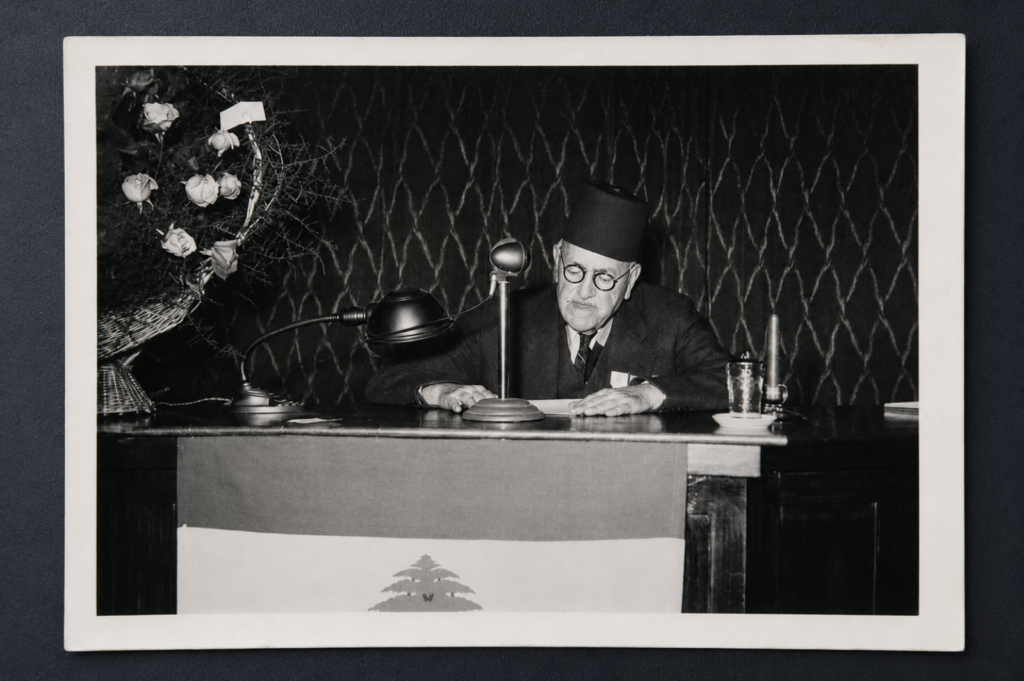
Yusuf Sader delivering his acceptance speech upon receiving the Order of Knowledge and the Golden Medal of Merit, awarded by the Lebanese Government. Beirut, 1952. SADER LEGAL ARCHIVES.
In 1952, the Lebanese government conferred upon Sader the Order of Knowledge and the Golden Medal of Merit, a formal acknowledgment of a contribution that had spanned more than three decades of sustained legal publication and civic engagement. That the Syrian government awarded him the Medal of Merit in the same period speaks to the reach of an enterprise whose compilations, periodicals, and reference works had shaped the practice and culture of law on both sides of the border.
Since 2025, the primary sources accumulated over six generations have been undergoing systematic archival organisation. Upon its formal launch soon, the SADER LEGAL ARCHIVES will constitute a resource of considerable scholarly value for historians, researchers, and legal experts engaged with the formation of legal culture and modern statehood in the Levant and the wider Middle East (12).
The centennial of the Lebanese Republic and its Constitution is an occasion that demands a serious and sustained return to the foundational text itself: its drafting, its contested adoption, and the conditions of its public dissemination. In that history, Yusuf Sader occupies a place that institutional memory has yet to honour adequately. His life’s work, the systematic publication and circulation of legal culture as a constitutive element of modern statehood, represents a model of civic engagement whose relevance to Lebanon’s present circumstances is considerable. At a moment when the foundations of the republic are once again subject to question, the example of a citizen who understood legal literacy as the precondition of freedom, and who acted on that understanding across more than six decades, deserves to be recovered, studied, and seriously reckoned with.
Charles al-Hayek is a public historian and the founder of Heritage and Roots.
The views in this story reflect those of the author alone and do not necessarily reflect the beliefs of NOW.
Endnotes
(1) https://lp.gov.lb/backoffice/uploads/files/Lebanese%20%20Constitution-%20En.pdf
(2) The Petit Sérail, so named in contrast to the Grand Sérail of Beirut, was an Ottoman administrative building constructed in 1881 that had served successively as the seat of the Syria then Beirut vilayet, before becoming the offices of the Lebanese President and cabinet under the French Mandate. It was demolished in 1950.
(3) Yusuf Ibrahim Sader (1870–1953), legal expert and leading publisher from Beirut. He established the Scientific Press in 1890 and founded al-Majalla al-Qadā’iyya in 1921, the first legal periodical in the Levant. The first to publish legal compendiums in Lebanon and Syria, Sader took an active part in the state-building process of the first half of the twentieth century through publishing and legal culture.
(4) Al-Majalla al-Qadā’iyya (La Revue Juridique), Vol. 7, Year 6 (July 1926). Beirut. SADER LEGAL ARCHIVES.
(5) For further details, see: Antoine Hokayem, La Genèse de la Constitution Libanaise de 1926 (Antélias: Éditions Universitaires du Liban, 1996). https://www.umambiblio.org/EN/book_detail/15024/
(6) Henri de Jouvenel des Ursins (1876–1935), French journalist and statesman. He served as French High Commissioner in Syria and Lebanon from 23 December 1925 to 23 June 1926.
(7) Antoine Hokayem, La Genèse de la Constitution Libanaise de 1926 (Antélias: Éditions Universitaires du Liban, 1996).
(8) For further reading, see Edmond Rabbath (1902–1991), Lebanese jurist, historian, and constitutional theorist: La Formation historique du Liban politique et constitutionnel (Beirut: Publications de l’Université Libanaise, 1973; nouvelle édition, 1986), 586 pp. The work remains one of the most authoritative accounts of Lebanon’s constitutional evolution.
(9) Charles Debbas (1885–1935), Greek Orthodox lawyer and statesman, served as the first President of the Lebanese Republic from 1926 to 1934.
(10) Michel Chiha (1891–1954), Lebanese banker, intellectual, and journalist of Chaldean Catholic background, widely regarded as one of the principal architects of the Lebanese Constitution of 1926 and a leading theorist of Lebanese national identity.
(11) Al-Majalla al-Qadā’iyya (La Revue Juridique), Vol. 1, Year 1 (March 1921). Beirut. SADER LEGAL ARCHIVES.
(12) SADER LEGAL ARCHIVES. Sader Legal, Sader Building, 3rd Floor, Dekwaneh, facing the Lebanese University — Faculty of Agronomy, P.O. Box 55530, Beirut, Lebanon.