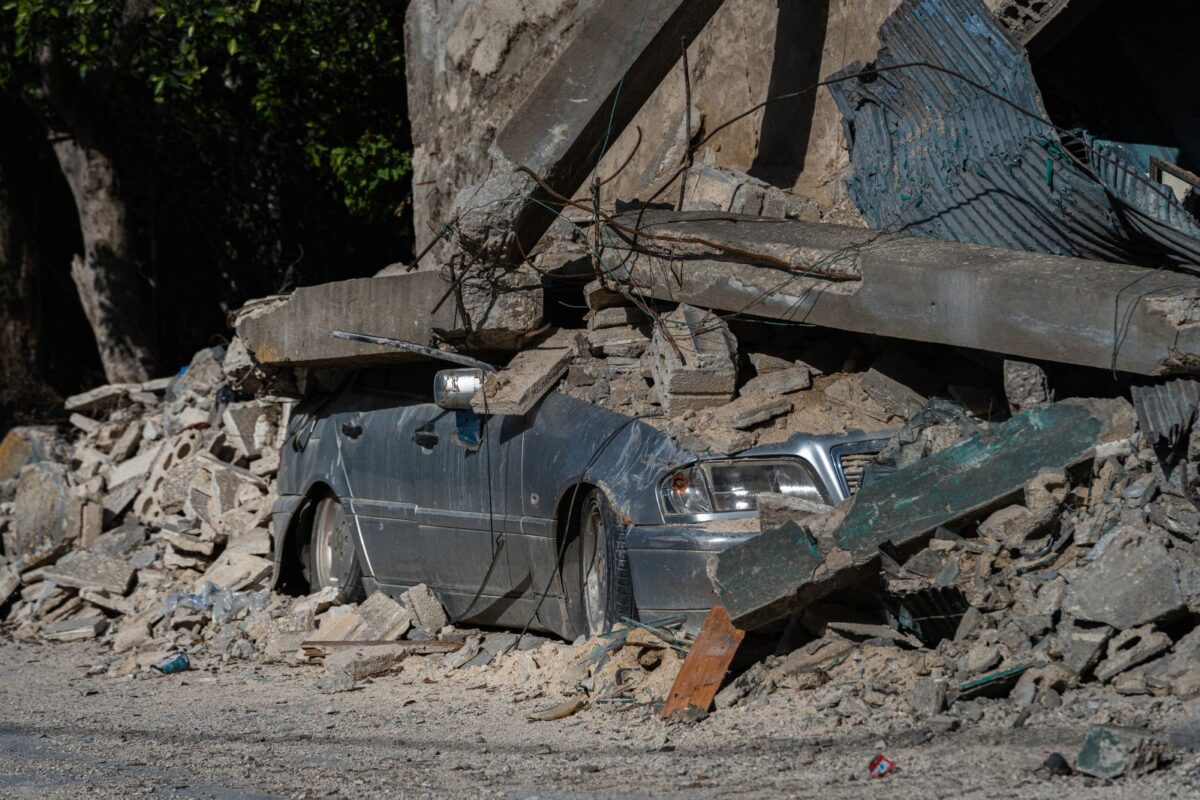
A car lies buried beneath rubble in the town of Harouf in the Nabatieh district of southern Lebanon on May 14, 2026, following Israeli bombardments. Despite the ceasefire announced on April 16, attacks in the Nabatieh district intensified in the following weeks. (Photo by Silvia Casadei / Middle East Images / Middle East Images via AFP)
The United States has widened pressure on Hezbollah and its support networks in Lebanon just as Washington and Tehran appear to be inching toward a possible agreement. In its latest sanctions package, the U.S. Treasury targeted Hezbollah-aligned figures as well as serving Lebanese security officials, accusing them of obstructing peace and disarmament efforts and of materially assisting Hezbollah. The move signals a broader shift in Washington’s approach: the problem is no longer framed only as Hezbollah itself, but also as the wider Lebanese networks and institutions that help sustain its power.
The U.S. and Iran are nearing a deal over the Strait of Hormuz. Trump has issued an ultimatum to break the stalemate between the U.S. and Iran, but Iran remains skeptical about successful negotiations.
“The deal with Iran will either be a great and meaningful one, or there will be no deal,” Trump declared on Truth Social on Monday. The details had been “largely negotiated,” he claimed a day earlier. For Secretary of State Marco Rubio, diplomacy should be given “every chance to succeed”. Both countries might sign a “solid” deal including the Strait of Hormuz, but in case the deal fails, the U.S. administration will have to look for “another way” to solve the problems with Iran.
The Iranians are playing down the success of the diplomatic progress. The spokesperson for Iran’s foreign ministry, Esmail Baghaei, said that both countries had “reached a conclusion on a large part of the issues under discussion” but that this does not mean “the imminent signing of an agreement.”
At the center of the debate between the two warring countries is a 60-day Memorandum of Understanding. Iran would open the Strait of Hormuz to international trade, the U.S. would in turn lift sanctions and release Iranian foreign assets, senior Iranian diplomat, Hossein Nooshabadi, said. Once the MoU is in place and the U.S. is abiding by its terms, Iran would be ready to discuss its nuclear program, Nooshabadi added.
For Washington, Iran’s nuclear program is at the core of the demands — as well as a one of the main reasons for going to war with the country. Amid the talk, the U.S. administration has pushed for limits on the enrichment, verification measures, as well as a promise that Tehran renounce any ambition to build nuclear weapons. Iran, in turn, has pushed the U.S. not to bomb Iran or otherwise take military action against the country during the talks.
At the onset of the war, Israel allegedly promised nothing less than regime change to President Trump. Netanyahu had urged Trump to start the war, raising hopes that a full-scale victory including the fall of the Iranian regime was possible.
After the joint meeting between the two countries’ representatives, U.S. President Donald Trump was convinced, despite concerns raised by his advisers — and ready to start the war alongside Israel against Iran.
Since the onset of the war, Trump’s decision has come under fire, both from the American public and from politicians in his ranks. With the American administration aiding Israel’s defense against Iranian missiles, the U.S. weapons stockpile has been partially depleted since the war began. Amid the blockade of the Strait of Hormuz, the global economy has likewise taken a hit, affecting the popularity of Trump’s decision to start the war.
In Lebanon
U.S. sanctions target Hezbollah-linked figures in Lebanon: Washington’s latest sanctions package named five individuals it says supported Hezbollah: Iranian ambassador-designate Mohammad Reza Sheibani, Amal security chief Ahmad Asaad Baalbaki, Amal militia commander Ali Ahmad Safawi, General Security Brigadier General Khattar Nasser Eldin, and LAF Intelligence officer Colonel Samir Hamadi. The U.S. Treasury said all five were designated for having “materially assisted, sponsored, or provided financial, material, or technological support for, or goods or services to or in support of, Hizballah,” in a move that broadens scrutiny beyond Hezbollah itself to allied political and security networks inside Lebanon.
Lebanon again is a point of dispute: Iranian agency Tasnim reportedly said that the U.S.-Iran deal would also include Lebanon.
Israeli minister wants more war in Lebanon: Israel’s far-right National Security Minister Itamar Ben Gvir demanded that Netanyahu inform Trump that Israel “is returning to war in Lebanon”.
Hezbollah wants Lebanon inside deal: Hezbollah politician Wafiq Safa said that the deal would not be valid if Lebanon was not included. Both Islamabad and Washington were informed of this stance, he argued.
Rubio warns of Hezbollah attacks: The U.S. Secretary of State said on Sunday that the Iranian-backed militia aims to drag Lebanon “back into chaos”. He warned that the group “ignored repeated calls” from Beirut to stop its attacks on Israel and said that this was a “deliberate campaign to destabilize the country”.
Israel flags bombing Beirut: Israel’s army chief Eyal Zamir suggested bombing buildings in the Lebanese capital on Monday. The attack, he said, would be a reaction to Hezbollah’s use of First-Person-View drones, which have become a major problem to Israel’s military, as they are immune to conventional jamming systems.
Hezbollah opposes negotiations with Israel: The group continues to oppose the Lebanese government in its attempts to disarm Hezbollah. The militia’s leader Naim Qassem wants Lebanon to halt its negotiations with Israel, calling the talks “completely unacceptable” and a “pure gain for Israel”.
Israel issues new evacuation: The Israeli military has again told residents of Lebanon’s southern city of Tyre to evacuate. Several Palestinian camps inside Lebanon have also been subject to evacuation orders Monday.
In The Region
Iran’s negotiators in Doha: Iran’s leading negotiator Mohammad Bagher Ghalibaf and Foreign Minister Abbas Araghchi are currently in Doha to discuss the details of a potential deal with Qatari Prime Minister, according to Reuters.
China talks with Pakistan amid negotiations: The Chinese leader met with the Pakistani Prime Minister Shehbaz Sharif in Beijing on Monday, as part of diplomatic efforts to end the war between the U.S. and Iran. Alongside Sharif, Islamabad’s top negotiator in the peace talks, Asim Munir, joined the discussions.
Pope criticizes Trump’s “just war”: Pope Leo XIV has said that the idea of waging a “just war” is outdated. Trump has previously advocated that his administration is waging a “just war”. According to the Pope, humanity is “slipping into a violent culture of power”.
Oil price drops ahead of possible deal: Oil prices is now below $100 per barrel as the expectation of a possible peace deal is affecting the oil markets.
What We’re Reading
A Nation in the Making: Yusuf Sader and the Publication of Lebanon’s Constitution, 1926. Charles H. Al-Hayek explains the centennial of Lebanon’s 1926 Constitution, highlighting its adoption under the French Mandate and its role in establishing the country as the first constitutional republic in the Arab world. It emphasizes the often-overlooked contribution of Yusuf Sader, a legal publisher who made the Constitution accessible to the public by publishing it in a legal journal. The piece situates Sader’s work within the broader political process, including French oversight, local debates over Lebanon’s identity, and key figures like Michel Chiha and Charles Debbas. It argues that Sader’s efforts in publishing and compiling legal texts were central to state-building and legal culture in Lebanon, and that his legacy deserves greater recognition today.
Sanctioning Baalbaki Is Washington’s Message to Lebanon’s Shadow Security State. Now argues that the U.S. sanctioning of Amal security chief Ahmad Asaad Baalbaki signals a broader shift from targeting Hezbollah alone to scrutinizing the wider Lebanese networks that enable its power. The designation highlights how Hezbollah operates through allies, militia coordination, and individuals embedded within state institutions, blurring the line between state and non-state actors. More significantly, sanctions against Lebanese security officials accused of sharing intelligence with Hezbollah suggest possible infiltration of official institutions. Overall, the move frames Hezbollah not just as an external militia problem, but as one sustained by internal state complicity that undermines Lebanese sovereignty.
War and the Ceasefire Nobody Believes. Elissa El Hachem argues that the so-called “full ceasefire” is a manufactured illusion, masking a mere tactical pause in a conflict still governed by regional power calculations rather than Lebanese sovereignty. She contends that neither Israel nor Hezbollah has any real incentive to sustain a lasting truce, as both remain locked in a broader confrontation tied to Iran’s strategic posture. At the core, she asserts, Lebanon has lost control over decisions of war and peace, with Hezbollah’s alignment to Tehran fundamentally undermining the state’s authority and rendering sovereignty largely nominal. Ultimately, she warns that the ceasefire narrative serves only to buy time while military, political, and territorial realities continue to shift, bringing Lebanon closer to a larger and potentially devastating escalation.
Signs of Life. Nasser Hafez writes that his return to Syria after years of exile revealed an unexpected, quiet resilience and renewed sense of possibility among Syrians, despite immense destruction and institutional collapse. He suggests that this emerging hope, visible in everyday life and return migration, is politically significant, even if material recovery remains daunting. Focusing on the appointment of central bank governor Mohammad Safwat Raslan, Hafez presents him as symbolic of a broader dynamic: the potential of returnees who combine exile experience with local knowledge to help rebuild trust and institutions. Ultimately, he contends that such figures and moments are not proof of recovery, but meaningful “signs of life” in a country long defined by despair.
The culinary art of Mount Lebanon. NOW’s Laura Hülsemann interviewed Claude Aoun Abi Nader about her new cookbook Une cuisine du Mont-Liban. Abi Nader explained the importance of olive oil in the cuisine of her region and examined how the culture of food has changed over time.