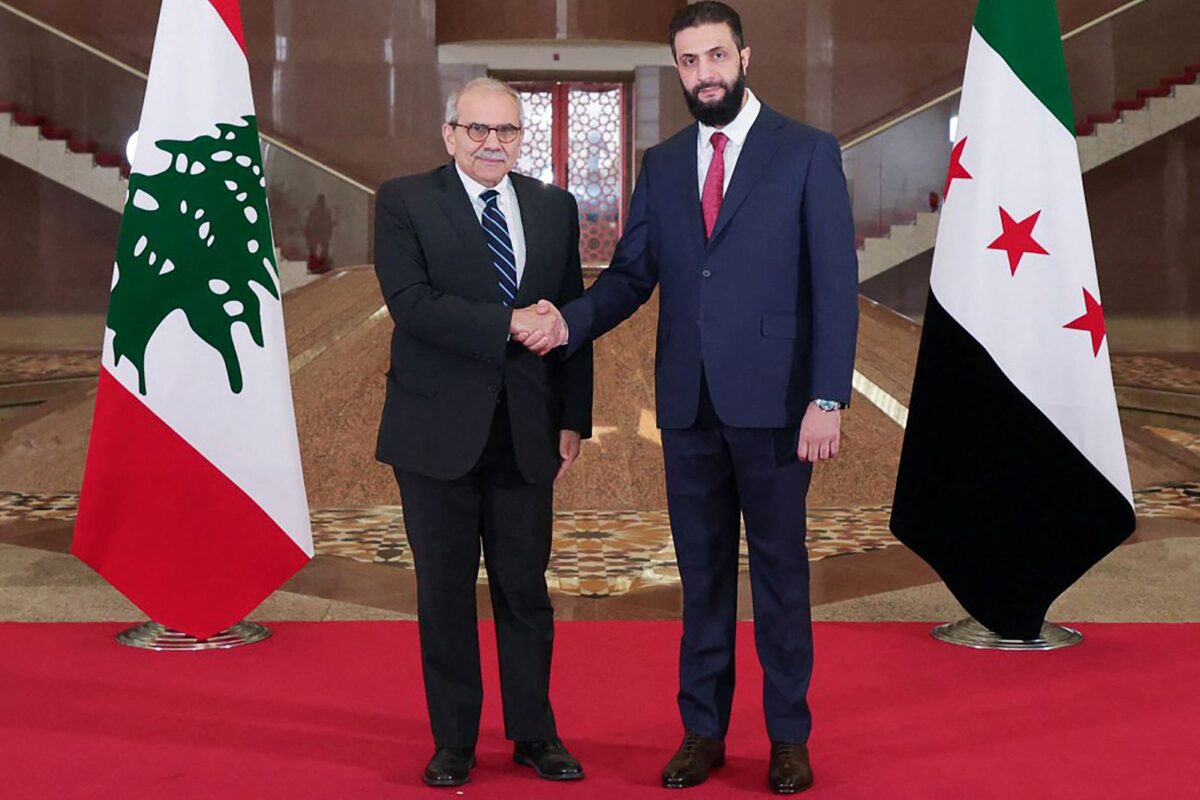
This handout picture released by the Syrian Presidency's Telegram page shows Syria's interim President Ahmed al-Sharaa (R) shaking hands with Lebanon's Prime Minister Nawaf Salam during their meeting in Damascus on April 14, 2025. Salam travelled on April 14 to Syria on his first official visit to meet Sharaa, seeking to readjust bilateral ties, a Lebanese official said. (Photo by Syrian Presidency Telegram Page / AFP)
In his recent interview with Lebanese journalist Tony Khalife on Al Mashhad, Syrian President Ahmad al-Sharaa delivered a firm and carefully calibrated message about Syria’s approach to Lebanon, Hezbollah, and the wider regional escalation. His position was neither impulsive nor ambiguous: Syria does not seek war, does not wish to see Lebanon collapse, and will not allow its territory or policy to become a tool against the Lebanese state.
This message matters because it comes at a moment when Lebanon stands at the intersection of several dangerous pressures: internal fragility, Hezbollah’s unresolved role, Israeli threats, Iranian influence, and the broader risk of regional disorder. In such a context, Syria’s position should not be read as weakness or retreat. It is, rather, a statement of political responsibility.
President al-Sharaa made clear that war is not an objective in itself. The real objective is to reach a new political approach that preserves Lebanon’s stability, prevents chaos, and stops both Syrians and Lebanese from paying the price of endless confrontation.
President al-Sharaa made clear that war is not an objective in itself. The real objective is to reach a new political approach that preserves Lebanon’s stability, prevents chaos, and stops both Syrians and Lebanese from paying the price of endless confrontation. This distinction is essential. Syria is not aligning itself with Iran’s policies, nor is it endorsing Hezbollah’s past conduct. At the same time, Damascus does not want Lebanon to be pushed into another destructive war whose consequences would inevitably spill across the border.
The Syrian position toward Hezbollah is particularly sensitive. Dialogue with the party does not mean that Syria has forgotten the pain, bloodshed, and wounds it suffered as a result of Hezbollah’s intervention in the Syrian war. Nor does it mean that Damascus has abandoned its objections to the party’s regional role. But states do not govern through memory alone. They govern through interests, risks, and the responsibility to prevent new tragedies.
This is the core of al-Sharaa’s message: Syria remembers, but it also calculates. It carries the weight of the past, yet it refuses to be imprisoned by it. The priority now is to prevent Lebanon from sliding into collapse, to protect Syria from the consequences of Lebanese instability, and to build a new Syrian-Lebanese relationship based on mutual respect and the interests of both peoples.
Lebanon, however, has yet to respond to this Syrian opening with the seriousness it deserves. The Lebanese state remains hesitant, constrained by internal divisions and external pressures. But hesitation is not a strategy. A fragile Lebanon cannot afford to ignore the messages coming from its neighbors, especially when those messages concern its sovereignty, its stability, and the possibility of another devastating conflict.
Israel’s repeated warnings regarding Hezbollah and Iran’s presence in Lebanon cannot simply be dismissed as rhetoric. Whether Lebanon agrees with Israel or not, these warnings reflect a real security equation that could quickly turn into military escalation. Syria’s message, by contrast, is an attempt to prevent such escalation and open the door to a political alternative. Ignoring both realities would leave Lebanon exposed to forces it may no longer be able to control.
The irony is striking. Hezbollah and the Iranian Revolutionary Guard once contributed to the conditions that brought foreign intervention and destruction into Syria. Today, the Syrian state is urging restraint, dialogue, and the protection of Lebanon from further devastation. This is not a minor shift. It reflects a new Syrian political language toward Lebanon — one based on strengthening state institutions, reducing sources of tension, and avoiding emotional reactions that could lead to strategic disasters.
Those who claim that Syria is acting under pressure misunderstand the nature of the Syrian decision. Damascus is not moving because of foreign dictates. It is acting out of a clear reading of national interest. Stability in Lebanon is a Syrian interest. A strong Lebanese state is a Syrian interest. Preventing chaos on Syria’s western border is a Syrian interest.
Those who claim that Syria is acting under pressure misunderstand the nature of the Syrian decision. Damascus is not moving because of foreign dictates. It is acting out of a clear reading of national interest. Stability in Lebanon is a Syrian interest. A strong Lebanese state is a Syrian interest. Preventing chaos on Syria’s western border is a Syrian interest.
Lebanon should therefore treat Syria’s message as an opportunity, not as a passing statement. The files on the table are urgent: detainees, border security, Hezbollah’s role, the prevention of war, and the construction of a new Syrian-Lebanese relationship. None of these files can be solved through denial, delay, or political slogans.
The past is indeed the past, but only if both sides have the courage to build a different future. Syria has signaled that it is ready for a new approach. Lebanon must decide whether it is willing to engage with that approach — not as a concession to Damascus, but as an investment in its own survival.
At this dangerous regional moment, Lebanon cannot afford to be passive. It must listen carefully, strengthen its state institutions, and act before others define its fate for it. Syria’s message is clear: the region does not need another war. It needs political courage, responsible dialogue, and states capable of protecting their people from collapse.
Alia Mansour is a Syrian Lebanese political writer.