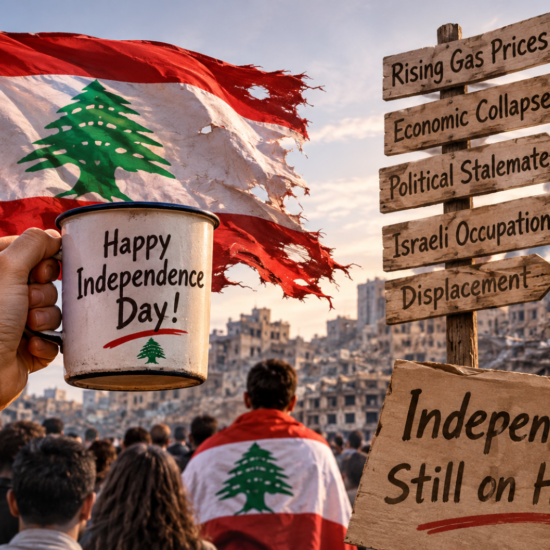
I came back from a week of meetings in Washington with one conviction, which I heard in different words in every room: Lebanon is short of time.
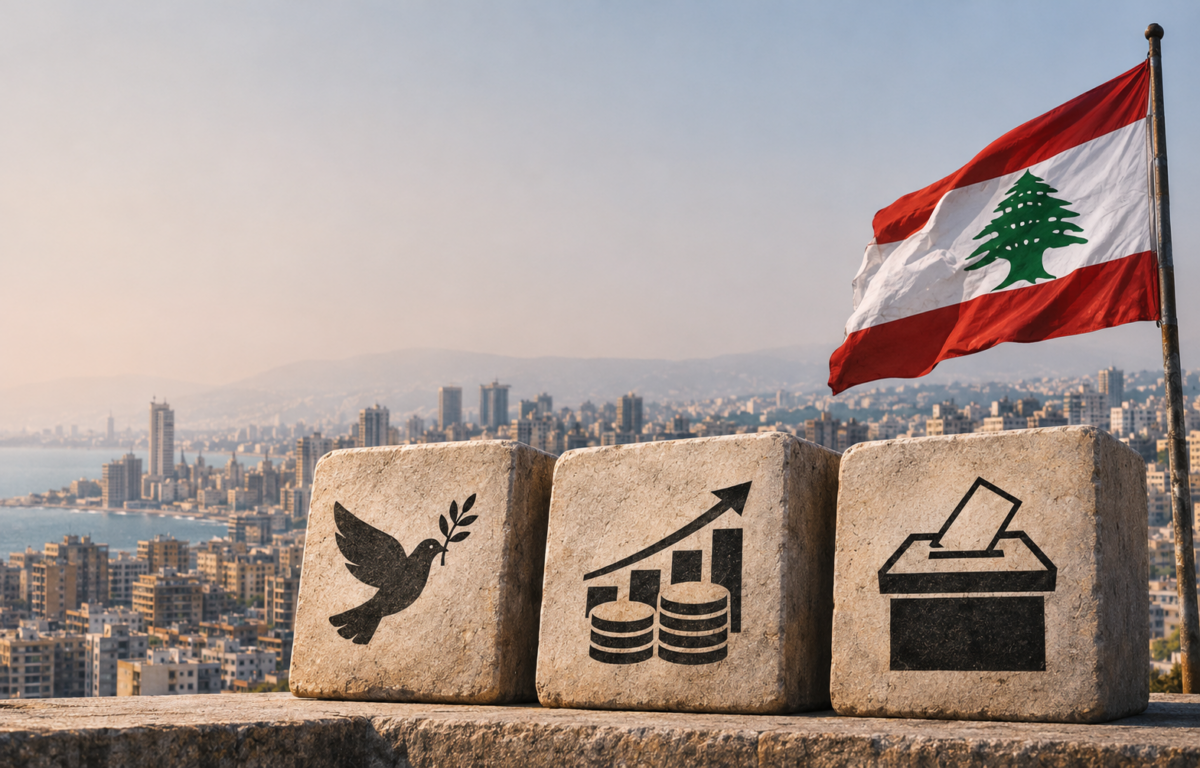
I share that conviction, and I would add this: Lebanon may be short of time, but it is not short of roadmaps. Only three decisions will determine whether it recovers or collapses. The first is implementing the Trilateral Framework with Israel; the second, reforming an economy that is sliding back into contraction; the third, adopting a new electoral law before the May 2028 elections. They are not decisions of the same magnitude, scope or nature. Peace is a strategic choice, the economy is a daily struggle, and the elections are a constitutional turning point. Yet they have this in common: each is urgent, and none has a deadline.
This is my argument. Lebanon’s three urgencies are like dominoes: if the first falls, the others follow. All three stand on one condition: state sovereignty, which begins with the state’s monopoly on arms. Unless each urgency is given a timeline and a deadline, and that deadline is met, the next becomes harder to deliver and the last becomes impossible.
The First Domino: Peace
The Trilateral Framework signed in Washington on 26 June 2026 was Lebanon’s most hopeful step towards real peace in more than forty years. Five months later, it has stalled. The first pilot zones were set up in July and have barely moved since. Israel refuses to widen them, Lebanon refuses direct military coordination, and each side accuses the other of bad faith.
Critics say Lebanon is making concessions and getting nothing in return. The opposite is true. At the core of the framework is the Lebanese army restoring sovereign authority over all Lebanese territory. That is not a concession; it is where sovereignty begins.
The framework has no deadline, and that is its weakness. Every month without progress, the Israeli army stays and Hezbollah’s argument for keeping its weapons survives. Yet a real date is approaching: the mandate of UNIFIL, the UN peacekeeping force in the south, expires on 31 December 2026. Lebanon should use it. The government should publish a timetable for the pilot zones and the army’s deployment, and ask Washington to hold both sides to it.
Many Lebanese hear the word peace and picture a drive to Tel Aviv for falafel. That is not the point. Peace is the precondition for investment, reconstruction and the return of the diaspora. The framework itself says so. It commits the United States to rally international partners behind Lebanon’s reconstruction, economic recovery and investment, and it opens the south to reconstruction zone by zone, once disarmament there is verified. This is the first domino. If it falls, the economy must, but cannot, stand alone.
The Second Domino: the Economy
The economy is already falling. Lebanon grew by an estimated 4.2% in 2025, its best year since the 2019 collapse. The ‘Support War’ of March 2026, which Hezbollah dragged Lebanon into in support of Iran, erased that. The World Bank now projects a 6.4% contraction in 2026. The IMF warns of a significant contraction with double-digit inflation.
The deeper danger is the cash economy. Since the banks froze deposits in 2019, the Lebanese have learned to live in dollars kept at home. In 2020, the World Bank put the cash economy at 14% of GDP. By 2022, it estimated it at almost $10 billion, or 45.7% of GDP: nearly half of the economy. A cash economy cannot be taxed or audited, and it starves the banks of the deposits they need to lend for long-term investment. It is also where illicit money hides. Every Lebanese who pays in cash, saves at home or moves money through transfer apps instead of a bank account adds to the cover under which illicit funds are laundered. Most do so unwillingly, because the banks left them no choice. But the world does not make that distinction: the more the cash economy grows, the closer Lebanon moves to sanctions.
The deadlines are lining up:
- FATF. Lebanon has been on the grey list of the Financial Action Task Force (FATF), the global watchdog on money laundering and terrorist financing, since October 2024. Its reviews in 2027 will decide whether Lebanon exits, stays, or slides toward the blacklist and near-total financial isolation.
- The IMF. In its 2022 staff-level agreement, the Fund made the financial gap law, which decides how the banking losses are shared, a condition for any programme. A condition without a deadline is easily ignored: four years later, Parliament has still not voted on it, and there is still no new agreement. The World Bank has been blunter: since 2020 it has called Lebanon’s crisis a “deliberate depression”, orchestrated by an elite that has captured the state.
How long can Lebanon survive like this? No one can give a date for rock bottom, but the direction is clear, and each missed deadline makes the next one harder. If the IMF talks stall, the gap law stays frozen and depositors stay outside the banks. If depositors stay outside, the cash economy grows. If it grows, FATF has little reason to lift the grey list in 2027.
Isolation would not come in a single day. Every verdict FATF issues is read by the governments that impose sanctions, led by the US Treasury, and by the banks that decide whom they will deal with. As money laundering continues, Washington and its partners add more names and institutions to their lists, and foreign banks quietly cut their ties with Lebanese ones. Lebanon does not need to become North Korea or Myanmar to suffer; Iraq is the nearer warning. After US authorities barred Iraqi banks from dollar transactions, nearly a third of the country’s 72 banks were cut off. For Lebanon, losing its correspondent banks would mean that even those with money in the bank could not send or receive it. Families, businesses, importers and patients seeking treatment abroad would all feel it. Aid from donors, including the Gulf states, would be slowed by compliance checks. International card payments and transfers could stop working. And once that system breaks, it is slow to rebuild: sanctions are easier to impose than to lift, and trust is easier to lose than to regain. Lebanon can absorb a contraction. It cannot absorb financial isolation.
This is the second domino. If it falls, the 2028 elections will be held in an impoverished country with a cash economy, where votes are easier to buy than to win.
The Third Domino: the 2028 Elections
In March 2026, citing the war, parliament extended its own mandate by two years and postponed the elections to May 2028. Whatever one thinks of that decision, it has raised the stakes. The parliament elected in 2028 will choose Lebanon’s next president when President Joseph Aoun’s term ends in January 2031. It will shape the country well into the next decade.
A governing system should resemble the people it governs. By that I do not mean a sectarian headcount. I mean a system in which citizens recognise their own priorities, and in which power sits close to the communities that live with its decisions. The current electoral law does not produce that. It rewards the same blocs that governed the country into collapse.
This is why the electoral law cannot wait. Here lies the paradox: the law must be passed by the same parliament that voted to extend itself, and MPs rarely change the rules that elected them. The pressure must come from outside: from voters, the diaspora, civil society and Lebanon’s international partners, who should tie their support to a clear legislative calendar. The precedent is clear: the current law was passed in June 2017, eleven months before the May 2018 vote. A new law must be adopted by June 2027. Anything later collides with diaspora registration, which for the 2022 elections closed in November 2021, and hands those who want another postponement a ready technical excuse.
I saw this myself on the 2022 campaign. The diaspora calendar closes long before the country pays attention, and every cycle reopens the same disputes: mega-centres, whether expatriates vote for all 128 seats or for six of their own, and the handling of ballot boxes. The earlier the law, the smoother the diaspora vote.
This is the last domino. If it falls, nothing is left standing.
What is at Stake
These three urgencies differ in magnitude, but they all need a timeline and a deadline. Without them, a parliament elected under the old rules would protect the weapons and choose a president in its image, and that would bury the framework and the reforms for another six years. Lebanon would be back at square one, with less time and fewer friends.
The reverse is also true. Every urgency that holds makes the next easier to hold: security brings investment, investment rebuilds trust, and trust makes a fair election possible.
What keeps these dominoes standing is state sovereignty, which begins with the state’s monopoly on arms. It is the condition for peace, because no agreement survives a parallel army. It is the condition for recovery, because no investor, bank or donor trusts a state that does not control its own territory. And it is the condition for genuine elections, because voters cannot choose freely in the shadow of weapons.
Recovery or Collapse
Lebanon does not lack diagnoses. It lacks deadlines. The country needs three timetables, published and enforced:
- A timetable for implementing the Trilateral Framework, starting with the pilot zones and the army’s deployment, before UNIFIL’s mandate ends on 31 December.
- A timetable for economic reform: the financial gap law, the 2027 budget and an IMF agreement, in time for the 2027 FATF review.
- A timetable for a new electoral law, adopted by June 2027, before the diaspora registers for the May 2028 elections.
If all three hold, Lebanon in 2031 is a sovereign state with an IMF programme, a reconnected banking system and a president chosen by a parliament that resembles its people. It is a country at peace with its neighbours, whose citizens no longer leave to build a future abroad.
Recovery, if the deadlines are met. Collapse, if they aren’t. Lebanon has a long history of missing its chances. The choice is still Lebanon’s to make, but not for much longer. Will it set its deadlines, and meet them, this time?
Cathryn Papadopoulo is a member of the Political Council of the National Liberal Party – Ahrar and Chair of its Federal Committee.
The views in this story reflect those of the author alone and do not necessarily reflect the beliefs of NOW.
Sources
- US Department of State, Trilateral Framework, 26 June 2026. https://www.state.gov/releases/office-of-the-spokesman/2026/06/trilateral-framework-between-the-united-states-of-america-the-state-of-israel-and-the-republic-of-lebanon
- UN Security Council, Resolution 2790 on UNIFIL, 28 August 2025. https://press.un.org/en/2025/sc16159.doc.htm
- World Bank, Lebanon Economic Monitor, Summer 2026, 21 August 2026. https://www.worldbank.org/en/news/press-release/2026/08/21/renewed-conflict-derails-lebanon-s-fragile-economic-recovery
- IMF, press releases on Lebanon, 18 September and 13 November 2026. https://www.imf.org/en/news/articles/2026/11/13/pr26362-lebanon-imf-staff-concludes-visit-to-lebanon
- World Bank, Lebanon Economic Monitor, Spring 2023 (cash economy). https://documents1.worldbank.org/curated/en/099027005152320346/pdf/IDU0ea0213ae0e0f804ba309c7a00638cf710a36.pdf
- FATF, Jurisdictions under Increased Monitoring, 30 October 2026. https://www.fatf-gafi.org/en/publications/High-risk-and-other-monitored-jurisdictions/increased-monitoring-october-2026.html
- World Bank, “The Deliberate Depression” (2020) and “The Great Denial” (2022). https://www.worldbank.org/en/news/press-release/2022/01/24/lebanon-s-crisis-great-denial-in-the-deliberate-depression
- The New Arab (Reuters), Iraqi banks barred from dollar transactions, July 2023. https://english.alaraby.co.uk/news/sanctioned-iraqi-banks-say-they-are-ready-face-audit
- Lebanese Parliament, extension of Parliament’s mandate, 9 March 2026. https://www.lp.gov.lb/ContentRecordDetails?Id=35713