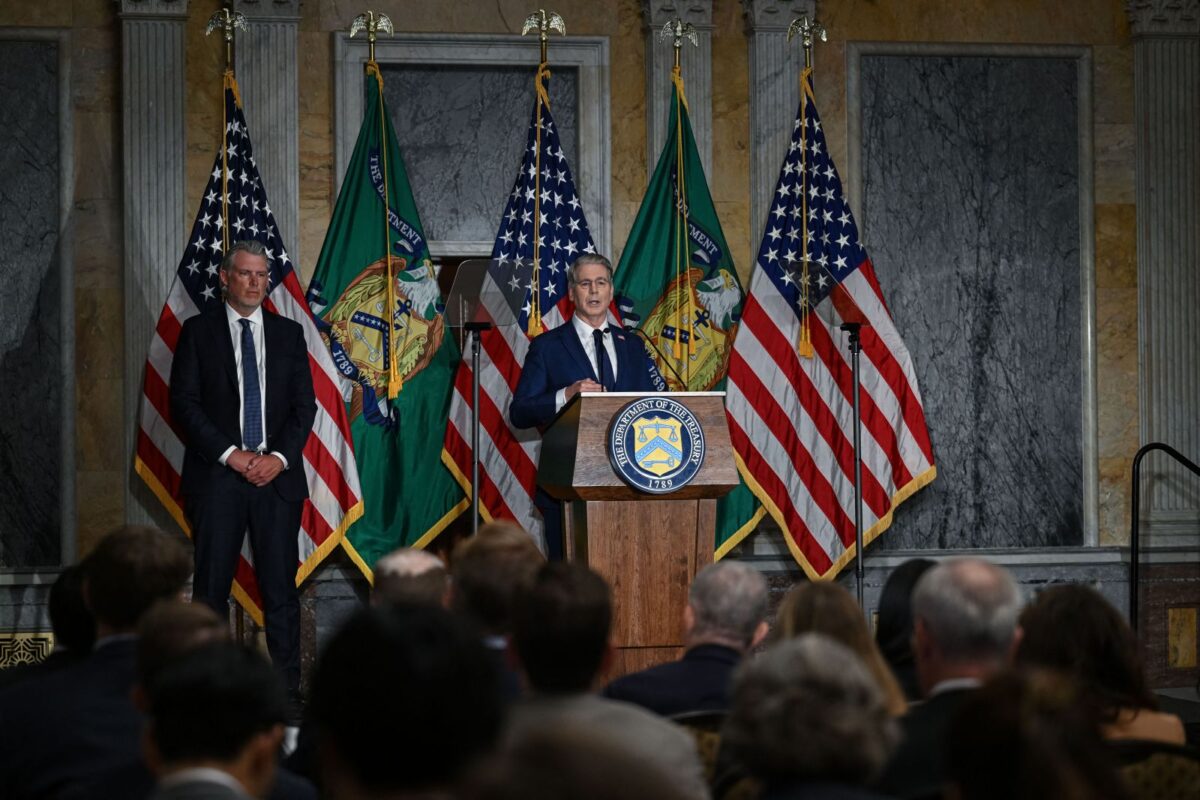
WASHINGTON, D.C., UNITED STATES - AUGUST 24: U.S. Treasury Secretary Scott Bessent speaks during a press conference at the Cash Room of the Treasury Department in Washington, D.C., on August 24, 2026, as he announces a new set of sanctions against Iran, describing the measures as “an economic D-Day.†Mehmet Eser / Anadolu (Photo by Mehmet Eser / ANADOLU / Anadolu via AFP)
Last week, the American President promised Iran an economic D-Day, the most crushing economic operation ever launched against any country. The US Treasury Secretary promised the greatest coordinated economic isolation in history. The escalation is that the threat is now explicitly directed at countries, not merely at companies doing business with Iran.
It is worth being literal about the phrase. In military terms, D-Day simply means the day an operation begins. But the D-Day everyone knows was June 6, 1944. More than 150,000 Allied troops landed in Normandy that day, supported by nearly 7,000 naval vessels. Eleven months later, Germany surrendered. The D-Day reference is not about pressure, leverage, or isolation. It refers to the start of the largest invasion in history.
So far, it is clear that the real D-Day is the one thing nobody in Washington intends to do. The instrument unveiled requires no landing, no occupation, and no boots on the ground. The US President has borrowed the name of history’s largest invasion to describe a policy whose entire appeal is that it is the opposite of that invasion.
Last week I wrote about Iran’s discovery that closing Hormuz pays, and I ended with an open question. What sanctions can threaten a government that treats sanctions as a governing tool? The war’s six-month mark falls this week, and the sixty-day negotiating window established by the June memorandum expired without an agreement. So I want to ask something duller than what is being asked everywhere else. Not whether this will work, but what conditions would have to be in place for sanctions to produce the intended political outcome.
The missing mechanism
A policy is a claim about cause and effect. It says: do this, and that will follow for these reasons. Economic pain is not political power unless there is a mechanism to convert one into the other. So what is the supposed mechanism?
“Economic pain is not political power unless there is a mechanism to convert one into the other.”
“Economic pain is not political power unless there is a mechanism to convert one into the other.”
Since my postgraduate studies, I have developed a particular interest in the impact of economic sanctions and the informal and illicit economies that emerge around them. The literature on the subject is extensive, diverse, and remarkably consistent on one point: economic pain does not automatically translate into political change. Johan Galtung posed this question in a 1967 World Politics article, “On the Effects of International Economic Sanctions,” while studying sanctions on Rhodesia, the colonial name for the white-minority-ruled territory that later became Zimbabwe. He gave the standard answer a name: the naive theory of economic warfare. Hurt the economy, and the population turns against the government, which changes course. He then showed why the logic could break down. Economies adapt. People adjust. And governments do not simply absorb deprivation; they decide who pays for it.
“Scarcity can weaken the people expected to challenge the regime more quickly than it weakens the regime itself.”
“Scarcity can weaken the people expected to challenge the regime more quickly than it weakens the regime itself.”
That last point matters enormously in an authoritarian state, which controls jobs, subsidies, foreign currency, food, licenses, and access. Scarcity can weaken the people expected to challenge the regime more quickly than it weakens the regime itself. The chain breaks at its first link, and it breaks in the opposite direction from the one intended.
If the mechanism does not work, why does the instrument survive? James Barber offered the answer in his 1979 International Affairs article, “Economic Sanctions as a Policy Instrument.”Sanctions, he argued, are asked to do several things at once, and this confusion is why nobody can decide whether they work. Primary objectives concern the target: change its behavior, force a concession, or end a war. Secondary objectives concern the government imposing them: demonstrate that it is willing and able to act, above all to its own public. Tertiary objectives concern everyone else: defend a rule and punish its violation.
Barber’s important point was that sanctions can fail to change the behavior of the regime they target yet still serve other purposes. For the power imposing them, sanctions can demonstrate that it is acting. Internationally, they can signal to other governments that a violation will carry a cost. In that sense, sanctions can fail as an instrument of coercion without becoming politically useless to the country imposing them.
Three regimes, three exits
Look at how these regimes actually ended.
From 1990 to 2003, Iraq lived under one of the most comprehensive sanctions regimes ever constructed. I studied the Oil-for-Food program extensively during my postgraduate work, and Iraq remains one of the clearest examples of the gap between inflicting economic pain and producing political change. At best, the sanctions constrained Saddam Hussein’s ambitions rather than changing the regime, as Charles Duelfer, who led the Iraq Survey Group, later concluded. But containment is not regime change. The investigation found that Saddam’s government generated nearly eleven billion dollars through smuggling, bilateral trade protocols, kickbacks, and surcharges. It also operated a secret oil-voucher system, allocating oil to politicians, organizations, and governments it believed could help weaken international support for sanctions (the oil coupons that the Lebanese became very familiar with). Scarcity did not simply squeeze the state. It created an economy the state learned to manipulate. After thirteen years, Saddam was removed by an invasion.
Syria is the same problem a decade later. The Caesar Act took effect in June 2020, on top of less than ten years of Western sanctions, all intended to create leverage for a political settlement. The pressure was real. The transmission was not. In 2022, the Carter Center described the strategy as an unsuccessful attempt to bring about a political transition, worsening the humanitarian crisis without meaningfully advancing the political process, and found that it had marginalized the Syrian middle class at the expense of war profiteers. Bashar al Assad survived another four and a half years. His regime collapsed in December 2024, in under two weeks, when Russia, Iran, and Hezbollah were too weakened or too distracted to rescue him again. The military balance shifted, and the regime paid the price.
Venezuela is the latest example. When the United States imposed oil sanctions in January 2019, Nicolas Maduro’s government was already presiding over a severe economic and oil-sector collapse: production had fallen to about 1.2 million barrels a day, down from more than three million two decades earlier. The sanctions further eroded the regime’s main source of revenue, but they did not create the crisis or force a political transition. Maduro remained in power for another seven years. He was ultimately captured in a U.S. military operation in Caracas in January.
Three regimes, three exits, and in none of them did the economic instrument achieve the intended political outcome. Sanctions can constrain, deprive, and raise the cost of survival. None of that is the same as producing the outcome for which they were imposed.
“Three regimes, three exits, and in none of them did the economic instrument achieve the intended political outcome.”
“Three regimes, three exits, and in none of them did the economic instrument achieve the intended political outcome.”
The asymmetry
So why reach for sanctions again?
Part of the answer may lie outside Iran. Yaroslav Trofimov, writing recently in the Wall Street Journal, summarizes the challenge facing the United States in three words: industrial decline, strategic incoherence, and political dysfunction. Recent reports highlight serious shortages in key US missile and interceptor stocks, and replenishing them will take years. A senior European defense official quoted by Trofimov captures the imbalance: “Our foes think they are at war, while we pretend that we are not.”
Iran understands that imbalance particularly well. It does not need to match American military power. It needs to make using that power costly. A relatively cheap drone or ballistic missile can force the use of interceptors that cost many times more. Proxies can impose costs without directly exposing the regime. The weaker power does not have to win a conventional war; it has to avoid fighting one on the stronger power’s terms.
The same adaptation has happened with sanctions.
Regimes have spent years learning to survive economic isolation. Iran moves oil through shadow fleets, front companies, and informal financial networks, and increasingly uses digital assets to move money outside conventional channels. North Korea is the extreme case. It has been under UN sanctions since 2006 yet has continued developing nuclear weapons and ballistic missiles while building an extraordinary capacity for cyber theft. UN investigators have examined cryptocurrency thefts attributed to North Korean actors, totaling roughly three billion dollars from 2017 to 2023.
Technology has therefore created an asymmetry on both fronts. It has made some forms of warfare cheaper for the weaker state and made economic isolation easier to evade.
But another asymmetry exists within the sanctioned country. The regime learns to evade sanctions; ordinary people do not. Governments find new routes for oil, weapons and money, while households lose income, savings and economic choices. The longer the pressure lasts, the greater the risk that sanctions weaken society faster than the institutions that sustain the regime.
“Sanctions remain the last available weapon not because targeted regimes have failed to adapt to them, but because the alternatives have become harder, more expensive, and more dangerous to use.”
“Sanctions remain the last available weapon not because targeted regimes have failed to adapt to them, but because the alternatives have become harder, more expensive, and more dangerous to use.”
That brings us back to the missing mechanism. Washington can almost certainly make Iran poorer. It can make trade harder and survival more expensive. What remains unanswered is how any of this translates into political change.
Perhaps the D-Day announcement tells us less about Iran’s vulnerability than about Washington’s choices. Sanctions remain the last available weapon not because targeted regimes have failed to adapt to them, but because the alternatives have become harder, more expensive, and more dangerous to use.
Khalil Gebara is an academic and researcher.
The views in this story reflect those of the author alone and do not necessarily reflect the beliefs of NOW.