The remarks made by Fadi Boudaya triggered an immediate and a wave of backlash across Lebanese social media, cutting across political and sectarian divides.
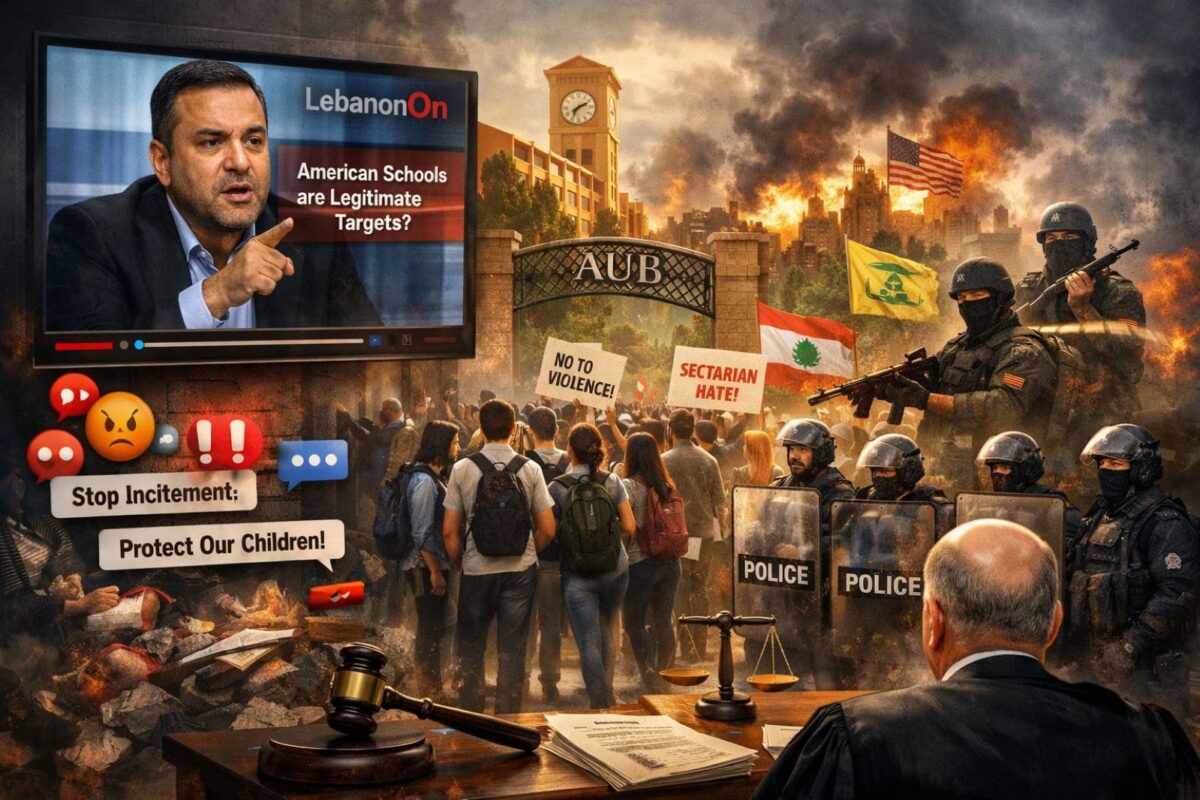
Clips from his appearance on the “LebanonOn” platform circulated rapidly, with users focusing in particular on his statement implying that children in American-affiliated educational institutions in Lebanon could be considered legitimate targets within a wider regional confrontation. Many described the rhetoric as a dangerous escalation and not just a political provocation.
Journalists, academics, and activists condemned the comments as reckless and inciting. Several pointed out that institutions such as American University of Beirut are not abstract symbols of foreign policy, but educational spaces hosting thousands of Lebanese students from all sects, including communities Boudaya claims to represent. Critics argued that framing these institutions as extensions of “American interests” effectively places Lebanese civilians at risk.
“A Dangerous crossing of moral and sectarian boundaries”
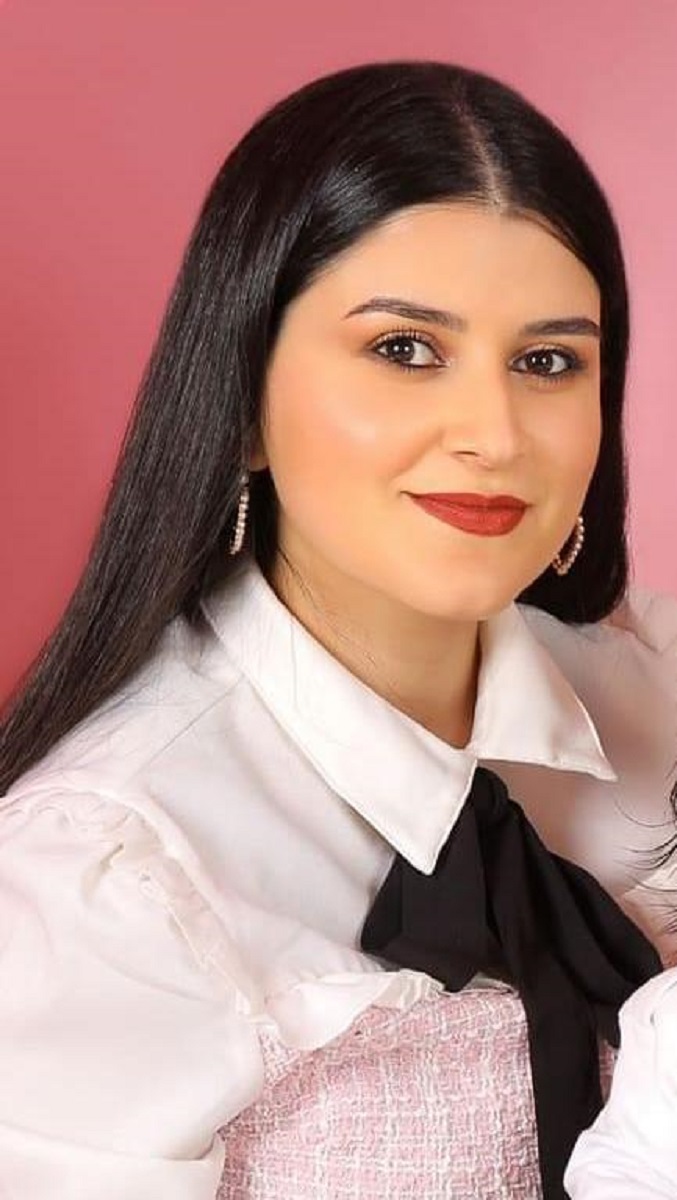
Speaking to NOW, political activist Mariam Kesserwan, who runs the “Lebanonuprising” page, described the remarks by Fadi Boudaya as going far beyond the limits of political discourse.
“These statements did not simply cross the line of political commentary, they violated basic moral and humanitarian standards,” she said. “They effectively incite harm against his own people, including children from within his own sect.”
Kesserwan stressed that institutions such as the American University of Beirut are deeply embedded within Lebanese society, noting that they include large numbers of Shiite students and faculty. “To frame such institutions as legitimate targets is not only irresponsible, it directly endangers Lebanese civilians,” she added, also arguing that media platforms hosting such content should share responsibility.
The backlash was not limited to Boudaya’s political opponents. Notably, segments of audiences typically aligned with pro-resistance narratives also expressed discomfort, with some distancing themselves from his rhetoric and emphasizing that such statements do not reflect the broader Shiite community.
Legal action?
Lebanon’s Justice Minister Adel Nassar announced that he had formally requested the Public Prosecutor’s Office to take action over statements and writings by Fadi Boudaya, following a wave of public outrage.
In a post on X, Nassar said he had asked the discriminatory public prosecution to move forward with the case, after Boudaya’s televised remarks sparked widespread controversy. The comments, which appeared to suggest the justification of violence against children in the context of broader geopolitical conflict, prompted growing calls for legal accountability.
Boudaya, however, rejected the accusations, insisting that his statements had been misinterpreted. “I have always operated under the rule of law, which must protect everyone without exception,” he said, adding that his remarks were not intended as incitement.
He went further, accusing authorities of selective enforcement. Boudaya cited multiple cases he claimed involved direct incitement to violence naming figures such as Rami Naeem and Ibrahim Murad, as well as media coverage by MTV Lebanon arguing that these had not prompted similar judicial action.
“Normalizing violence under the cover of free speech”
Kesserwan warned that rhetoric of this kind risks creating a broader culture of justification for violence.
“What is most alarming is the normalization of treasonous discourse under the banner of freedom of speech,” she said. “This kind of messaging can influence individuals who lack critical awareness, encouraging them to adopt similar thinking.”
She pointed to the timing of the remarks, noting that both American University of Beirut and Lebanese American University have been operating under heightened security concerns. In that context, she argued, such statements risk legitimizing potential attacks on educational institutions, particularly those perceived as linked to Western entities.
Irans Revolutionary Guard on Sunday threatened to target US universities in the Middle East after saying US-Israeli strikes had destroyed two Iranian universities.
The American University of Beirut (AUB) announced that it will shift all educational activities to online learning for two days as a precaution following Iranian threats against American institutions in the region.
The administration stressed that there is no confirmed direct threat to the campus or its affiliated medical centers, urging the university community to rely only on official communications for updates.